

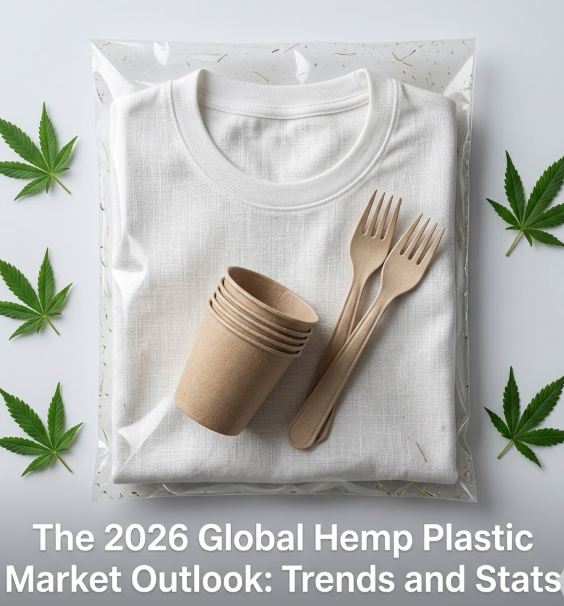
The 2026 Global Hemp Plastic Market Outlook: Trends and Stats
The world is generating over 350 million tonnes of plastic waste annually. Plastics account for 3.4% of global greenhouse gas emissions. It is critical to explore alternatives, and hemp plastic has emerged as a strong contender.
In 2026, the global hemp plastic market is expanding rapidly. The industrial hemp market is projected to reach $16 – $30 billion by 2030. The broader bioplastics market continues to expand due to single-use plastic bans around the world. In this article, we track the growth of the hemp plastic market and explore why it is moving from niche curiosity to large-scale commercial adoption.
How Big Is the Global Hemp Plastic Market in 2026?
When people hear “hemp plastic,” they often imagine a polymer made from pure hemp. That is rarely the case. Most hemp-based plastics are composites made by blending hemp with PLA and PHA.
The hemp plastic market is expanding fast. Let’s begin with verified numbers:
- As of 2024, it was estimated to be between $150 million and $170 million.
- It is slated to grow and reach $290 million by 2031.
- Experts estimate a CAGR between 13.6% and 20%.
The high CAGR indicates that the market is still nascent. It leads to a steep growth trajectory.
Other sources estimate global hemp-based packaging at more than $237 million in 2024 and projected to reach $1 billion by 2035.
The US and Europe industrial hemp plastics segment is the largest in the world: It is valued at $125 million in 2025 and projected to grow to $268 million by 2032 at a CAGR of 11.5%.
Here is a summary of the various projections given above
Hemp Market Segment Projections
The broader bioplastics market is already multi-billion dollar and expanding. Hemp plastics are a small and fast-growing niche in the larger ecosystem.
That brings us to the next question: what is driving this expansion?
What Is Driving Growth in the Hemp Plastic Industry?
The rapid growth of the hemp plastic industry is not an accident. It is being pushed forth by regulations and consumer demand.
The global plastics waste crisis we mentioned at the opening has led to:
- EU packaging reforms and the UK Plastic Packaging Tax
- Emergence of Extended Producer Responsibility
- circular economy mandates and single-use plastic bans.
Note that none of these measures ask for hemp plastic as an alternative. But they penalize fossil fuel-based packaging, and hemp-based packaging fits neatly in that policy direction.
Are Carbon Targets Influencing Material Choices?
Net zero commitments are no longer theoretical. Scope 3 emissions from supply chains are now under scrutiny. Companies looking to reduce their carbon footprint want lightweight, biobased packaging. Hemp plastics and hemp composites are ideal solutions.

Is Industrial Hemp Expansion Unlocking Supply?
The 2018 US Farm Bill unlocked the supply of hemp. Europe has gradually legalized hemp cultivation over the years.
Hemp fiber is projected to account for roughly 45% of industrial hemp revenue by 2026.
Extensive cultivation of hemp also means:
- More decortication
- Improved fiber processing
- Reliable feedstock processing.
Next lets see where this momentum is strongest?
Which Regions Are Leading the Hemp Plastic Market?
Most of the growth is coming from North America and Europe at the moment. But Asia is gathering pace.
Is Europe the Policy Leader?
Without doubt, Europe is leading the world when it comes to hemp plastic production.
Why?
- Europe has the most favorable regulatory climate.
- Strict recycling and circular economy targets.
- Well-implemented packaging reforms and EPR systems.
The European hemp plastic market shows strong early adoption. It is particularly notable in the automotive and packaging industries.
Is North America Scaling Production?
The US Farm Bill 2018 ushered in an era of change. No longer was it a crime to plant cannabis sativa.
The region is showing smart growth. The combined North America hemp bioplastic demand, together with Europe, is already above $125 million in the mid-2020s. Years of steady growth are projected.
Automotive demand is a growing sector. Major manufacturers such as BMW, Mercedes-Benz, and Volkswagen have integrated natural fiber composites in vehicle interiors to:
- Reduce weight
- Lower carbon footprint
- Improved recyclability
This has created a long-term demand for hemp-based composites.
What Role Does Asia-Pacific Play?
The Asia-Pacific region, in general, is:
- Expanding capacity and improving decortication infra
- Implementing large-scale manufacturing to bring down costs
- Experimenting with various types of hemp-based polymers
- China, in particular, is a leading producer of hemp and hemp plastic.
The impact will become visible towards the end of this decade.
The Top Players: The “Hemp Titans” of 2026
The market has consolidated. The early 2020s were defined by thousands of small-scale startups. Now it has consolidated to a few key industrial giants:
The Hemp Plastic Company (USA): Now the primary supplier for global e-commerce mailers.
LATI Industria Thermoplastici (Italy): Leading the high-performance engineering grade hemp-polymers.
HempFlax Group (Netherlands): The vertically integrated king of Europe, controlling everything from seed to finished polymer.
Bast Fibre Technologies (Canada): Specializing in the “soft” bioplastics used in the hygiene and non-woven sectors.
The Hemp Foundation (India): The leader in social-impact hemp, connecting thousands of small-holder farmers to the global supply chain.
Current Challenges: The Roadblocks to $1 Billion
The future trajectory of the hemp plastic market is definitely optimistic, but not without a few hurdles to cross. There are three critical issues:
The Cost Gap
While prices have come down dramatically, hemp plastic remains 2.5X more expensive on average. This makes adoption difficult and drives the market towards PBAT made from fossil fuels.
Thermal Degradation
Hemp fibers begin to degrade at about 180°C. This makes it difficult to use them on standardised molding equipment.
Supply Chain Fragility
Any agricultural product is susceptible to climate-driven volatility. Drought during 2025 drove up the price of US hemp fiber by 15%. This can upset plans of expansion.
Conclusion: No Longer a Novelty
However, these are hurdles and not insurmountable problems. Hemp plastic is no longer a novelty but a well-known commodity in the mid-2020s. That alone is a reason for hope. The message is clear: the future is carbon-negative, and it is grown in a field, not pumped from a well.
Frequently Asked Questions
How fast is the global hemp plastic market growing?
The best estimates indicate the global hemp plastic market is growing in double digits. Rapid adoption of hemp plastic can be seen in the automotive and packaging sectors.
What is the current hemp plastic market size worldwide?
The market is between $100 and 200 million currently but slated to cross $1 billion in a few years. There is no dearth of demand at the moment. There is some degree of supply bottleneck, and infra grows to match the demand.
Is hemp plastic a good investment opportunity in 2026?
It is the material of the future, all set to replace conventional plastic. The hemp plastic market will cross a billion dollars soon and be an important part of the entire bioplastics sector. It represents an excellent investment opportunity with a 5 – 8 year horizon.
What industries are driving the hemp plastic market growth?
The hemp plastic market growth is led by:
- Packaging sector
- Automotive industry
- Building insulation
- Electronics casings
More applications are being discovered every day.
Why is hemp plastic growing in popularity?
It is an ideal replacement for traditional plastic. Hemp plastic is made from hemp, a robust fiber that grows easily with little water and pesticide use. It is carbon negative and very durable. These factors have led to its popularity.

Vishal Vivek
Vishal Vivek is the Founder and CEO of Ukhi, a pioneering bio-materials company dedicated to ending plastic pollution by converting agricultural waste into high-performance compostable polymers. With a background in sustainable entrepreneurship and over a decade of technology experience, he leads Ukhi’s vision to create scalable, planet-positive material solutions. Previously, Vishal founded the Hemp Foundation, where he empowered more than 1,000 farmers and advanced sustainable livelihood initiatives. His work has been recognized through awards such as the HDFC Parivartan Grant and featured in leading publications like Forbes and Entrepreneur. Times Group recognized him as a legendary entrepreneur and published his biography in “I Did IT- Vol 2” alongside social pioneers like Bindeshwar Pathak (Sulabh International) and Anshu Gupta (Goonj). Vishal has authored more than 200 articles on sustainability and hemp, reflecting his deep expertise and advocacy for regenerative solutions. His commitment to grassroots impact led him to live in the remote mountains of Uttarakhand, where he immersed himself in the lives of marginal farmers, understanding their challenges and co-creating economic opportunities through hemp-based initiatives. A deeply passionate innovator, Vishal often draws inspiration from seemingly impossible achievements: “If Elon Musk can make rockets reusable, or Dashrath Manjhi can carve a path through a mountain with rudimentary tools, why can’t we eliminate the demon of single-use plastic while uplifting struggling farmers? We will make it happen—whatever it takes.” Ukhi is proud to be supported by premier institutions including IIT Guwahati, NSRCEL-IIM Bangalore, Indian School of Business (Hyderabad), Indian Council of Agricultural Research (ICAR Pusa), and the Indian Institute of Packaging. Vishal is committed to demonstrating that business can be a powerful catalyst for global environmental and social good. Connect with Vishal Vivek
Related Posts

Why N95 Face Mask Can Be Dangerous
[vc_row][vc_column][vc_column_text] Why You Should Avoid Wearing N95 Valved Face Mask [/vc_column_te
How Hemp Will Revolutionize the Auto Industry
Here’s some news for naysayers who don’t yet buy the idea of a major role of hemp in auto indust

How Face Masks Can Save From the Second Wave of Coronavirus
How Face Masks Can Save From the Second Wave of Coronavirus A study conducted in London has come to

