

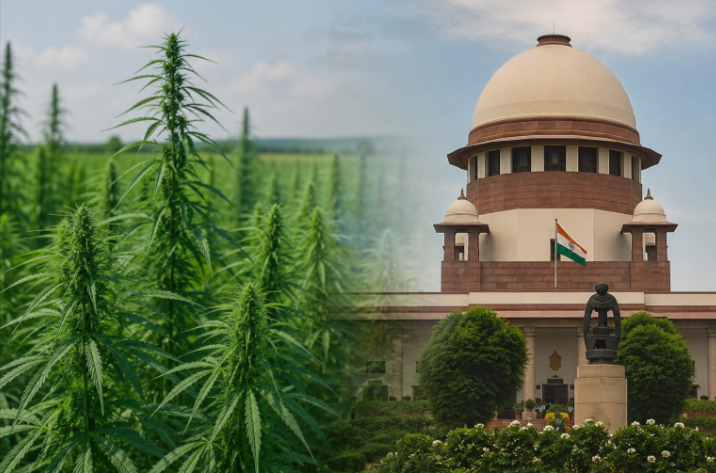
State of Industrial Hemp Legality in India – 2026 Update
A hemp shirt, a packet of hemp seeds, a bhang drink, and a farmer’s hemp crop may all come from the cannabis family. But in India, they do not sit in the same legal box.
That is where most confusion begins.
In everyday life, hemp already appears in clothing, food ingredients, wellness conversations, and traditional use. Yet the moment we talk about growing the plant, extracting compounds, or selling hemp-based products, the law becomes more specific.
India does not treat every part of the cannabis plant in the same way. It looks at the plant part, intended use, state permission, and controlled substance risk.
So, is industrial hemp legal in India in 2026? The honest answer is yes, but not freely, not everywhere, and not without conditions.
A quick overview of the legal status of industrial hemp in India
Industrial hemp is legal in India but with conditions. Not anyone can grow hemp anywhere or sell any hemp product without checks.
The cleaner way to understand it is this: industrial hemp can be legal when it is grown, processed, or used under the right permission, for the right purpose, and within the limits set by law.
Industrial hemp is different from intoxicating cannabis in its intended use and chemical profile. Hemp is mainly grown for fiber, seed, stalk, hurd, textiles, paper, construction material, and similar industrial uses. The legal concern rises when the plant is used for resin, narcotic extraction, or products linked to intoxication.
So, hemp cultivation being legal in India is not without exception. It depends on the state, the license, the crop variety, THC control, and the end use.
That is why the answer to “is Industrial hemp legal in India?” is not simply yes or no. In 2026, it is better understood as regulated, conditional, and state-dependent.
Which laws and regulations at the national and state levels govern the cultivation of industrial hemp in India?
To understand why industrial hemp being legal in India is a conditional answer, we need to look at two layers: national law and state permission.
National Law

The NDPS ACT and its regulations for hemp Source
At the national level, the main law is the Narcotic Drugs and Psychotropic Substances Act, 1985, or the NDPS Act. This law controls cannabis because of its narcotic risk. But it also leaves room for cannabis cultivation for industrial and horticultural purposes when it is permitted and controlled by the government.
That is the legal opening for industrial hemp.
The real decision, however, usually happens at the state level. A state has to create the licensing route, decide which department will issue approvals, monitor cultivation, and check whether the crop is being used for the approved purpose.
State Laws
When asked, “In which state is hemp legal in India?” the answer should not be a loose list. It should be a state-wise view of where permission is clearer, where the policy is emerging, and where no practical route is visible yet.
This is why stating that hemp is legal in all the states of India can be misleading. A state may discuss hemp, approve research, or allow a pilot project. That is not the same as saying every farmer can grow hemp commercially.
The same caution applies to legal hemp cultivation in India. It is possible in the right state, under the right license, for the right use. But without that permission, cultivation can still create legal risk.
Other Regulations


FSSAI (Food Safety and Standards Authority of India): In November 2021, FSSAI officially recognized hemp seeds, hemp seed oil, and hemp seed flour as food and food ingredients under the Food Products Standards and Food Additives (Fifth Amendment) Regulations, 2021. It also mandated the labeling of multiple product categories, specifying that THC content in hemp food products must stay within prescribed limits. There must be no medicinal or psychoactive benefit claims made.
Ministry of AYUSH: Since 2018, the Ministry of AYUSH has permitted the use of cannabis (referred to as Vijaya) in certain Ayurvedic, Siddha, and Unani formulations. This added another regulated channel for cannabis plant derivatives in India.
So, industrial hemp being legal in India in 2026 means regulated legality. The national law creates the framework. The state and regulatory bodies decide whether the crop can actually be grown.
Next let’s see how one can get a license for hemp in India.
How to get a hemp license in India?
Once we understand the state-wise position, the next practical question is: How to get a hemp license in India?
The process starts with the state, not with a single central online form. Depending on the state, the concerned authority may be linked to excise, agriculture, industry, narcotics control, or a department specifically notified for hemp cultivation.
A serious application usually needs more than basic identity documents. The authority may ask for:
- land ownership or lease details
- proposed crop area
- purpose of cultivation
- seed or variety details
- buyer or processing plan
- THC testing and monitoring plan
- storage and movement records
- undertaking that the crop will be used only for approved industrial purposes
This is important because a hemp license is not just permission to sow a crop. It is permission to grow a controlled plant under declared conditions.
The process:
- Submit the application to the District Magistrate.
- Application is reviewed against the state’s hemp cultivation policy under Section 14 of the NDPS Act.
- THC compliance is part of the approval. Hemp cultivation is only legally possible with certified low-THC varieties (≤ 0.3% THC).
- A season-specific, land-specific license is issued upon approval.
One important note: a license from Uttarakhand does not permit cultivation anywhere else. Each state with an active policy runs its own licensing process. If your state does not yet have a framework under Section 14, cultivation is not currently possible regardless of intent.
So, getting a hemp license in India depends on the state’s current rules, the purpose of cultivation, and the applicant’s ability to maintain compliance.
Next let’s see what the legal status of industrial hemp means for smaller units like farmers and businesses.
What can farmers and businesses legally do with industrial hemp?
The biggest issue in India is not only whether industrial hemp is legal in India on paper. The bigger issue is enforcement on the ground.
Within the current framework, here is what is permitted for farmers and businesses:
- Cultivation: Hemp cultivation legal in India is permitted in licensed states with a valid license, specifically for fiber, seed, or horticultural purposes.
- Fiber and textile products: A common question: Is hemp fabric legal in India? The answer is yes. Hemp rope, hemp fabric, hemp paper, and other fiber-derived products are legal to manufacture and sell across India. Most manufacturers currently import raw hemp fiber from China, Europe, or North America due to limited domestic supply (this is permitted under India’s phytosanitary import guidelines.)
- Food products: Under FSSAI’s 2021 standards, hemp seeds, hemp seed oil, and hemp seed flour are legal as food ingredients. However they should adhere to the THC limits (total THC in most hemp food products must not exceed 5 mg/kg, and 0.2 mg/kg in beverages).
- Ayurvedic formulations: Cannabis leaf-based formulations are permitted under AYUSH-approved frameworks, manufactured by licensed Ayurvedic companies.
- Industrial applications: Hemp fiber’s use in construction materials, bioplastics, and technical textiles is legally unobstructed as a manufacturing application. The only thing is that the raw material sourcing should be compliant.
What is not permitted:
- Cultivation without a state license,
- extraction of high-THC products,
- CBD as a standalone food supplement (FSSAI does not permit CBD in food products),
- or interstate transport of cannabis-derived materials without a narcotics transport license under NDPS Rules, 1985.
This means that opportunity exists. But enforcement rewards the players who can show licenses, sourcing records, lab tests, and clean product claims.
What should brands check before using industrial hemp?
If you are building a product that uses hemp as an ingredient or raw material, here is the compliance checklist that matters:
- Raw material sourcing: You should definitely have the know-how on getting a hemp license in India in this case. Confirm that your supplier holds the appropriate cultivation license (if domestic) or has compliant import documentation (if imported). Ask for the Certificate of Analysis confirming THC content is below 0.3%.
- Product category clarity: If you’re sourcing fiber, there is a clear answer that the fabric is legal, but the sourcing chain behind it still needs to be compliant. Are you using hemp seed derivatives (legal under FSSAI)? Or hemp flower/extract/CBD (subject to significantly stricter rules)? These are not the same category under Indian law.
- FSSAI compliance for food and nutraceutical products: Obtain FSSAI registration or license. Ensure your labeling meets the latest standards. You should ensure ingredients are fully disclosed, THC/CBD content is declared if detectable, and no medicinal or psychoactive benefit claims are made.
- AYUSH licensing for Ayurvedic formulations: If your product is positioned as an Ayurvedic preparation using hemp leaf, it requires AYUSH licensing and compliance with the Drugs and Cosmetics Act, 1940.
- State-level checks for physical operations: If you are setting up processing, storage, or cultivation facilities, verify the applicable state’s rules. Not just the national guidelines.
At the Hemp Foundation, we believe hemp becomes meaningful only when it is understood properly. Legal clarity, farmer-linked sourcing, and practical product use must move together. If you want to see how responsibly sourced hemp can become everyday products, explore our hemp products and understand how industrial hemp moves from field to finished use.
For brands, this is the practical rule: do not build a hemp story only around sustainability. Build it around documentation. In 2026, the strongest hemp brands in India will be the ones that can show clean sourcing, clear product use, and honest claims.
Closing Thoughts: Where does industrial hemp legality stand in India in 2026?
Understanding that industrial hemp being legal in India is a conditional, evolving framework and not a binary yes or no is the most important thing. Hemp’s legal story in India is still being written.
In 2026, hemp’s more accurate position is this: industrial hemp is legal in India when the activity fits the law, the state allows it, and the business can prove compliance.
For farmers, this means cultivation is still the hardest part. A farmer needs state permission before treating hemp as a commercial crop. Without that approval, the same plant that could have industrial value may still create serious legal risk.
For businesses, the opportunity is more active but still documentation-heavy. Hemp textiles, seed-based foods, fiber products, and industrial materials can move into the market more easily when the sourcing is clean and the product stays within its legal category.
So, the practical state of industrial hemp in India is clear: the market is opening, but through controlled channels.
The next phase will depend on three things:
- more states creating clear licensing systems
- better testing and traceability infrastructure
- businesses making honest, specific claims instead of vague hemp claims
That is where India stands today. The legality of industrial hemp in India is not a marketing claim. It depends on meeting specific legal and regulatory requirements.
FAQs
1. Is Industrial hemp legal in India?
Yes, but only under conditions. Industrial hemp needs state permission, legal sourcing, controlled use, and proper documentation. It is not open cultivation.
2. Which are the hemp-legal states in India?
Uttarakhand has the clearest route. Himachal Pradesh and Madhya Pradesh have shown policy movement, but permissions still depend on the notified state rules.
3. HOW TO GET A HEMP CULTIVATION LICENSE IN INDIA?
Start with the relevant state authority. You may need land details, crop purpose, seed information, THC testing plans, and buyer or processing documents.
Is hemp cultivation legal in India for farmers?
Yes, but only where the state allows it. Farmers need a valid license before growing hemp as an industrial crop.
5. Is hemp fabric legal in India?
Usually, yes, if made from legally sourced hemp fibre. The bigger question is not the fabric itself, but whether the supply chain is traceable.

Vishal Vivek
Vishal Vivek is the Founder and CEO of Ukhi, a pioneering bio-materials company dedicated to ending plastic pollution by converting agricultural waste into high-performance compostable polymers. With a background in sustainable entrepreneurship and over a decade of technology experience, he leads Ukhi’s vision to create scalable, planet-positive material solutions. Previously, Vishal founded the Hemp Foundation, where he empowered more than 1,000 farmers and advanced sustainable livelihood initiatives. His work has been recognized through awards such as the HDFC Parivartan Grant and featured in leading publications like Forbes and Entrepreneur. Times Group recognized him as a legendary entrepreneur and published his biography in “I Did IT- Vol 2” alongside social pioneers like Bindeshwar Pathak (Sulabh International) and Anshu Gupta (Goonj). Vishal has authored more than 200 articles on sustainability and hemp, reflecting his deep expertise and advocacy for regenerative solutions. His commitment to grassroots impact led him to live in the remote mountains of Uttarakhand, where he immersed himself in the lives of marginal farmers, understanding their challenges and co-creating economic opportunities through hemp-based initiatives. A deeply passionate innovator, Vishal often draws inspiration from seemingly impossible achievements: “If Elon Musk can make rockets reusable, or Dashrath Manjhi can carve a path through a mountain with rudimentary tools, why can’t we eliminate the demon of single-use plastic while uplifting struggling farmers? We will make it happen—whatever it takes.” Ukhi is proud to be supported by premier institutions including IIT Guwahati, NSRCEL-IIM Bangalore, Indian School of Business (Hyderabad), Indian Council of Agricultural Research (ICAR Pusa), and the Indian Institute of Packaging. Vishal is committed to demonstrating that business can be a powerful catalyst for global environmental and social good. Connect with Vishal Vivek
Related Posts

Why You Should Avoid Cotton Masks
Why Using Cotton Masks Are Dangerous The rise in the number of COVID cases has led to an increase in
How GM Seeds Damage the Environment
Generically Modified Seeds – Your environment’s death-sentence? Source While many are pleased wi

Illinois Hemp Industry in Limbo as Delta-8 Regulation Bill Fails Amid Equity Concerns
News of the Illinois House Bill 4293, failing to pass in the state legislature as of January 2025 ha

