

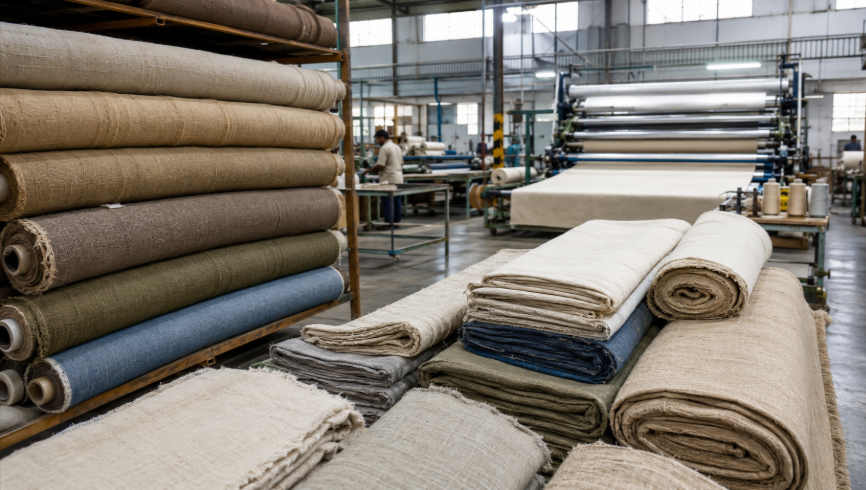
Bulk Hemp Fabric in India – Sourcing Guide for International Buyers
Before a shirt reaches a store shelf, the fabric has already passed through a chain of decisions: fiber, yarn, weave or knit, dyeing, finishing, shrinkage control, packing, and shipment. One weak link can turn a good-looking sample into a bulk order problem.
That is why sourcing bulk hemp fabric in India is not just about finding a supplier with a catalog. It is about knowing what to ask, what to test, and what to confirm before money moves.
For international buyers in the US, UK, and India, hemp is attractive because it gives fabric a rare mix of strength, breathability, texture, and natural character. But the right result depends on the right sourcing process.
This guide explains how to evaluate bulk hemp fabric in India with clarity, from fabric type to price, quality, MOQ, and supplier checks.
What should you know before sourcing bulk hemp fabric in India?

Hemp fabric comes from the stalk of the hemp plant, not from the seed or flower. The fiber is extracted, processed, spun into yarn, and then woven or knitted into fabric.
Before you contact a single supplier, there are two things you need to understand: the legal landscape, and what makes Indian hemp different from what’s sourced elsewhere.
On the legal side, hemp cultivation in India is governed by the NDPS Act, 1985. Under this act, industrial hemp (defined as cannabis) with less than 0.3% THC is legal to cultivate and process for fiber. However, this can happen only under state-issued licenses. Uttarakhand, Uttar Pradesh, and Madhya Pradesh allow licensed hemp cultivation for industrial purposes.
What makes Indian hemp particularly valuable as a source?
- The Himalayan growing belt, especially Uttarakhand’s districts like Chamoli and Nainital, produces long-fiber hemp, which is stronger and easier to weave.
- India’s labor costs are significantly lower than EU hemp-producing countries.
- The country has deep handloom and natural fiber processing traditions going back centuries.
- India offers vertically integrated supply chains from fiber processing to dyeing. Also, compliance with global organic certifications like GOTS and Oeko-Tex.
This combination of geography, regulation, and craft heritage is exactly why purchasing bulk hemp fabric in India has become a serious option for international buyers.
What types of hemp fabric can international buyers source?

Hemp is not one single fabric. The same fiber can behave very differently depending on yarn count, blend, weave, GSM, dyeing, and finishing.
For buyers sourcing bulk hemp fabric in India, this matters because the wrong fabric can pass a swatch review but fail in production, stitching, washing, or customer wear.
A fabric buyer should never judge hemp only by touch. Hand feel is important, but it tells only one part of the story.
For example, a soft hemp-cotton blend may work beautifully for clothing collections, but a bag brand may need heavier canvas with higher tear strength. A resortwear label may prefer a hemp-linen blend because the texture looks premium, while hemp clothing manufacturers in India working on repeat bulk orders may recommend a more stable hemp-cotton construction for easier cutting, stitching, and size control.
The practical rule is simple: decide the end product first, then select the fabric. That is how sourcing bulk hemp fabric in India becomes a reliable decision, not just a material experiment.
How do you check quality and price before placing a bulk order?
Once you know the fabric type, do not move straight to price negotiation. First, define what “acceptable quality” means in measurable terms.
For ordering bulk hemp fabric in India, the most important checks are:
- GSM, because it tells you the fabric weight.
- Yarn count, because it affects softness and strength.
- Weave or knit construction, because it controls drape and durability.
- Shrinkage after washing, because poor control can ruin garment sizing.
- Colorfastness, because export buyers cannot risk bleeding or fading.
- Tensile and tear strength, because hemp is often chosen for durability.
- Finishing, because the same hemp fabric can feel rough, soft, crisp, or washed-in depending on treatment.
For international orders, ask suppliers if they can share test results based on recognized textile methods such as ISO 6330 for domestic washing behavior, ISO 105 for colorfastness, and ISO 13934 or ASTM D5034 for tensile strength. You do not need every test for every order, but you do need the right tests for the product.
This also affects hemp fabric prices in India.
A quote for hemp fabric is not useful unless it is linked to clear specifications. A 170 GSM hemp-cotton fabric and a 280 GSM 100% hemp canvas are completely different buying decisions.
Price can change because of:
- Fiber quality
- Hemp percentage in the blend
- GSM
- Dyeing method
- Softening or enzyme wash
- MOQ
- Certification requirement
- Export packing and documentation
So, when comparing prices, compare like with like. Ask for the price per metre or yard only after the supplier has confirmed composition, GSM, width, finish, MOQ, and testing support.
That is how you avoid a cheap quote becoming an expensive production mistake.
At Hemp Foundation, we work directly with licensed hemp farmers in Uttarakhand and supply verified bulk hemp fabric in India. Whether you’re a fashion brand, a wholesaler, or a retailer building a sustainable line, we can match you with the right fabric grade and MOQ. Explore our hemp products.
Now let’s look at how to shortlist hemp fabric suppliers in the next section.
How should buyers shortlist hemp fabric suppliers in India?
After quality and price, the next question is supplier capability. A good supplier is not just someone who can send a swatch. They should be able to repeat the same fabric in bulk, document the composition, and support export requirements.
Here is what to look for when evaluating hemp clothing manufacturers in India:
- Traceability: Can the supplier tell you which state the fiber was grown in, and under which license? If they can’t answer this, move on. Legally sourced hemp has a paper trail.
- Vertical integration: Suppliers with control over spinning, weaving, and finishing minimize quality inconsistencies. A supplier who sources yarn from one party, weaves with another, and dyes with a third has multiple failure points.
- Sampling process: Any credible supplier will send samples before bulk orders. Test for GSM accuracy, color consistency across the roll, and shrinkage after washing. What you receive in a sample should match what arrives in the container.
- Export experience: Ask specifically about their experience shipping to the US or UK. Customs documentation, HS codes for hemp textiles, and compliance paperwork are different from domestic orders. Experienced exporters already have these systems in place.
- Communication quality: How fast do they respond? How specifically do they answer technical questions? The clarity of a supplier’s answers in the conversation stage reflects how they’ll behave once you’ve paid.
The safest route is to shortlist suppliers based on proof, not promises. For bulk hemp fabric in India, that means samples, specifications, testing support, export readiness, and the ability to repeat the same quality when the order scales.
Conclusion: What is the right way to start?
The right way to source bulk hemp fabric in India is to start with the product, not the supplier list.
Decide whether you are making shirts, trousers, bags, home textiles, or finished garments. Then choose the fabric type, GSM, blend, finish, and testing requirements around that product.
After that, compare suppliers on samples, specifications, documentation, MOQ, and repeat-order capability.
Hemp can be a strong material choice for international buyers, but only when sourcing is done with discipline. Start small, test properly, approve carefully, and scale only when the fabric performs in real use.
FAQs
Is India a good place to source bulk hemp fabric?
Yes. Bulk hemp fabric in India is worth considering because India offers fiber knowledge, textile processing, garmenting support, and export-ready supplier networks.
How do I compare hemp fabric suppliers properly?
Use this best bulk hemp fabric in India sourcing guide approach: compare samples, GSM, blend ratio, shrinkage, colorfastness, MOQ, documentation, and repeat-order capability.
What affects hemp fabric price in India?
Hemp fabric price in India depends on hemp percentage, GSM, weave, dyeing, finishing, certification needs, MOQ, and whether the fabric is custom-developed.
Can buyers source finished hemp clothing from India?
Yes. Suppliers of hemp clothing in India can support shirts, trousers, T-shirts, bags, and accessories, but fabric consistency and sizing approval matter before bulk production.
What is hemp clothing wholesale?
Hemp clothing wholesale means buying finished hemp garments in bulk, while fabric sourcing means buying rolls of fabric for your own manufacturing or brand production.

Vishal Vivek
Vishal Vivek is the Founder and CEO of Ukhi, a pioneering bio-materials company dedicated to ending plastic pollution by converting agricultural waste into high-performance compostable polymers. With a background in sustainable entrepreneurship and over a decade of technology experience, he leads Ukhi’s vision to create scalable, planet-positive material solutions. Previously, Vishal founded the Hemp Foundation, where he empowered more than 1,000 farmers and advanced sustainable livelihood initiatives. His work has been recognized through awards such as the HDFC Parivartan Grant and featured in leading publications like Forbes and Entrepreneur. Times Group recognized him as a legendary entrepreneur and published his biography in “I Did IT- Vol 2” alongside social pioneers like Bindeshwar Pathak (Sulabh International) and Anshu Gupta (Goonj). Vishal has authored more than 200 articles on sustainability and hemp, reflecting his deep expertise and advocacy for regenerative solutions. His commitment to grassroots impact led him to live in the remote mountains of Uttarakhand, where he immersed himself in the lives of marginal farmers, understanding their challenges and co-creating economic opportunities through hemp-based initiatives. A deeply passionate innovator, Vishal often draws inspiration from seemingly impossible achievements: “If Elon Musk can make rockets reusable, or Dashrath Manjhi can carve a path through a mountain with rudimentary tools, why can’t we eliminate the demon of single-use plastic while uplifting struggling farmers? We will make it happen—whatever it takes.” Ukhi is proud to be supported by premier institutions including IIT Guwahati, NSRCEL-IIM Bangalore, Indian School of Business (Hyderabad), Indian Council of Agricultural Research (ICAR Pusa), and the Indian Institute of Packaging. Vishal is committed to demonstrating that business can be a powerful catalyst for global environmental and social good. Connect with Vishal Vivek
Related Posts

The Eco Appeal of Hemp Courier Bags in E-Commerce
When your product reaches your customer’s doorstep, what is the first thing they see? It’s
Hemp Bioplastic: Nature’s Gift to End Plastic Pollution
[vc_row][vc_column][vc_column_text]Few inventions have affected human lives as much as synthetic pla
How Hemp Will Revolutionize the Auto Industry
Here’s some news for naysayers who don’t yet buy the idea of a major role of hemp in auto indust

