

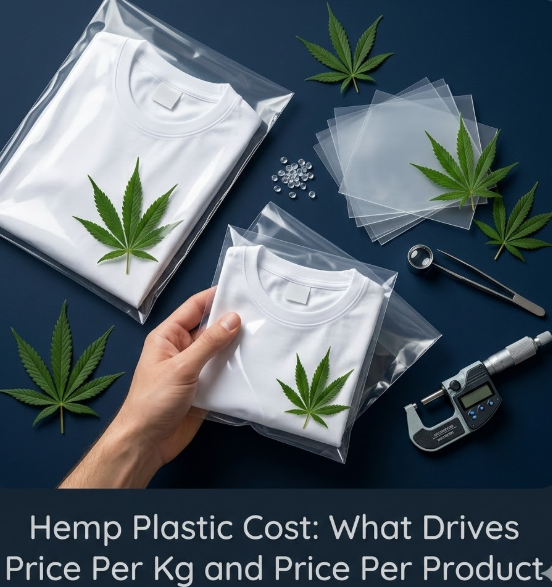
Hemp Plastic Cost: What Drives Price Per Kg and Price Per Product
If you’ve ever asked, “Why is hemp plastic expensive?”, you’re not alone.
Most people believe that hemp grows fast, it’s natural, so the plastic should be cheap. In reality, hemp plastic cost is less about the plant and more about everything that happens after the harvest.
That includes how the hemp is processed, what it’s blended with, and how reliably it can run in real factories without defects.
So let’s start with one clarity point that changes the whole conversation. To understand cost, we first need to understand what “hemp plastic” actually is in the market today.
Why Does Hemp Plastic Cost Vary So Much?
“Hemp plastic” is not one material. It’s a family of materials, and that’s why the price range varies a lot.
In practice, 100% hemp-based plastics are uncommon. Most products sold as hemp plastic are composites that combine hemp with another polymer.
What you see in the market usually falls into buckets like:
- Hemp cellulose-based plastics, where cellulose is extracted from the stalk
- Hemp fibre or hurd-filled bioplastics, where hemp is blended with PLA, PBAT, PHA, or similar materials
- Hemp-filled conventional plastics, where hemp is blended with PP, ABS, or recycled polymers
Once you see this, the cost becomes easier to explain.
A 30% hemp and 70% PLA compound will behave like PLA in pricing because it dominates. A hemp-filled PP compound behaves differently and often is cheaper per kilo. But it is not compostable.
That’s why hemp plastic cost varies so much:
- Different proportions of hemp vs polymer
- Different performance requirements
- Different processing routes
The next step is understanding what cost buckets go into making it.
What Is Included in Hemp Plastic Production Cost?
When people say hemp plastic production costs, they often picture one step: “turn hemp into pellets.”
In reality, it’s a cost stack with many steps.
Here’s an inside look at the hemp plastic production process.
Feedstock
This is the hemp cultivation and harvest layer.
Even when the farm-gate price of hemp straw is low, that is, before industrial separation and cleaning happens.
Pre-Processing and Refinement
This is where costs start climbing:
- Decortication (separating bast fibre from hurd)
- Cleaning and drying (moisture control is critical)
- Milling and size reduction
- Sometimes cellulose extraction, depending on the product
Polymer Matrix and Additives
Most hemp plastics are composites, so you’re paying for:
- The base polymer (PLA, PBAT, PP, ABS, or recycled blends)
- Compatibilizers (to improve bonding between hemp and polymer)
- Stabilizers, pigments, and performance modifiers
Compounding and Pelletization
Typically, hemp plastic undergoes extrusion-based compounding, where hemp and polymer are melt-mixed and pelletized. Energy use, throughput, yield loss, and equipment cost all show up here.
Scale matters a lot, and smaller plants carry higher fixed costs per kilo. At Hemp Foundation, we are constantly investing in new technology and refining the production process to reduce the cost of hemp plastic.

Testing, Certification, and Compliance
If the product is marketed as compostable or food-contact safe, testing and documentation become unavoidable.
With this background, it’s easier to answer the next question: what pushes the price per kilo up or down?
What Drives Hemp Plastic Price Per Kilo?
Price per kilo is where most procurement conversations start and where most misunderstandings happen.
A few factors affect hemp plastic cost per kilogram more than anything else.
Hemp Content Percentage
More hemp can reduce the share of expensive polymer, but high loading can also:
- Narrow the processing window
- Increase scrap rates
- Require more coupling agents
So “more hemp” does not automatically mean “cheaper compound.”
Polymer Matrix Choice
As mentioned above, this is often the single biggest driver. A hemp-PLA blend and a hemp-PP blend sit in different supply and pricing cycles because the base resins are in different markets.
Additives and Performance Packages
Do you want more performance? If a buyer needs:
- UV stability
- Flame-retardant properties
- Anti-static properties
- High impact strength
The cost rises because the additive package expands and compounding becomes more demanding.
Scale and Infrastructure
The hemp plastics industry is in its infancy compared to petroleum plastics. Limited processing and compounding infrastructure means higher equipment costs per kg and fewer economies of scale.
Geography and Supply Chain
Freight, duties, and inconsistent feedstock quality add a risk premium. If fibre processing and compounding facilities are located near cultivation areas, delivery costs can fall.
Even when you know the price per kilo, you still don’t know what it means for a bag, a casing, or a panel. That conversion step is where real decision-making happens.
How Do You Move From “Price Per Kilo” to “Price Per Product”?
Rupees per kilo does not equal rupees per product.
To move from resin pricing to product pricing, you need a simple conversion ladder:
- Resin price per kilo
- Multiply by part weight in kilos
- That equals the material cost per unit
Then you layer real-world manufacturing costs:
- Processing cost (machine time, labor, energy)
- Tooling amortization (moulds, dies, changeovers)
- Scrap and rejection (startup waste, cosmetic defects)
- Packaging and logistics
- Compliance labeling and documentation
A Simple Example
If a part weighs 40 grams (0.04 kg), then every ₹100 per kilo change in resin price changes the part’s raw material cost by ₹4. If your product price is moving by ₹4 or even ₹8, the cost driver is often not resin alone. It’s the processing cost, cycle time, scrap, validation, or compliance costs.
This is why “cost per functional unit” is the correct way to look at the calculation:
- Per bag delivered
- Per casing produced
- Per panel installed
With this framework in place, we can apply it to real product categories.
Why Do Biodegradable Packaging Products Have Different Hemp Plastic Costs?
Packaging is where most early adoption is happening.
When someone searches for hemp plastic for sale, they usually see two different things:
- Hemp composite pellets (raw material)
- Finished packaging products (bags, jars, cutlery, containers)
These are not priced the same way.
Bags and Pouches
Film extrusion runs at high speeds. Cost depends heavily on:
- Thickness
- Seal integrity
- Barrier performance (moisture and oxygen)
- Print and branding layers
A small thickness change across millions of bags shifts material cost quickly.
Food Containers
Thermoformed or injection moulded.
Now you need:
- Heat resistance
- Structural rigidity
- Food-contact compliance
If compostability is claimed, certification and documentation add cost.
Cutlery and Cosmetic Packaging
Cutlery requires stiffness and fast cycle times.
Cosmetic packaging requires:
- Surface finish
- Color uniformity
- Dimensional precision
Each of these increases additive complexity and scrap risk.
Packaging is relatively forgiving compared to electronics. Once you enter consumer goods, the performance bar rises.
What Drives Hemp Plastic Costs in Consumer Goods and Electronics?
Electronics and durable consumer goods change the equation.
A phone casing, laptop housing, or molded furniture panel must deliver:
- Impact resistance
- Dimensional stability
- Surface smoothness
- Long-term durability
If electronics are involved, flame-retardancy requirements may apply, which usually means:
- Additional additives
- Tighter compounding control
- Higher testing burden
In these segments, hemp loading often drops because mechanical consistency becomes critical.
And that shifts cost weight back toward the polymer matrix. Even if the part contains hemp, per-kilo prices may resemble engineered plastics more than simple packaging blends.
The automotive sector pushes this logic even further.
Why Are Automotive Hemp Plastic Components Priced Differently?
Automotive is not just about material price.
It’s about qualification.
An interior door panel or dashboard trim must pass:
- Mechanical stress testing
- Thermal cycling
- OEM validation protocols
- Long supplier approval cycles
Before a single large order is placed.
That validation cost is front-loaded.
Tooling is heavier. Quality standards are stricter. Consistency must be proven at scale.
So automotive hemp composites may achieve competitive long-run pricing — but entry barriers keep early costs higher.
How Do Industrial and Construction Applications Change the Economics?
Industrial and construction uses shift the conversation from “performance per gram” to “cost per installed unit.”
Applications may include:
- Composite boards
- Pipes
- Insulation systems
- Structural panels
Now, bulk material usage dominates. When kilograms per unit replace grams per unit, freight and throughput become decisive.
Building codes matter too. Fire resistance testing, structural compliance, and safety certifications can represent significant upfront investment.
It’s also important to separate polymer composites from binder-based materials such as hempcrete. They are not the same cost structure.
In construction, durability often outweighs compostability, and that changes formulation priorities and cost drivers.
What You Should Understand About Hemp Plastic Cost
Here’s the clear takeaway. The hemp feedstock is rarely the dominant cost. Hemp plastic cost depends on a complex set of material choices and processing overheads.
It is primarily shaped by:
- The polymer and the amount used
- The hemp loading percentage
- Processing scale and infrastructure
- Product-level conversion economics
There is no way to draw a straight line from cost per kilo to cost per unit. Though the cost of raw hemp fibre is on a downward trajectory, it might be a while before the cost per functional unit declines on the same scale.
The Hemp Foundation’s average catalogue price for hemp plastic materials is around 15 to 20% more than conventional plastics. Our own studies have led me to conclude that the price will reduce significantly by 2030 and dip below the cost of conventional plastics by 2035.
Frequently Asked Questions
How much does hemp plastic cost per kilo?
Hemp bio-plastic granules in India generally cost around ₹400 per kilo. The costs for raw hemp fibre start from about ₹220 per kilo.
Is hemp plastic more expensive than conventional plastic?
At the present moment, hemp plastic is 2 – 3 times more expensive to manufacture compared to conventional plastics. This is due to the limited availability of hemp fibre and processing facilities. As the industry matures, cost is estimated to come down dramatically.
Can hemp plastic become cheaper at scale?
The production of hemp plastic requires 35% less energy compared to traditional plastic. Large-scale production will reduce costs even further, and technological advancements will bring its costs closer to fossil-fuel-based plastics.
What is the size of the hemp plastic market?
The global hemp plastic market is valued at approximately $237 million in 2024. It is projected to grow to $1 billion in the next few years. In India, too, the hemp plastic market is poised for an upward trend over the next decade as single-use plastics are phased out.
Why do some suppliers quote very different hemp plastic prices?
The differences are due to hemp percentage and polymer choices. Also, there is some amount of green premium inserted by manufacturers.

Vishal Vivek
Vishal Vivek is the Founder and CEO of Ukhi, a pioneering bio-materials company dedicated to ending plastic pollution by converting agricultural waste into high-performance compostable polymers. With a background in sustainable entrepreneurship and over a decade of technology experience, he leads Ukhi’s vision to create scalable, planet-positive material solutions. Previously, Vishal founded the Hemp Foundation, where he empowered more than 1,000 farmers and advanced sustainable livelihood initiatives. His work has been recognized through awards such as the HDFC Parivartan Grant and featured in leading publications like Forbes and Entrepreneur. Times Group recognized him as a legendary entrepreneur and published his biography in “I Did IT- Vol 2” alongside social pioneers like Bindeshwar Pathak (Sulabh International) and Anshu Gupta (Goonj). Vishal has authored more than 200 articles on sustainability and hemp, reflecting his deep expertise and advocacy for regenerative solutions. His commitment to grassroots impact led him to live in the remote mountains of Uttarakhand, where he immersed himself in the lives of marginal farmers, understanding their challenges and co-creating economic opportunities through hemp-based initiatives. A deeply passionate innovator, Vishal often draws inspiration from seemingly impossible achievements: “If Elon Musk can make rockets reusable, or Dashrath Manjhi can carve a path through a mountain with rudimentary tools, why can’t we eliminate the demon of single-use plastic while uplifting struggling farmers? We will make it happen—whatever it takes.” Ukhi is proud to be supported by premier institutions including IIT Guwahati, NSRCEL-IIM Bangalore, Indian School of Business (Hyderabad), Indian Council of Agricultural Research (ICAR Pusa), and the Indian Institute of Packaging. Vishal is committed to demonstrating that business can be a powerful catalyst for global environmental and social good. Connect with Vishal Vivek
Related Posts
Breathable, Eco-friendly Mask For Teens And Senior Citizens: Pure Hemp Face Cover By Hemp Foundation
I was born a brought up in a typical Marathi home. Though my mother was a Gujarati, we followed almo
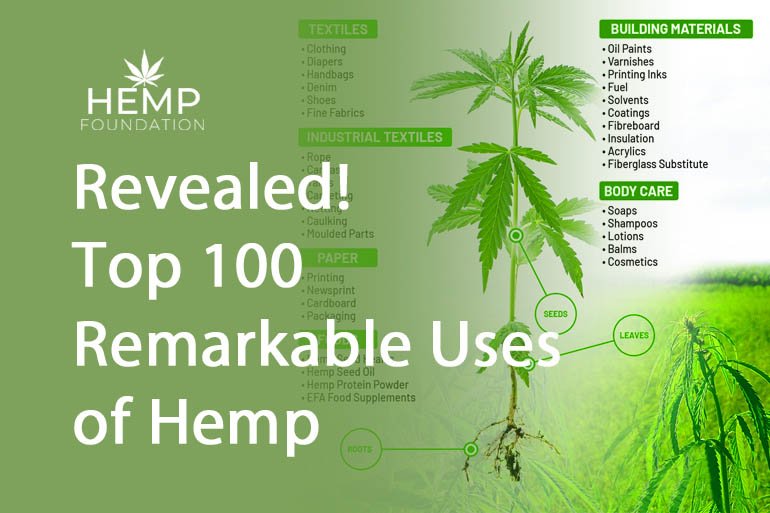
Revealed! Top 100 Remarkable Uses of Hemp
Hemp is a part of the Cannabis Sativa plant and was first used in China and the Middle East in 8000

Is Hemp Plastic Food Safe? Facts for Everyday Use
Every time a new packaging material enters the market, the first question isn’t about how green it

