

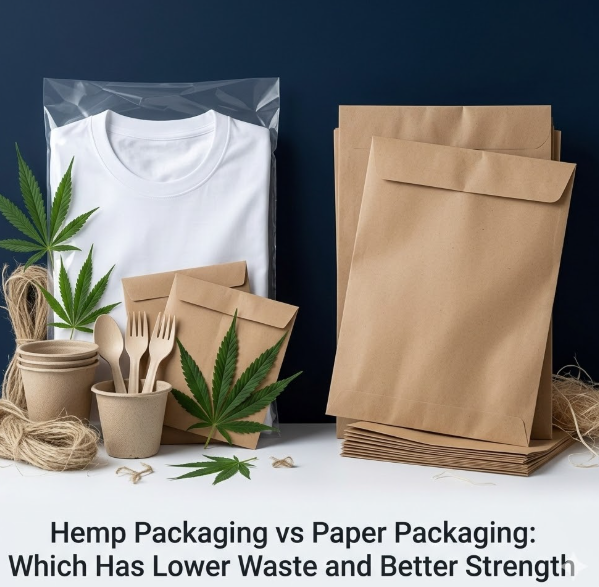
Hemp Packaging vs Paper Packaging: Which Has Lower Waste and Better Strength
As we phase out plastic packaging, the two most discussed options are hemp packaging and conventional paper packaging. If you’re choosing between hemp packaging and paper packaging, you’re not really choosing between two “materials.”
You’re choosing between two ecosystems:
- What it takes to make the package
- How well it protects the product
- And what happens after use
On paper, both look “green.” In the real world, one may end up recycled, while the other quietly becomes landfill.
So in this article, I’ll compare hemp packaging vs paper packaging on two outcomes that matter most: waste and strength, without marketing language, and with real test logic.
To do that, we first need to agree on what we’re actually comparing.
What Is Hemp Packaging and What Is Paper Packaging?
When people say hemp packaging, they often mean one of four things:
- Hemp fibre paper (hemp pulp used to make paper or board)
- Molded fibre packaging (trays, clamshells, inserts made from hemp pulp)
- Hemp biocomposites (hemp fibre reinforcing another material)
- Hemp-based films (often marketed as hemp plastic)
That last category matters because “hemp” doesn’t automatically mean “plastic-free.”
In many real products, hemp plastic means hemp fibres combined with polymers and additives to create a plastic-like material.
Paper packaging is more straightforward: kraft paper, paperboard cartons, and corrugated board.
But there’s a catch.
Many “paper” packages have coatings or laminates for moisture or grease resistance. Those layers change recyclability and end-of-life options completely.
Now that definitions are clear, we can talk about the real question: which creates less waste?
Which One Creates Lower Waste Across the Full Lifecycle?
Waste doesn’t happen only at disposal. It shows up at three points:
- Raw material stage
- Manufacturing stage
- End-of-life stage
In mature paper systems, a lot of manufacturing waste is captured and looped back internally. That maturity matters because it reduces both cost and wasted material.
With hemp, you can get a different waste profile, especially if you use parts of the plant that are otherwise undervalued. Hemp hurd, for example, is often treated as a low-value byproduct and has been explored as a packaging fibre.
But this is where it gets non-intuitive.
Hemp does not automatically win on lifecycle impact in every scenario. Results can flip depending on:
- Fertiliser inputs
- Processing energy
- Transport distances
- Whether the processing system is optimized at scale
So the honest answer is not “hemp good, paper bad.” It’s:
- What feedstock is used
- How efficiently it’s processed
- And whether the end-of-life system delivers
Which brings us to the biggest claim people make about hemp: agricultural residues.
Does Hemp Reduce Waste Because It Uses Agricultural Residues?
This is the strongest argument for sustainable hemp packaging. It is also the easiest one to oversimplify.
The logic is simple. If part of the hemp stalk is normally underused, turning it into packaging reduces waste and increases value per hectare.
But for policymakers and investors, the real question is not “can it be done?” It’s “is it actually being done responsibly and at scale?”
Here’s what to verify:
- Is the hurd truly a by-product, or is it becoming a primary demand crop?
- Is there traceability and chain-of-custody?
- Are there competing uses for hurd that could shift impacts elsewhere?
One practical angle here is land health. The Hemp Foundation is actively engaged in promoting hemp cultivation as a solution to soil erosion.
And this isn’t only theory. We also work with local artisans in Uttarakhand to produce biodegradable hemp packaging, so the value chain stays rooted in real communities, not just lab claims.
Even if sourcing is perfect, the waste story still depends on what happens after use.
Is Hemp Packaging Recyclable, Compostable, or Neither?
Here’s the simplest way to think about hemp packaging vs paper packaging after-use outcomes.
If it’s fibre-based hemp, meaning paper or molded fibre, then if it’s uncoated and reasonably clean, it behaves like paper packaging in recovery systems.
If it’s hemp plastic or a composite, then end-of-life depends on:
- What the polymer matrix is
- Whether the product is certified for a specific disposal route
This is where language matters.
- Recyclable means it is designed to be reprocessed in a recycling stream that actually exists and accepts it
- Compostable means it breaks down under defined composting conditions and meets a standard
- Biodegradable is often vague unless it specifies conditions and timelines
The blunt reality is this: waste outcomes depend more on collection, sorting, and infrastructure than on labels.
Once you understand end-of-life, the next decision is performance.
Which Is Stronger in Real Packaging Use?
Strength isn’t one number. In real packaging, we care about:
- Tensile strength (how hard it is to pull apart)
- Tear resistance (how quickly a tear runs)
- Burst and puncture resistance (handling, drops, sharp edges)
- Compression strength (stacking and storage)

Paper packaging, especially corrugated, is a masterclass in structural engineering. It’s why boxes stack so well in warehouses.
Hemp fibre has a real advantage in strength-to-weight in the right formats. In lab and packaging research, hemp hurd and hemp fibre sheets can show improvements in tensile, tear, and barrier-related behaviour compared to some wood-fibre references, especially when processing steps like pressing densify the structure.
The practical takeaway is simple:
- Paper wins on proven rigidity and stacking systems
- Hemp can win on tear and tensile performance, and lightweighting potential
Wet performance matters because moisture is where many “strong” packages quietly fail.
Is Hemp Packaging Stronger Than Paper When It Gets Wet?
Moisture is where packaging gets exposed.
Not in a lab. In the real world:
- Humid warehouses
- Monsoon deliveries
- Cold-chain condensation
- Leaking bottles inside a shipper
Paper fibres absorb water quickly. Once that happens, strength drops unless the paper is treated or coated.
What’s interesting is that hemp fibre can behave differently depending on how it’s processed. Some comparative packaging research shows hemp hurd sheets absorb less water than certain pine-based sheets under the same test method, and pressing steps can reduce absorption further.
The takeaway isn’t “hemp is waterproof.” It’s that processing choices can materially change wet behaviour.
So if wet performance varies so much, the next question is how to compare fairly.
Hemp Packaging vs Paper Packaging: What’s the Most Fair Comparison?
If you compare hemp packaging and paper by “per kg of material,” you’ll end up with misleading conclusions.
The fair comparison is always by packaging job:
- Mailer vs mailer
- Carry bag vs carry bag
- Tray vs tray
Then compare what actually matters:
- Grams used per shipped unit
- Damage rate and returns
- The real end-of-life pathway in that market
In policy terms, define the functional unit first. Otherwise, you’ll regulate the wrong thing.
Which Should You Choose, Hemp or Paper?
If your goal is lower waste, choose the material that your system can actually collect and process. In many markets today, paper’s recovery pathways are clearer and more mature.
If your goal is better strength, decide by the job:
- Stacking and shipping: Engineered paperboard, especially corrugated, is hard to beat
- Tear-heavy flexible applications: Hemp fibre can offer strong strength-to-weight upside
- Wet conditions: Compare wet strength and water absorption performance — and be honest about coating trade-offs
The practical future is not that sustainable hemp packaging replaces paper. It’s hemp used where it measurably reduces material intensity and still fits the end-of-life reality.
Frequently Asked Questions
Is hemp packaging stronger than paper packaging?
Yes, it is. Hemp packaging uses longer fibres and has about five times more tensile strength. Due to high cellulose content, hemp packaging is not easily degraded.
What is the difference between hemp packaging vs paper packaging?
The core difference is that they are differently sourced. Paper uses wood pulp, while hemp plastic originates from hemp fibres.
Is hemp packaging really sustainable?
Hemp plastic and packaging are made from hemp plants. It is a hardy crop that grows on arid soil without much need for pesticides. Also, hemp plants absorb 4 times more carbon dioxide compared to trees in the growing phase. Hemp packaging is a truly sustainable product that breaks down in a few weeks in a composting facility.
How does the hemp plastic process work in packaging applications?
Hemp cellulose mixed with other polymers and binding agents creates a durable material that can be extruded and molded. It can be used to manufacture bags, wraps, and films that are eco-friendly and biodegradable.
Is hemp packaging in India ready to scale?
The Indian hemp packaging industry is on the verge of a breakthrough moment. Due to the relaxation of farming laws, it is easier to cultivate hemp, particularly in states like Uttarakhand, Uttar Pradesh, and Madhya Pradesh. The Hemp Foundation is at the forefront of this movement and aims to scale the production of hemp plastic vastly.

Vishal Vivek
Vishal Vivek is the Founder and CEO of Ukhi, a pioneering bio-materials company dedicated to ending plastic pollution by converting agricultural waste into high-performance compostable polymers. With a background in sustainable entrepreneurship and over a decade of technology experience, he leads Ukhi’s vision to create scalable, planet-positive material solutions. Previously, Vishal founded the Hemp Foundation, where he empowered more than 1,000 farmers and advanced sustainable livelihood initiatives. His work has been recognized through awards such as the HDFC Parivartan Grant and featured in leading publications like Forbes and Entrepreneur. Times Group recognized him as a legendary entrepreneur and published his biography in “I Did IT- Vol 2” alongside social pioneers like Bindeshwar Pathak (Sulabh International) and Anshu Gupta (Goonj). Vishal has authored more than 200 articles on sustainability and hemp, reflecting his deep expertise and advocacy for regenerative solutions. His commitment to grassroots impact led him to live in the remote mountains of Uttarakhand, where he immersed himself in the lives of marginal farmers, understanding their challenges and co-creating economic opportunities through hemp-based initiatives. A deeply passionate innovator, Vishal often draws inspiration from seemingly impossible achievements: “If Elon Musk can make rockets reusable, or Dashrath Manjhi can carve a path through a mountain with rudimentary tools, why can’t we eliminate the demon of single-use plastic while uplifting struggling farmers? We will make it happen—whatever it takes.” Ukhi is proud to be supported by premier institutions including IIT Guwahati, NSRCEL-IIM Bangalore, Indian School of Business (Hyderabad), Indian Council of Agricultural Research (ICAR Pusa), and the Indian Institute of Packaging. Vishal is committed to demonstrating that business can be a powerful catalyst for global environmental and social good. Connect with Vishal Vivek
Related Posts
How Hemp Can Help Fulfill The Swachh Bharat Mission
[vc_row][vc_column][vc_column_text]India, a developing nation, has been dealing with many growing is
Top Hemp Plastic Manufacturers in the UK
Did you know the UK is now home to more than 1,000 hectares of industrial hemp farms? This number ha

