

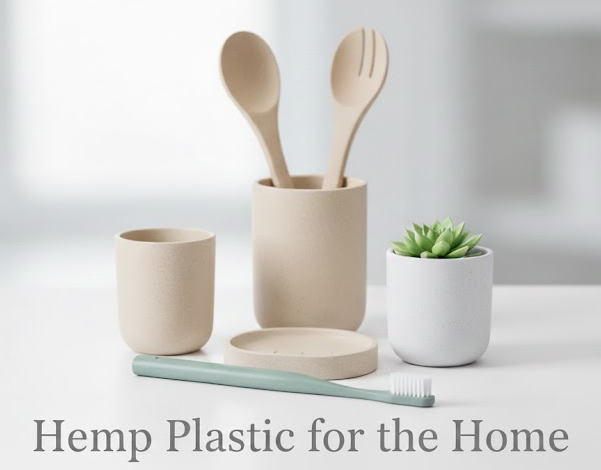
Hemp Plastic for the Home: Everyday Products You Can Switch To
I spend a lot of time talking to people about hemp and how it can change our relationship with plastics.
More often than not, people respond in a predictable way. They assume hemp plastic is relevant only for industrial usage. The first use cases that come to their mind include packaging, auto manufacturing, or large-scale product design.
Most believe that cost-competitive compostable packaging and innovative biocomposites are beyond the reach of ordinary households.
But that’s far from the truth.
Sure, options might be limited today. But choosing hemp for everyday products helps shape demand. And when enough families make these choices, companies and governments follow.

This is why I am writing this article. To explain how you can switch to hemp plastic at home today. One product at a time.
So let’s dive in and see some everyday hemp products you can switch to.
Everyday Home Products You Can Switch to Hemp Plastic
Hemp usage doesn’t have to be industrial and large-scale to make an impact. You can use hemp plastic in your homes, everyday. This is a guide to help you visualize what a home with fewer traditional plastics can look like.
1. Kitchenware and Food Storage
This is where most families can start with the most ease. In your kitchen, hemp plastic can replace many traditional plastic items you use daily like:
- Containers
- Plates and bowls
- Reusable cups and tumblers
- Cutlery sets
- Kids’ lunch boxes
- Food storage boxes
- Compostable storage wraps and lids
Unlike traditional plastics, hemp plastic does not leach harmful chemicals into food. It is also more resistant to heat, sturdier, and produces fewer microplastics during use and washing.
For families with children, this alone makes the switch meaningful. Everyday items that come into contact with food are among the biggest contributors to unintentional plastic ingestion. Hemp plastic reduces this risk.
Research across materials demonstrates that hemp composites maintain durability without the chemical toxicity associated with conventional plastics. This gives deep confidence in their use for food-safe kitchenware.
2. Home Storage and Organisers
Hemp plastic is also well suited for home organising products. You can find hemp products like:
- Drawer dividers
- Shelf organisers
- Under-bed storage boxes
- Lightweight crates
- Desk organisers
- Small furniture components
Hemp composite has an excellent strength-to-weight ratio. It performs well in structures that need to be sturdy but not heavy. That makes it a natural fit for home storage solutions. These products last long, maintain shape, and resist cracking better than several petroleum-based plastics.
For families who want their homes to feel more environmentally responsible, this is a simple category to explore first.
3. Packaging and Wraps for Daily Use at Home
Many households now try to reduce single-use plastic waste, especially in the kitchen.
Here, hemp-based affordable and sustainable packaging solutions are steadily improving, and they include:
- Compostable grocery bags
- Biodegradable food wraps
- Reusable storage bags
- Compostable zip-lock style pouches
- Hemp-plastic food-grade containers

This is where the idea of cost-competitive compostable packaging becomes important. Hemp-based and plant-based packaging solutions are becoming more affordable. Especially as demand grows across markets. They can be used for storing vegetables, leftovers, or dry goods, and they break down more easily than petroleum-based plastics.
Households produce a surprising amount of plastic waste just through packaging. Switching even 20–30% of your home packaging materials can significantly reduce the trash you generate each week.
4. Disposable and Single-Use Products
If your family relies on food delivery or if you entertain guests often, this category can make a real difference. Hemp plastic alternatives exist for:
- Disposable plates
- Cups
- Cutlery
- Takeaway containers
- Compostable serving bowls
Replacing single-use petroleum plastics with biodegradable options is one of the simplest ways to reduce household waste. These products not only break down faster but also release fewer toxins during use and disposal.
For many, this will likely be the easiest starting point. You do not need to buy in bulk or change any habits. You simply switch one item for another when your current supply runs out.
5. Niche and Miscellaneous Household Items
There are also smaller categories where hemp plastic is finding meaningful applications:
- Planter pots
- Home décor items
- Storage crates
- Brush handles
- Keychains and accessories
- Small hardware components
- Kids’ toys
Many people are surprised to learn that hemp composites are already used in car interiors and other durable goods. That should give households confidence in using similar materials for everyday items at home. They are durable, lightweight, and stable, ideal for small, frequently used products.
What to Know Before Buying Hemp Plastic
Switching to new materials becomes easier when you know what to expect. Here are a few simple points to keep in mind when you begin exploring hemp plastic products for your home.
1. Understand the difference between hemp plastic and hemp composite.
Some products are made entirely from bioplastics, while others are blends. Both can be environmentally beneficial, but they behave differently. A pure hemp bioplastic item may be more compostable. A hemp composite may be stronger and longer lasting.
2. Look for credible certifications.
As hemp products grow in popularity, some companies may exaggerate their claims. Always check for compostability certification and biodegradability standards. You may also want to check food-safety labels for products that would come in contact with food items.
3. Understand bioplastics cost comparison.
Many families compare hemp plastic to traditional plastic, and the price difference can be confusing. When I speak with families, I encourage them to evaluate value in a simple way:
- How long will the product last? Hemp plastic tends to be stronger and more durable.
- How safe is the product for children and daily use? Reducing exposure to chemical additives has long-term benefits.
- Does it reduce your waste output? That alone can lower monthly disposal costs and environmental strain.
This is where compostable packaging ROI becomes useful to understand.
When doing any bioplastics cost comparison, it helps to remember that the cheapness of petroleum plastic hides the environmental cost we pay much later.
And remember: As production scales and more households adopt these alternatives, prices will drop even further.
4. Not everything labelled “green” is truly sustainable.
Be cautious of brands that greenwash their products that use minimal hemp but market themselves aggressively. An honest brand will share percentages, materials, and standards openly.
Understanding these points will make your journey smoother and more confident.
A Sustainable Home Is the First Step Toward a Sustainable Country
Switching to hemp plastic will not solve the plastic crisis overnight. But it will reduce your home’s environmental footprint, one product at a time. And when thousands of households do this together, industries notice. Markets shift. And new possibilities open.
At HempFoundation, I have seen change begin with communities that believed they were too small to make a difference. I believe the same about families. Your home, your kitchen, and your daily choices carry more power than you realise.

If you want to begin somewhere, begin with one product today. Let that single decision be your first step toward a cleaner home, a healthier family, and a more responsible planet.
FAQs
1. Are hemp products cost-effective for families?
Absolutely. Hemp products are especially cost-effective when you look beyond upfront price. A simple bioplastics cost comparison shows that hemp items often last longer and reduce waste.
2. How do I know a hemp product is genuinely sustainable?
To ensure that your cost-competitive compostable packaging and products made of hemp are truly sustainable, you can:
Check certifications
Ensure material transparency
Assess the product durability
Products from trusted brands usually follow globally recognized standards for affordable and sustainable packaging and offer clearer environmental benefits.
3. Can switching to hemp at home make a real difference?
Yes. Even small changes reduce daily plastic waste. Switching to cost-competitive compostable packaging solutions made from hemp makes shifting easier for households. And when more families adopt hemp, the collective impact grows and prices come down. Over time, improved compostable packaging ROI, further encourages continued change.

Vishal Vivek
Vishal Vivek is the Founder and CEO of Ukhi, a pioneering bio-materials company dedicated to ending plastic pollution by converting agricultural waste into high-performance compostable polymers. With a background in sustainable entrepreneurship and over a decade of technology experience, he leads Ukhi’s vision to create scalable, planet-positive material solutions. Previously, Vishal founded the Hemp Foundation, where he empowered more than 1,000 farmers and advanced sustainable livelihood initiatives. His work has been recognized through awards such as the HDFC Parivartan Grant and featured in leading publications like Forbes and Entrepreneur. Times Group recognized him as a legendary entrepreneur and published his biography in “I Did IT- Vol 2” alongside social pioneers like Bindeshwar Pathak (Sulabh International) and Anshu Gupta (Goonj). Vishal has authored more than 200 articles on sustainability and hemp, reflecting his deep expertise and advocacy for regenerative solutions. His commitment to grassroots impact led him to live in the remote mountains of Uttarakhand, where he immersed himself in the lives of marginal farmers, understanding their challenges and co-creating economic opportunities through hemp-based initiatives. A deeply passionate innovator, Vishal often draws inspiration from seemingly impossible achievements: “If Elon Musk can make rockets reusable, or Dashrath Manjhi can carve a path through a mountain with rudimentary tools, why can’t we eliminate the demon of single-use plastic while uplifting struggling farmers? We will make it happen—whatever it takes.” Ukhi is proud to be supported by premier institutions including IIT Guwahati, NSRCEL-IIM Bangalore, Indian School of Business (Hyderabad), Indian Council of Agricultural Research (ICAR Pusa), and the Indian Institute of Packaging. Vishal is committed to demonstrating that business can be a powerful catalyst for global environmental and social good. Connect with Vishal Vivek
Related Posts

Explained – Why Industry Leaders Are Calling Hemp Plastic a Billion Dollar Idea
When you think about hemp, it’s easy to associate it with traditional uses like textiles or oils.
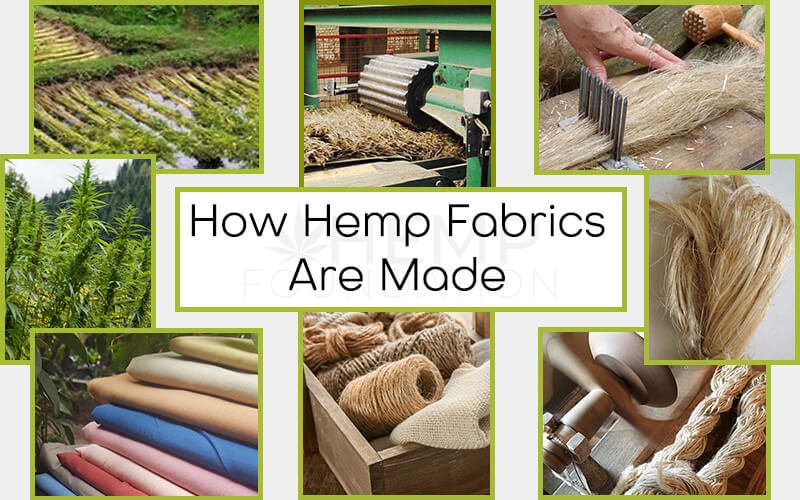
How Hemp Fabrics Are Made
Before we tell you how to make hemp fabric, let’s showcase a bit of hemp’s history.Hemp for Vict
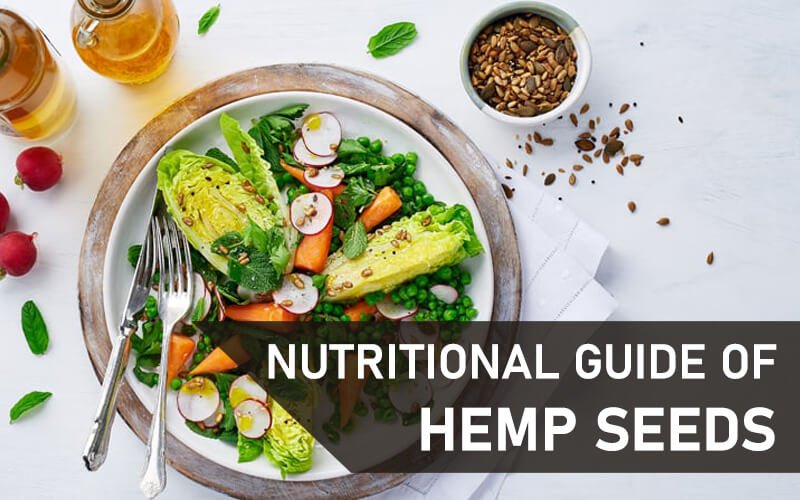
Hemp Seeds Benefits and Detailed Nutritional Guide
Let us start with a clarification: hemp or industrial hemp as it is also called is not a narcotic. T

