

Hemp Plastic Bags vs. Regular Plastic Bags: An Honest Comparison
If you walked into a grocery store today and picked up a standard plastic bag, you would likely use it for about 12 minutes. That is the global average “working life” of a polybag. From the checkout counter to your kitchen cupboard.

But that same bag will spend the next 500+ years in a landfill. And it won’t just sit there. It will slowly break down into toxic microplastics that enter our soil, our water, and eventually, our bloodstreams.
For decades, petroleum-based polymers were viewed as a logistical necessity. Today, they are a massive corporate liability.
Switching to hemp plastic isn’t just an environmental statement. It’s a strategic pivot. As global regulations tighten around single-use plastics, sticking with traditional polybags means anchoring your supply chain to a sinking ship.
But can hemp truly compete on performance and scale? Well, dive in as we compare the two head to head and look at what the data tell us.
The Basic Difference: The Material
To understand why one bag vanishes while the other lingers for centuries, we have to look at their birth stories.
Regular Plastic Bags are the children of the oil refinery. They are created through a violent industrial process called “cracking,” where natural gas or crude oil is heated to extreme temperatures to create ethylene. This process releases massive amounts of CO2 before the bag even reaches a warehouse. These bags are essentially “dead” matter, synthetic chains that nature does not recognize and therefore cannot “eat.”
Hemp plastic bags, on the other hand, are biological. They are crafted from the cellulose-rich fibers of the industrial hemp plant. This is where the magic of hemp packaging begins: in the soil of the Himalayas, not a smoke-belching refinery. As the hemp grows, it breathes in carbon, meaning the raw material for your bag actually helps repair the atmosphere.
When these bags reach the end of their life, they undergo “triggered degradation.” Unlike plastic, which fragments into smaller pieces of plastic, hemp-based polymers are recognized by microbes as food. Under composting conditions, they return to the earth as nutrient-rich organic matter.
Performance Showdown: Strength, Static, and Shelf-Life
One of the biggest hurdles in adopting sustainable hemp packaging is the “performance myth.” Many procurement heads fear that a bio-based bag will be flimsy or “melt” at the first sign of a monsoon. Let’s put the two side-by-side on the metrics that actually matter for your bottom line.
1. Strength and Durability
Traditional LDPE (Low-Density Polyethylene) bags are notorious for “necking” or stretching thin until they tear. Hemp cellulose, however, is nature’s carbon fiber. It is roughly 3.5 times stronger than traditional polypropylene. This means you can often use a thinner gauge of hemp packaging to achieve the same burst strength as a thicker plastic bag, reducing the total weight of your shipments.
2. The Static Factor
Have you ever noticed how black garments in plastic bags arrive covered in white lint? That’s because petroleum plastic is a magnet for static electricity.

Hemp products bags have a naturally low static charge. This keeps your products pristine and dust-free, ensuring that the “unboxing” experience is exactly what you intended, without the “clingy” frustration of synthetic films.
3. Shelf-Life and Stability
There is a fear that hemp plastic bags will start disappearing while sitting in a warehouse. This is a misunderstanding of material science. These bags are stable for 12 to 18 months in standard dry storage. They only begin to break down when exposed to the specific heat, moisture, and microbial activity of a compost environment. In fact, hemp’s natural breathability prevents the “greenhouse effect” inside the bag, which protects fabrics from the trapped moisture and mildew that often plague plastic-wrapped goods during long-sea freight.
Scaling the Future: Global Availability and Export Legality
It is obvious to question whether this is truly scalable. Can you get 50,000 bags by next Tuesday? Is it okay for exports to Europe or the US?
The answer is a resounding yes. The industrial hemp market including the hemp products bags in India is expanding at a CAGR of 20.2%. We are no longer in the “experimental” phase. These materials are designed to be “plug-and-play,” meaning they work on the same extrusion and blowing machinery as regular plastic.
From a legal standpoint, sustainable hemp packaging is your greatest asset. With the UK Plastic Tax, the EU’s Green Claims Directive, and India’s own Plastic Waste Management (PWM) rules, “virgin plastic” is becoming a legal liability. Using certified compostable hemp packaging ensures your exports sail through customs without the heavy “plastic taxes” that are now being levied on petroleum-based packaging globally.
The Elephant in the Room: Hemp Plastic Cost
Let’s be honest: if you look purely at the “per-bag” price on a spreadsheet, hemp plastic cost is currently higher than that of regular plastic, roughly 2.5x to 3x higher. This is primarily due to the massive, decades-old subsidies enjoyed by the oil industry and the relatively young infrastructure for hemp processing.
However, a smart CEO looks at the Total Cost of Ownership (TCO), not just the unit price.
The Counter-Argument: The “Hidden” Costs of Plastic
- Green Taxes: Governments are increasingly taxing non-recycled plastic content.
- EPR Fines: Extended Producer Responsibility (EPR) laws now hold you financially responsible for the “afterlife” of your plastic.
- Brand Damage: Modern consumers are vocal. A single viral video of your plastic packaging floating in an ocean can cost millions in lost brand equity.
When you factor in these costs, the hemp plastic cost actually begins to look like a bargain. It is a proactive investment in regulatory compliance. Paying a few rupees more today saves millions in fines and “reputation repair” tomorrow. This is the ROI of integrity.
What the Industry is Saying: Hemp Plastic Reviews
The sentiment in the fashion and consumer goods world is shifting rapidly. We are seeing a massive movement from “Plastic-Free” to “Bio-Based”
Customer feedback on hemp-based bags consistently highlights one theme: elevated quality.
One reviewer described their hemp bag as “very classy” with a “beautiful texture outside.” Another called it “beautiful, feels like a bespoke quality gift.” Others simply summed it up as “stylish and smooth,” or praised the “amazing quality” and durability after washing.
What stands out is the tactile experience. Plastic bags are crinkly and noisy. But hemp-plastic bags are described as smooth, substantial, and refined.
The material itself communicates care, intention, and quality even before the product is revealed.
But it isn’t just about aesthetics. Durability is another recurring theme. Customers frequently mention that hemp bags can “handle heavy loads without showing signs of damage.” They are described as “a bag that lasts.”
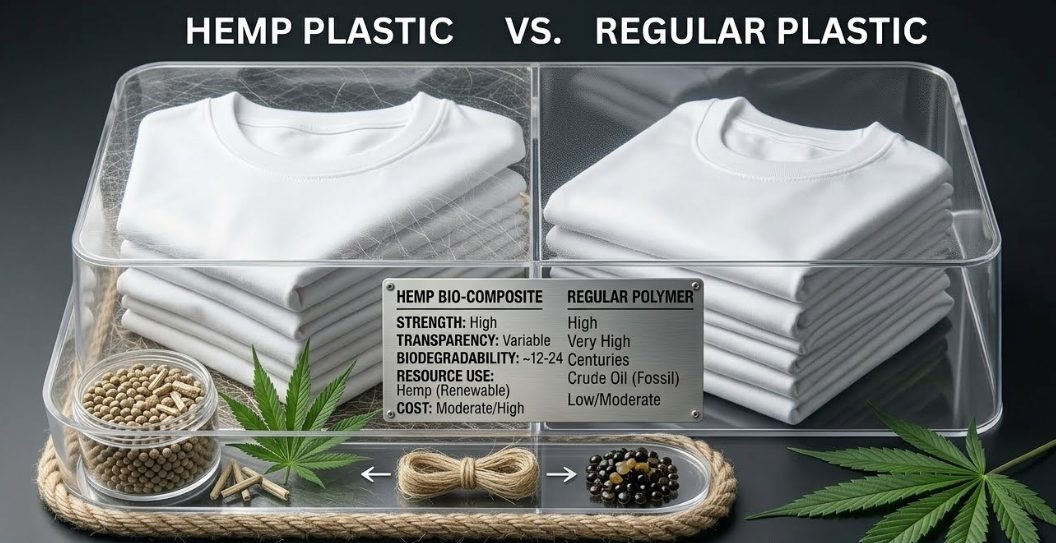
Head-to-Head Comparison
Here’s a quick look at the complete comparison of regular plastic bags vs. hemp plastic bags
The verdict is clear. Regular plastic is a relic of the 20th century, a material designed for a world that didn’t care about tomorrow. Hemp plastic bags are the material of the 21st century.
Experience the Hemp Revolution
Stop spending your time reading hemp plastic reviews and start testing the material yourself. Sustainable hemp packaging is more than just a box or a bag. It is an investment in the “soul” of your brand and the health of our planet.
Ready to compare for yourself? Request a quote today and feel the “hemp difference” in your own hands. Don’t just follow the future of packaging, hold it.
FAQs
1. Will hemp plastic bags affect the smell of my products?
Not at all. While raw hemp has a distinct earthy scent, the processed cellulose used in hemp plastic bags is virtually odorless and food-safe, ensuring your products smell exactly as they should.
2. Is the hemp plastic cost expected to go down soon?
Yes. As the Indian hemp market scales toward its USD 417 million projection by 2030, economies of scale will naturally drive down the hemp plastic cost, making it increasingly competitive with recycled plastics.
3. Are these bags really 100% compostable in India?
Absolutely. For sustainable hemp packaging to be legal in India, it must meet CPCB standards. Our products, for example, are designed to break down into organic compost without leaving any toxic residue or microplastics behind.

Vishal Vivek
Vishal Vivek is the Founder and CEO of Ukhi, a pioneering bio-materials company dedicated to ending plastic pollution by converting agricultural waste into high-performance compostable polymers. With a background in sustainable entrepreneurship and over a decade of technology experience, he leads Ukhi’s vision to create scalable, planet-positive material solutions. Previously, Vishal founded the Hemp Foundation, where he empowered more than 1,000 farmers and advanced sustainable livelihood initiatives. His work has been recognized through awards such as the HDFC Parivartan Grant and featured in leading publications like Forbes and Entrepreneur. Times Group recognized him as a legendary entrepreneur and published his biography in “I Did IT- Vol 2” alongside social pioneers like Bindeshwar Pathak (Sulabh International) and Anshu Gupta (Goonj). Vishal has authored more than 200 articles on sustainability and hemp, reflecting his deep expertise and advocacy for regenerative solutions. His commitment to grassroots impact led him to live in the remote mountains of Uttarakhand, where he immersed himself in the lives of marginal farmers, understanding their challenges and co-creating economic opportunities through hemp-based initiatives. A deeply passionate innovator, Vishal often draws inspiration from seemingly impossible achievements: “If Elon Musk can make rockets reusable, or Dashrath Manjhi can carve a path through a mountain with rudimentary tools, why can’t we eliminate the demon of single-use plastic while uplifting struggling farmers? We will make it happen—whatever it takes.” Ukhi is proud to be supported by premier institutions including IIT Guwahati, NSRCEL-IIM Bangalore, Indian School of Business (Hyderabad), Indian Council of Agricultural Research (ICAR Pusa), and the Indian Institute of Packaging. Vishal is committed to demonstrating that business can be a powerful catalyst for global environmental and social good. Connect with Vishal Vivek
Related Posts
The Complete Cycle of Hemp Oil Manufacturing
[vc_row][vc_column][vc_column_text]Before we go into hemp oil manufacturing, let’s set a backgroun
Hemp Plastic in India: What’s Available, Who’s Making It, and Where to Buy
When I tell people I’m building a business around hemp plastic in India, I usually get a very spec
Why N95 Face Mask Can Be Dangerous
[vc_row][vc_column][vc_column_text] Why You Should Avoid Wearing N95 Valved Face Mask [/vc_column_te

