

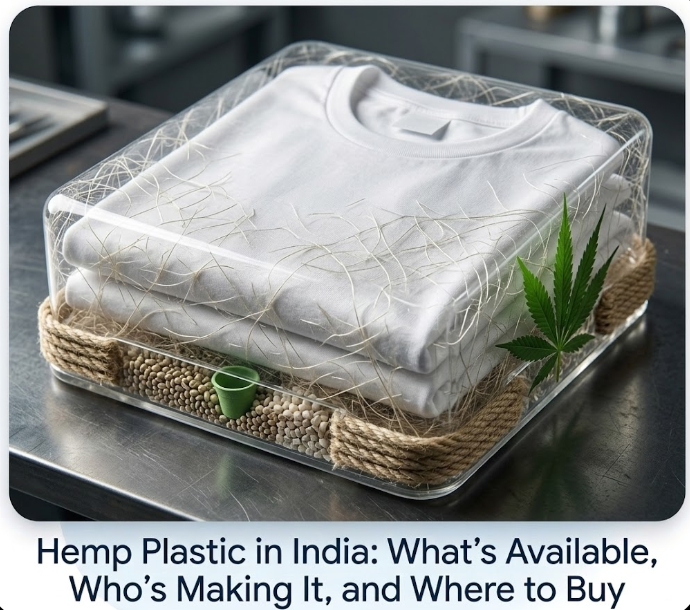
Hemp Plastic in India: What’s Available, Who’s Making It, and Where to Buy
When I tell people I’m building a business around hemp plastic in India, I usually get a very specific look. A mix of skepticism and genuine confusion. To most, hemp plastic sounds like a futuristic lab experiment whispered about in Silicon Valley boardrooms. It is certainly not something happening here.
And I get it.
In India, we’ve finally embraced hemp textiles and the nutritional powerhouse of hemp seeds. But when people think about hemp plastic in India? It is often dismissed as “years away.”
The reality, however, is different. Hemp plastic isn’t a “new” or “niche” foreign trend. In fact, it’s quite the opposite. The Indian industrial hemp market, which includes the fiber for manufacturing hemp plastics, has matured far beyond seeds and textile. In 2023, the sector generated USD 115.9 million. By the end of this decade, it’s projected to be worth USD 417.6 million.

We are currently scaling at a CAGR of 20.2%. The material revolution isn’t “coming”, it has already arrived. So, if you’re still viewing hemp plastic as a distant foreign dream, you’re missing out on a multi-million dollar Indian reality unfolding in our own backyard.
To help you navigate this transition, I’ve put together this guide to walk you through the essentials of hemp plastics in India. Below, I’ll cover:
- What are hemp plastics?
- Who is making plastic hemp products in India?
- How can you integrate hemp plastic into your supply chain today?
Let’s dive right in.
What is Hemp Plastic?
At its core, hemp plastic is a biological polymer. While traditional plastics are long chains of synthetic polymers derived from fossil fuels, hemp plastic uses the cellulose found in the industrial hemp plant (Cannabis sativa).
But the best part? It is hemp’s “carbon-negative” footprint. As the hemp plant grows, it absorbs massive amounts of CO2 through carbon sequestration. This carbon remains trapped within the hemp products that we manufacture, effectively turning a simple shipping mailer into a carbon sink.
Hemp plastic isn’t just a “green” alternative. It is a performance upgrade. It is roughly 3.5 times stronger than traditional polypropylene.
- Exceptional Strength
It is 3.5x stronger and significantly stiffer than traditional polypropylene. This allows for more durable finished products.
- Lightweight Efficiency
Hemp composites are much lighter than conventional plastics and even glass fibers. This is a game-changer for reducing fuel consumption in the automotive sector.
- Superior Heat Resistance
Hemp plastic has a higher thermal stability than many petroleum-based plastics. With that, hemp plastic can maintain its structural integrity under much higher temperatures.
- Natural UV Resistance
The material is inherently resistant to ultraviolet light. That ensures hemp products in India don’t become brittle or discolored when exposed to the sun.
- Non-Toxic Composition
Unlike traditional polymers that leach harmful chemicals like BPA, hemp-based materials are non-toxic. They are thus safer for both food contact and skin.
So, if you are looking for hemp plastic for sale, the draw is more than just the green tag. It is usually its incredible versatility across various manufacturing sectors.
Hemp Plastic vs. Regular Plastic: The Showdown
Here’s a quick break down of how hemp plastic in India compares to regular plastic
How It’s Made: From Himalayan Soil to High-Tech Resin
Before you go about exploring options on an industrial hemp products list or start speaking to hemp plastic bottles manufacturers you must understand the journey from soil to resin:
- Cultivation: It starts with industrial hemp (low THC) grown by our farmer clusters in Uttarakhand.
- Decortication: We separate the tough outer fiber from the woody “hurds” or shives inside the stalk.
- Cellulose Extraction: The fibers are processed to extract cellulose—the building block of all plastics.
- Compounding: This cellulose is mixed with other bio-based polymers (like PLA or PHA) to create “pellets” or resins.
- Molding: These pellets are fed into standard injection molding or blow-molding machines (the same ones used for regular plastic!) to create finished products.
What Hemp Plastics are Available in India?
One of the biggest mistakes buyers make is thinking all “Hemp Plastic” is identical. In reality, there is a spectrum of materials depending on your needs. Here are the hemp plastic in India options you can consider:
1. Hemp Cellulose Nanofibers (CNF)
This is the high-performance stuff. It’s used to create extremely thin, strong, and transparent films. If you need a high-end clear wrap that won’t tear, CNF is the future.
2. Hemp-PLA Composites
This is the most common “entry-level” hemp plastic. It blends hemp fiber with Polylactic Acid (usually from corn). It’s rigid, durable, and perfect for 3D printing filaments or disposable cutlery. It is also widely used by hemp plastic bottles manufacturers.
3. Hemp-Based Thermoplastics
These are engineered to replace traditional Polypropylene (PP) or Polyethylene (PE). They are often used in automotive interiors because they are significantly lighter than traditional plastics, which helps with fuel efficiency.
4. 100% Bio-Based Hemp Plastic
The “Holy Grail.” This material uses zero petroleum and is 100% compostable. It is increasingly available for items like coffee lids, straws, and cosmetic jars.
5. Hemp Fiber Reinforced Polymers (HFRP)
Used for heavy-duty industrial applications. Think of it like “nature’s carbon fiber.” It’s used for building panels and structural components where you need high strength but low weight.
Who’s Making Hemp Plastic in India?
While the market is growing, only a few players have the “Seed-to-Shelf” infrastructure to provide consistent, high-quality material. Here are the top companies you should know:
Hemp Foundation

- Year of Establishment: 2017
- Primary Location: Farms in Uttarakhand & offices in Haryana
That’s us. We focus on social-impact hemp. We bridge the gap between thousands of small-holder farmers in the Himalayas and the global industrial demand for hemp-based resins and composites.
Ukhi

- Year of Establishment: 2019
- Primary Location: Faridabad, Haryana
Our sister brand, which specializes in the high-tech R&D of ag-waste biopolymers, including biogranules for hemp packaging in India.
BOHECO (Bombay Hemp Company)

- Year of Establishment: 2013
- Primary Location: Mumbai, Maharashtra
One of the pioneers in the Indian hemp space, primarily focusing on wellness but expanding into industrial biomass.
NHempCo (National Hemp Co.)

- Year of Establishment: 2016
- Primary Location: Bengaluru, Karnataka
The National Hemp Co. focuses on creating a large-scale hemp ecosystem in India, including R&D into bioplastics and industrial fibers.
Indian Hemp Store

- Year of Establishment: 2017
- Primary Location: Dehradun, Uttarakhand
If you are looking for immediate, small-scale hemp plastic for sale, the Indian Hemp Store (based in Dehradun) offers raw pellets that a hemp plastic bottles manufacturer would need to start prototyping sustainable containers and general plastic goods.
Where and How to Buy Hemp Plastics in India
You no longer have to import these materials from Europe or North America. You can buy hemp plastic online and offline in India with relative ease, but you need a discerning eye. “Hemp-looking” isn’t the same as “Hemp-performing.”
So here are the 5 things you need to look out when you are buying hemp plastics in India:
1. Check the “Bio-Content” Percentage
Some brands sell “Hemp Plastic” that is only 5% hemp and 95% regular plastic. If it isn’t at least 20-30% bio-based, it’s just greenwashing.
2. Verify Composting Certifications
For India, look for IS/ISO 17088 or CPCB approval. If they can’t show you the certificate, the bag won’t disappear in the compost pile.
3. Mechanical Strength vs. Thickness
Don’t just look at the price per kg. A high-quality hemp composite can be thinner while being stronger than thick, cheap plastic, saving you money on shipping weight.
4. Odor and Texture
Genuine hemp plastic has a slight, pleasant “earthy” scent. If it smells like heavy chemicals, check the MSDS (Material Safety Data Sheet) for hidden additives.
5. Supply Chain Transparency
Can the manufacturer tell you which farm cluster the hemp came from? At Hemp Foundation, we can point to the exact village in Uttarakhand. Also, make sure the brand you pick can meet your demands not just today, but in the future too.
Hemp Plastics Aren’t a Foreign Dream. They are an Indian Reality
The era of “Made in India” petroleum plastic is coming to a close. Whether you are looking for compostable garment bags for your fashion brand or high-strength components for electronics, hemp is the answer. We have the farmers, we have the technology, and we have the market growth to lead the world.
Don’t wait for your competitors to make the switch. Start your “Plastic Reset” today. Whether you need raw resins, finished hemp packaging in India, or a custom industrial solution, we are here to guide you from the soil up.
Ready to slay the plastic demon? Request a quote for hemp plastic from Hemp Foundation here.
Frequently Asked Questions
1. Is hemp plastic more expensive than regular plastic?
The raw material cost can be higher, but because hemp is 3.5x stronger, you can often use less material to make the same product. This reduces the weight and can save you money on shipping and logistics.
2. Do I need new machines to manufacture with hemp?
No. Hemp plastic pellets are designed to be “drop-in” ready. They work with the same injection molding and blow-molding machines you already use for traditional plastic.
3. Does hemp plastic actually biodegrade?
Yes. While regular plastic lasts for centuries, 100% bio-based hemp plastic can compost in 3 to 6 months. Even the industrial blends are better for the planet because they can be recycled up to 7 times.

Vishal Vivek
Vishal Vivek is the Founder and CEO of Ukhi, a pioneering bio-materials company dedicated to ending plastic pollution by converting agricultural waste into high-performance compostable polymers. With a background in sustainable entrepreneurship and over a decade of technology experience, he leads Ukhi’s vision to create scalable, planet-positive material solutions. Previously, Vishal founded the Hemp Foundation, where he empowered more than 1,000 farmers and advanced sustainable livelihood initiatives. His work has been recognized through awards such as the HDFC Parivartan Grant and featured in leading publications like Forbes and Entrepreneur. Times Group recognized him as a legendary entrepreneur and published his biography in “I Did IT- Vol 2” alongside social pioneers like Bindeshwar Pathak (Sulabh International) and Anshu Gupta (Goonj). Vishal has authored more than 200 articles on sustainability and hemp, reflecting his deep expertise and advocacy for regenerative solutions. His commitment to grassroots impact led him to live in the remote mountains of Uttarakhand, where he immersed himself in the lives of marginal farmers, understanding their challenges and co-creating economic opportunities through hemp-based initiatives. A deeply passionate innovator, Vishal often draws inspiration from seemingly impossible achievements: “If Elon Musk can make rockets reusable, or Dashrath Manjhi can carve a path through a mountain with rudimentary tools, why can’t we eliminate the demon of single-use plastic while uplifting struggling farmers? We will make it happen—whatever it takes.” Ukhi is proud to be supported by premier institutions including IIT Guwahati, NSRCEL-IIM Bangalore, Indian School of Business (Hyderabad), Indian Council of Agricultural Research (ICAR Pusa), and the Indian Institute of Packaging. Vishal is committed to demonstrating that business can be a powerful catalyst for global environmental and social good. Connect with Vishal Vivek
Related Posts
What Can Hemp Plastic Replace? A Room-by-Room Guide
As plastic pollution continues to plague the planet, the search is on for alternatives. Hemp plastic

Hemp Food Boxes Could Shrink Metro Cities’ Carbon Footprint
Food delivery services have exploded in recent years, especially in metro cities. Most metro dweller

Hemp Market Trends Worth Tracking In 2022
[vc_row][vc_column][vc_column_text] Hemp, aka industrial hemp, has been at the center of market anal

