

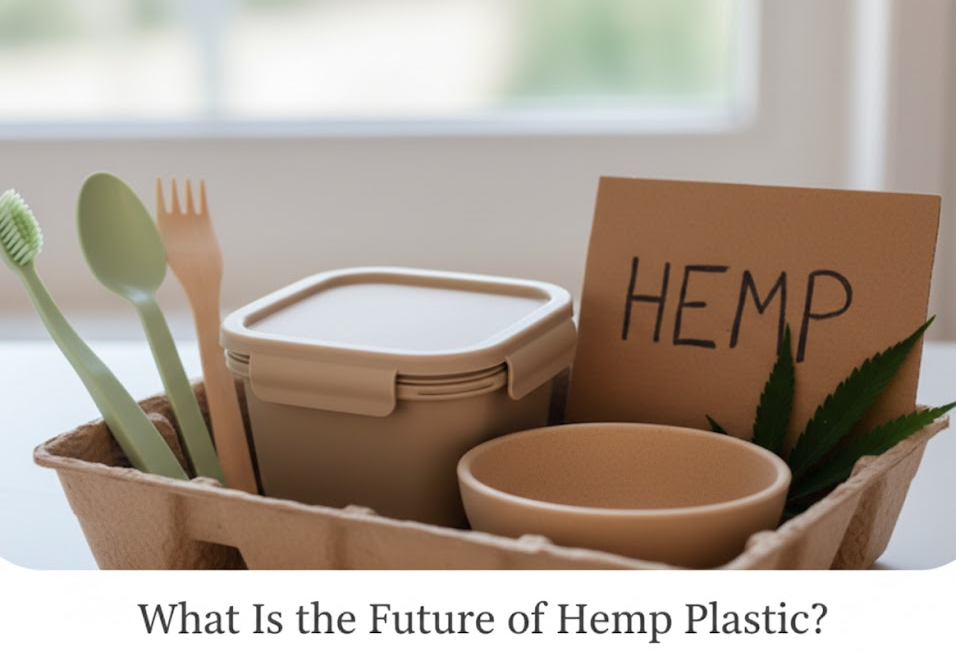
What Is the Future of Hemp Plastic?
There is an uncomfortable fact that we are learning to live with. Most of the plastic ever made still exists on our planet today. It is in the soil, the oceans, and the food chain that sustains us.
So what’s the alternative?
Biodegradable alternatives to plastics have emerged as real solutions. We’re at a point where hemp plastic is no longer a novelty. It’s stepping up as a serious, industrial-scale answer to the plastic crisis.
But why is this happening now? And what is the future of hemp plastics? I will break it down, step by step.
Where Is Hemp Plastic Used Today?
Hemp plastic is a new generation of material made by combining fibers from the industrial hemp plant with a polymer. The polymer can be plant-based or petroleum-based.
The composite material is strong, lightweight, and can break down in the right conditions.
Commonly, you can find hemp bioplastics in:
Automotive Industry
What many do not know is that hemp plastic is already being used by several European automakers. BMW, Porsche, Peugeot, and Mercedes-Benz are already using hemp composites in their vehicles.
Porsche’s 718 Cayman GT4 uses body panels made from a hemp and flax composite. It offers similar stiffness to carbon fiber, but at a lower cost and weight.
Forvia NAFILean is a lightweight biocomposite material for automotive interiors. It combines hemp with recycled polypropylene (PP) to drastically cut weight and CO₂ emissions.
It is used in 13 million vehicles on the road, including models from Renault, Alfa Romeo, and Land Rover.
Packaging
Major European companies like PAPACKS and The Hemp Plastic Company are producing hemp fiber trays, containers, and films.
These molded products use the existing manufacturing lines.
The demand for hemp plastics in Europe is due to a ban on single-use plastics. The “bags” segment alone is projected to be nearly half the hemp packaging market by 2025.

From Freepiks
Other Real-World Uses
Hemp plastic can be used to make kitchenware, toys, and 3D printing filaments. It is a durable and versatile material for building and construction.
Roofing tiles, wall panels, and composite boards made of hemp plastics are widely available.
How Fast Is the Hemp Plastic Market Growing?
The hemp plastic market is experiencing robust growth. The broader industrial hemp market is projected to see CAGRs around 22-27% due to its rapid adoption as an alternative to traditional plastics.
Let’s look at some numbers:
Market Size:
- In 2024, the hemp plastic market was valued at about $11 billion.
- By 2029, forecasts put it at $30 billion 2029.
- The packaging segment alone is aiming for $6 billion by that time.
That is a CAGR of over 22% annually. By the end of the decade, the growth in hemp plastic production and sale will far outstrip traditional plastics and other bio-based materials.
Regional Leaders:
The US, Canada, France, Germany, and the UK are at the forefront. Growth here is driven by strong environmental policy and automotive innovation.
The Asia-Pacific, particularly China and Japan, is a rising force. There is expanding cultivation in this region and innovative research as plastic bans spread.
What is driving this growth?
There is a growing urgency to find sustainable alternatives to conventional plastic. The change in legislation in different countries is leading to the rapid adoption of hemp plastic and changing it into a mainstream packaging material.
There is also growing pressure from consumers. The young generation in particular are very conscious of the economic impact of consumption. Several brands are eager to prove they are serious about being eco-friendly.
So, what does this mean for the industry?
The growth is not just a forecast. It’s being validated by growing demands, capacity expansion, and investment in research. At Hemp Foundation, leading sustainable packaging manufacturers in India, we have seen firsthand the rising demand from different brands.
Can Hemp Plastic Replace Conventional Plastics?
The short answer? Hemp bioplastic is already replacing conventional plastics in key sectors.
It outperforms conventional plastics in strength and durability leading to rapid adoption.
Technical Performance:
- Strength-to-weight: Hemp composites can be up to 5x stiffer and 2.5x stronger than polypropylene.
- Lightweight: Hemp fibers are significantly lighter than glass fiber (1.5 g/cm³ vs 2.54 g/cm³), making them ideal for car doors or panels.
- Vibration absorption: It is superior to carbon fiber. Hemp plastic panels help in noise reduction in vehicles.

From Freepiks
Best-Fit Applications:
- Automotive (lightweight panels and trims that increase EV range and lower emissions).
- Packaging (biodegradable alternatives for bags, trays, containers).
- Consumer goods (products where eco-branding and strength both matter).
But are there any limitations to its adoption?
Scaling up production and reducing per-unit cost is a bottleneck. As both these hurdles are overcome, we can expect hemp plastic to move to mainstream applications.
What Needs To Happen Next For Hemp Plastic To Succeed?
Turning a promise into reality requires more than just good intentions. It takes a whole ecosystem working together. Here’s what will move the needle fastest:
Policy Support
Government initiatives are key to the broader adoption of hemp plastics. Tax credits for the use of sustainable materials and streamlining hemp farming regulations will go a long way to help growth.
Investment
More funding is essential for the hemp plastic sector to grow. Investments are necessary for building large-scale processing plants and for supporting R&D into even better composites.
Industry Partnerships
Just like the automotive sector, other industries need to look into the possibilities offered by hemp plastic. Greater collaboration is the key to driving growth.
Global Standards
Unified standards will help buyers, sellers, and consumers understand the hemp content. At the present moment, many manufacturers are indulging in green washing with as little as 10% hemp fiber in composite materials.
These steps are easy to achieve, but if only all stakeholders put in equal effort. We can turn today’s potential into tomorrow’s normal if only we try hard enough.
Time Is Of The Essence
Here’s the thing – there is a rare window where technology and compulsions have made change possible and inevitable.
At the current moment, rapid growth, policy momentum, and technological breakthroughs are all aligning. These factors are helped along by public sentiment.
Double-digit growth of the hemp plastic market is possible only if we keep pushing forward. The demand and the supply sides must move equally to make it possible. If we wait, we risk ruining the planet.
Frequently Asked Questions
Will hemp plastic replace traditional plastic in the future?
Without any doubt, hemp bioplastic is the future of sustainability. Hemp plastic might not replace all conventional plastic in the next decade or two, but it has the potential to replace all single-use plastic within a few years.
How long does hemp plastic take to decompose?
Hemp plastic is biodegradable. It decomposes in an industrial compost within three months. It might take up to a year if you put it in your backyard. The presence of soil microbes and high humidity speeds up the process.
Is hemp plastic a good investment for the future?
It is widely forecast that the hemp plastic market will see 20% – 25% annual growth between now and 2035. There is a rising demand from multiple sectors, especially automotive and packaging.
Can hemp plastic be used for everyday products?
Hemp bioplastic can be used to package everyday products. Ideal uses include cutlery, bottles, containers, food wrap, compostable bags, and industrial pouches.
How strong is hemp plastic?
Processed hemp fibers have tensile strength of around 475 megapascals. It is stronger than mild steel. It is also more durable than plastics.

Vishal Vivek
Vishal Vivek is the Founder and CEO of Ukhi, a pioneering bio-materials company dedicated to ending plastic pollution by converting agricultural waste into high-performance compostable polymers. With a background in sustainable entrepreneurship and over a decade of technology experience, he leads Ukhi’s vision to create scalable, planet-positive material solutions. Previously, Vishal founded the Hemp Foundation, where he empowered more than 1,000 farmers and advanced sustainable livelihood initiatives. His work has been recognized through awards such as the HDFC Parivartan Grant and featured in leading publications like Forbes and Entrepreneur. Times Group recognized him as a legendary entrepreneur and published his biography in “I Did IT- Vol 2” alongside social pioneers like Bindeshwar Pathak (Sulabh International) and Anshu Gupta (Goonj). Vishal has authored more than 200 articles on sustainability and hemp, reflecting his deep expertise and advocacy for regenerative solutions. His commitment to grassroots impact led him to live in the remote mountains of Uttarakhand, where he immersed himself in the lives of marginal farmers, understanding their challenges and co-creating economic opportunities through hemp-based initiatives. A deeply passionate innovator, Vishal often draws inspiration from seemingly impossible achievements: “If Elon Musk can make rockets reusable, or Dashrath Manjhi can carve a path through a mountain with rudimentary tools, why can’t we eliminate the demon of single-use plastic while uplifting struggling farmers? We will make it happen—whatever it takes.” Ukhi is proud to be supported by premier institutions including IIT Guwahati, NSRCEL-IIM Bangalore, Indian School of Business (Hyderabad), Indian Council of Agricultural Research (ICAR Pusa), and the Indian Institute of Packaging. Vishal is committed to demonstrating that business can be a powerful catalyst for global environmental and social good. Connect with Vishal Vivek
Related Posts

How Hemp Can Help Fight Global Warming
Global warming and climate change have become everyday words in contemporary public discourse. Neith
7 Major Fibers & Textiles In The World And Their Carbon Footprint
Ever considered how your clothes affect the environment? All clothes are made of fibers, but h
How Hemp Can Save Our Planet from Plastic Pollution
Hemp plastic can replace plastic and save our planet from this environmental menace. Here are some o

