

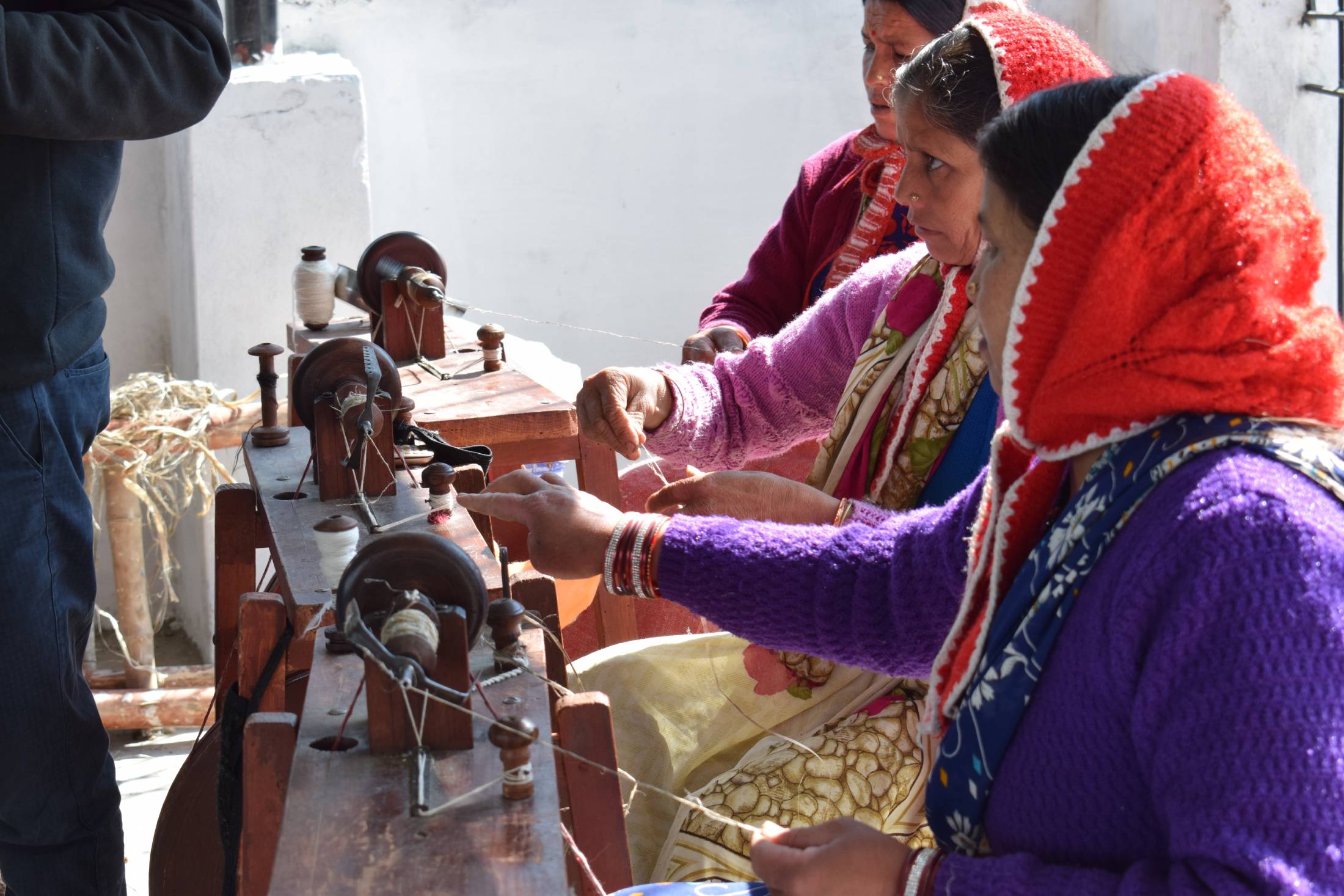
Mobilizing SHGs
Strengthening Women’s Role In Rural Economy
Nobel Peace Prize winner Muhammad Yunus is the pioneer of the self-help group (SHG) initiative. His microfinance program for the economic empowerment of poor rural women of Bangladesh created this model of voluntary collectives of 10-20 members.
What These Terms Mean
The National Bank for Agriculture and Rural Development (NABARD) started the SHG program in India in 1986-1987. The NABARD initiatives include both women and men in rural India. Many non-governmental organizations also run SHGs, focused primarily on women.
SHGs In Uttarakhand & Their Importance
The National Rural Livelihood Mission (NRLM), Government of India, supports 30,821 SHGs in Uttarakhand. There are additional SHGs supported by civil society organizations, both nonprofit and for-profit..
THemp Foundation has also been actively mobilizing women’s SHGs in Uttarakhand, linking them to hemp farming and hemp-based agro-industries. This initiative has a number of advantages.
- The primary objective of all SHGs is to transform women’s unpaid labor into paid economic activity. Through organizing women into SHGs, Hemp Foundation is linking the rural women of Uttarakhand with the transforming rural economic process.
- This economic empowerment also has a number of sociocultural ramifications that significantly change women’s position in families and communities. There are several studies that capture such stories of change.
- Hemp Foundation has also been instrumental in enabling women to emerge in autonomous decision-making roles in their families and communities. Through this ongoing process, we are facilitating a movement towards a more egalitarian, gender-just society.
How SHGs Are Empowering Women
Mobilizing women into SHGs is only the first step of the empowerment process. Several other measures constitute the entire process.
- The formation of SHGs in itself creates a space for women to meet on their own beyond their everyday familial responsibilities.
- We build women’s entrepreneurial capacity through a variety of training. These training are focused on occupational skills and marketing capabilities.
- We involve the SHGs in income-generating activities, thereby creating opportunities for the members to earn an income of their own. Women’s labor gets integrated into the rural economic process through this.
- This is a radical change from women’s participation in agriculture, as women’s labor in agriculture remains unrecognized. The SHG process changes women’s positions from derecognized participation in the labor force to a recognized one.
- The marketing skills training programs facilitate women’s exposure to the global hemp market. By linking rural women from Uttarakhand’s farming families with the global hemp market, we are changing women’s role in the social fabric of the region.
- As emerging entrepreneurs, SHG members are gaining a voice in family and community decisions. This is a new role for them as traditional systems did not encourage public spaces for women.
- Through women’s integration into agro-industries based on hemp products, we are reducing their dependence on marginal agricultural production. With this increase in family income, there is an overall improvement in the standard of living of rural families.
Looking Ahead
We at Hemp Foundation believe that our SHG mobilization initiative will soon reflect far-reaching changes in the overall development of the rural fabric of Uttarakhand, especially with reference to children’s education.

Vishal Vivek
Vishal Vivek is the Founder and CEO of Ukhi, a pioneering bio-materials company dedicated to ending plastic pollution by converting agricultural waste into high-performance compostable polymers. With a background in sustainable entrepreneurship and over a decade of technology experience, he leads Ukhi’s vision to create scalable, planet-positive material solutions. Previously, Vishal founded the Hemp Foundation, where he empowered more than 1,000 farmers and advanced sustainable livelihood initiatives. His work has been recognized through awards such as the HDFC Parivartan Grant and featured in leading publications like Forbes and Entrepreneur. Times Group recognized him as a legendary entrepreneur and published his biography in “I Did IT- Vol 2” alongside social pioneers like Bindeshwar Pathak (Sulabh International) and Anshu Gupta (Goonj). Vishal has authored more than 200 articles on sustainability and hemp, reflecting his deep expertise and advocacy for regenerative solutions. His commitment to grassroots impact led him to live in the remote mountains of Uttarakhand, where he immersed himself in the lives of marginal farmers, understanding their challenges and co-creating economic opportunities through hemp-based initiatives. A deeply passionate innovator, Vishal often draws inspiration from seemingly impossible achievements: “If Elon Musk can make rockets reusable, or Dashrath Manjhi can carve a path through a mountain with rudimentary tools, why can’t we eliminate the demon of single-use plastic while uplifting struggling farmers? We will make it happen—whatever it takes.” Ukhi is proud to be supported by premier institutions including IIT Guwahati, NSRCEL-IIM Bangalore, Indian School of Business (Hyderabad), Indian Council of Agricultural Research (ICAR Pusa), and the Indian Institute of Packaging. Vishal is committed to demonstrating that business can be a powerful catalyst for global environmental and social good. Connect with Vishal Vivek
Related Posts

Hemp Oil Benefits and Nutritional Analysis
[vc_row][vc_column][vc_column_text]Hemp oil is a marginally confusing term, for it can mean either h
Can Hemp make India rich?
Can legal cannabis make India rich? Imagine a plant. A plant that has been misunderstood, maligned,
A Miracle Drug: Can Hemp Cure Cancer?
[vc_row][vc_column][vc_column_text] Have you stumbled across this article while browsing the web for

