

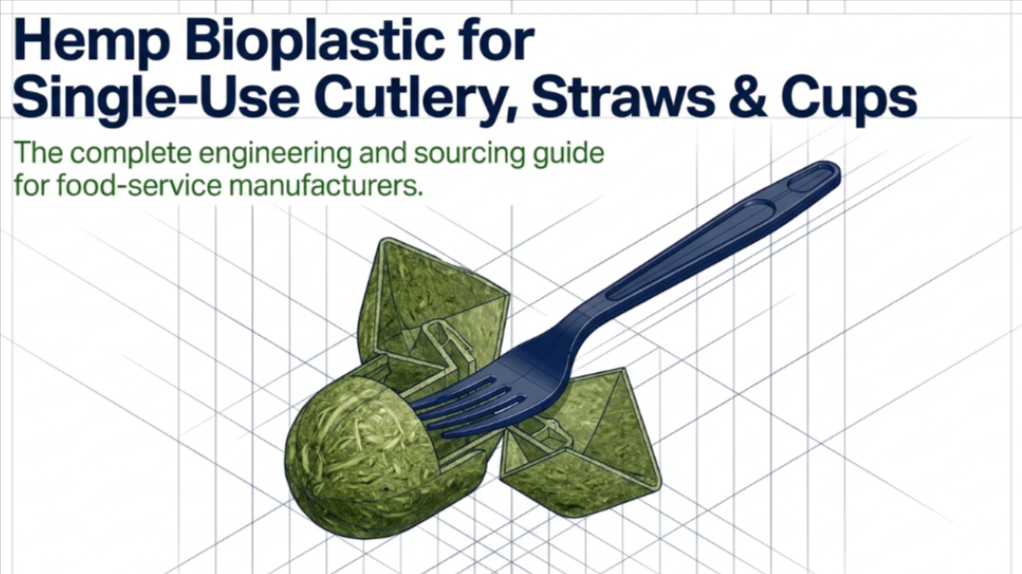
Hemp Bioplastic for Single-Use Cutlery, Straws & Cups
Every year, in India, around 5.5 million tons of single-use plastic items are thrown away, just after a few minutes of use. These then remain in the environment for centuries. Hemp bioplastics have now emerged as a worthy alternative to traditional plastics.
But not all hemp bioplastics may meet the demands of everyday food-service products.
So, here’s what you should know before choosing hemp bioplastic for single-use cutlery, straws and cups.
Why Single-Use Items Are Moving to Hemp Bioplastic?
Several single-use plastic items (like specified plastic cutlery, straws, cups and even glasses) are banned in India. These restrictions make material selection an important consideration for food-service businesses.

Hemp bioplastic cutlery is considered a worthy replacement to traditional plastic cutlery because it is a more sustainable and eco-conscious alternative. Made using agricultural waste as raw material, hemp bioplastic cutlery also has benefits such as:
- Easy processing as most hemp granules work with injection moulding or extrusion
- Product strength as hemp-filled compounds offer the required stiffness for food-service use
- Flexible applications as different formulations are available for cutlery, straws and cups
Note: Hemp content alone does not make a product biodegradable or compostable. The complete formulation and its disposal route determine its environmental performance.
Is Hemp Bioplastic Safe for Straws, Cups and Cutlery?
In most cases, yes. Hemp-based materials can be used for food-contact applications.
But it depends on the complete formulation and the finished product. Just the presence of hemp doesn’t make single-use bioplastic granules food-safe.
The polymer, additives, colourants and processing conditions all matter. So, look for food-contact test reports for the specific grade and intended use. Temperature is another important consideration. A material that performs well with cold drinks may soften or deform when exposed to hot tea, coffee or soup.
So, when considering hemp bioplastic cutlery, check intended temperature range, contact duration and resistance to hot liquids too.
Note: For sale and use in India, compliance with applicable FSSAI requirements and other food-contact regulations is also a must.
Which Hemp Granule Grade Suits Each Single-Use Cutlery Category?
Not every single-use tableware needs the same type of material
- Hemp plastic straws, for example, need to retain their shape during use.
- Compostable cutlery, like spoons/forks, need sufficient stiffness to handle food.
- Hemp bioplastic cups, on the other hand, must resist deformation and leakage.
Here are the different grades of hemp granules you can choose from, based on the intended use:
The right grade depends on the polymer system, hemp content and manufacturing process. Knowing how hemp plastic products are manufactured helps understand why compounds designed for one process often don’t work for another.
Compostability Standards for Food-Service Items
If you are looking for compostable cutlery, not all single-use bioplastic granules would fit your needs. So, look for evidence that the complete formulation meets the relevant standard. Some of the standards and certification schemes worth checking are:
IS/ISO 17088
Specifies requirements for plastics labelled as compostable under the standard’s defined testing conditions.
EN 13432
European requirements for packaging recoverable through industrial composting and biodegradation.
ASTM D6400
A US standard for plastics designed for aerobic composting in municipal/industrial facilities.
ASTM D6868
Addresses compostable end products with plastics/polymers as coatings or additives
BPI certification
A third-party certification programme for eligible products assessed against applicable compostability requirements. This is not itself a technical standard.
OK compost INDUSTRIAL
A certification scheme for products assessed for industrial composting under specified conditions.
Important: Home and commercial compostability are not the same, so check how the two are classified and which one you need.

Also, compostable products still need appropriate collection and treatment systems. Do not describe hemp-based products as compostable solely because they contain plant material.
Hemp vs PLA and Paper for Single-Use Tableware
Hemp is not the only alternative to conventional fossil fuel-based plastic. So here’s how hemp plastic tableware compares to PLA-based compounds and paper products:
Hemp-filled formulations offer a balance of renewable content, product design and branding potential. However, hemp may not be universally suitable for every use case. A life-cycle assessment and a comparison of actual unit costs provide a stronger basis for choosing.
Sourcing Hemp Granules for Manufacturing Single-Use Cutlery
The hemp granules you choose impact product quality, manufacturing efficiency and the credibility of environmental claims. So, first decide what kind of hemp bioplastic cutlery you want to produce.
Then based on whether you need hemp plastic straws, cups, or other tableware, explore materials. At Hemp Foundation, our team can help you find the granules for your application.
Reach out to our team to discuss manufacturing needs and samples.
FAQs
How much does hemp bioplastic cost compared with conventional plastic?
Traditional plastic costs ₹80–₹150 per kg, but for hemp-based single-use bioplastic granules you may have to shell out ₹150–₹400 per kg. While the upfront cost for the latter is higher, it often pays off through environmental benefits, regulatory compliance, and a stronger brand image among sustainability-conscious customers.
Can hemp bioplastic cutlery be customised for branding purposes?
Yes, hemp plastic tableware can be customised with desired logos, colours and prints. Though customisation depends on the formulation, mould design, surface finish and marking method. Also, check the minimum order quantity for customised bioplastic products.
What is the minimum order quantity for hemp granules?
There’s no fixed minimum order quantity. It depends on the material grade, packaging and customisation requirements. It’s usually better to start with samples and then move to a pilot batch before placing a bulk order.
How do I check whether a supplier can maintain consistent quality?
Ask for batch-specific documents, clear product specifications and details of their quality checks. For repeat orders, compare melt flow, dimensions, mechanical properties and appearance across batches.
Can hemp-based biodegradable straws, cups, and other cutlery be exported?
Yes, hemp bioplastic cutlery can be exported if it meets the destination country’s requirements for compostability, biodegradability, and food safety.

Vishal Vivek
Vishal Vivek is the Founder and CEO of Ukhi, a pioneering bio-materials company dedicated to ending plastic pollution by converting agricultural waste into high-performance compostable polymers. With a background in sustainable entrepreneurship and over a decade of technology experience, he leads Ukhi’s vision to create scalable, planet-positive material solutions.Previously, Vishal founded the Hemp Foundation, where he empowered more than 1,000 farmers and advanced sustainable livelihood initiatives. His work has been recognized through awards such as the HDFC Parivartan Grant and featured in leading publications like Forbes and Entrepreneur. Times Group recognized him as a legendary entrepreneur and published his biography in “I Did IT- Vol 2” alongside social pioneers like Bindeshwar Pathak (Sulabh International) and Anshu Gupta (Goonj).Vishal has authored more than 200 articles on sustainability and hemp, reflecting his deep expertise and advocacy for regenerative solutions. His commitment to grassroots impact led him to live in the remote mountains of Uttarakhand, where he immersed himself in the lives of marginal farmers, understanding their challenges and co-creating economic opportunities through hemp-based initiatives.A deeply passionate innovator, Vishal often draws inspiration from seemingly impossible achievements: “If Elon Musk can make rockets reusable, or Dashrath Manjhi can carve a path through a mountain with rudimentary tools, why can’t we eliminate the demon of single-use plastic while uplifting struggling farmers? We will make it happen—whatever it takes.”Ukhi is proud to be supported by premier institutions including IIT Guwahati, NSRCEL-IIM Bangalore, Indian School of Business (Hyderabad), Indian Council of Agricultural Research (ICAR Pusa), and the Indian Institute of Packaging.Vishal is committed to demonstrating that business can be a powerful catalyst for global environmental and social good.Connect with Vishal Vivek
Related Posts
Why Should You Be Ditching the Cotton Face Mask Trend
As you step out of your house, donning a cotton face mask, a child somewhere in East Asia is forced
Hemp Textile Market, Growth, Outlook and Other Trends
Hemp: A natural fiber made from the Cannabis sativa plant is increasingly being used in fashion as a

Minnesota Becomes The First US State To Approve Hemp Seed Meal As Feed, Green Signals Market Expansion Of Hemp
In a milestone development, hemp seed meal has been approved for use as feed for laying hens by the

