

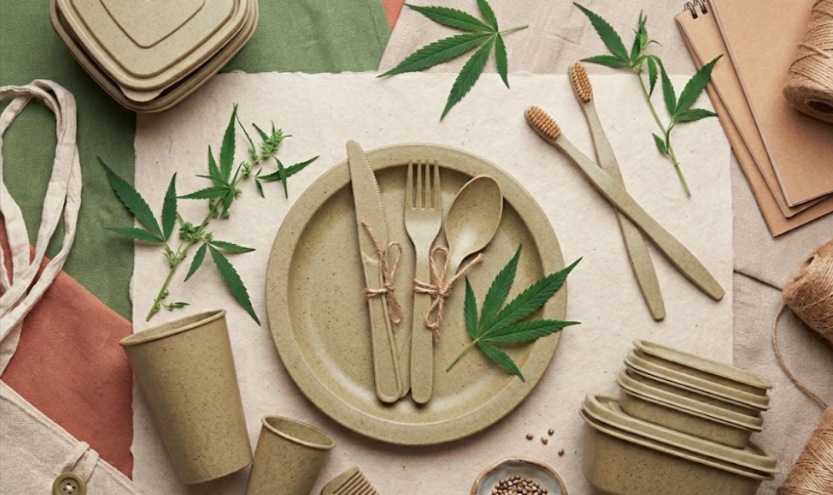
Can Hemp Replace Plastic? An Honest Look (2026)
Plastic is not one material problem. It is a systems problem.
It is in food packs, films, cars, medical devices, electronics, textiles, logistics, and construction. That is why the honest answer to “Can hemp replace plastic?” is not a simple yes.
Hemp cannot replace all plastic. But it can replace some fossil-plastic applications where the product does not need ultra-low cost, extreme clarity, sterile performance, or very high barrier protection.
It can work as a fiber, filler, reinforcement, cellulose source, or bio-based input. In that role, hemp becomes a practical hemp alternative to plastic, not a miracle material.
The useful question is not “Can hemp replace every plastic use case?”
The useful question is: “Where does using hemp as plastic make the product better?”
How can hemp be used as plastic?
Hemp plastic is not one fixed material. Instead, it can refer to at least four different material families:
- Hemp fiber mixed into plastic
- Hemp powder used as a filler
- Hemp cellulose processed into plastic-like films
- Hemp blended with biopolymers such as PLA
In most cases, hemp does not act alone. The plastic-like behavior usually comes from the polymer matrix. Hemp improves the material by adding renewable content, stiffness, lower weight, or a better carbon story.
For example, a hemp-filled polypropylene part is still a polypropylene composite. It may use less fossil input and perform better in some ways, but it is not the same as a fully compostable bioplastic.
There are three practical ways to use hemp as a plastic
The first is reinforcement.
Hemp fibers can be added to a polymer to make the final part stronger or stiffer. This is similar to how glass fiber is used in composites, but hemp is lighter and renewable. This route is useful for molded products, panels, trays, and some automotive interiors.
The second route is cellulose.
The hemp stalk contains cellulose. With the right processing, that cellulose can be turned into films, coated papers, molded fiber formats, or other plastic-like materials. Recent research on hemp hurds has shown potential for packaging films and molded fiber packaging.
The third route is filler material.
Hemp powder or fiber can partly replace mineral fillers or fossil-based material in a plastic compound.
But here is the important warning: hemp content does not automatically make the final product biodegradable, compostable, or recyclable.
The surrounding polymer still decides much of the end-of-life behavior.
Is hemp a real alternative to plastic?
Yes, hemp can be a real alternative to plastic. But only in some cases.
The strongest use cases are formats where stiffness, weight reduction, and renewable content are more important than perfect transparency or the lowest possible price.
That includes:
- Rigid Packaging
- Molded Trays
- Containers
- Caps And Closures
- Consumer Goods
- Automotive Interior Parts
- Composite Panels
- Construction-Adjacent Materials
- 3D Printing Filaments
This is why hemp plastic has more credibility in molded and composite formats than in very thin flexible packaging.
A transparent snack pouch, a high-barrier coffee pack, or a sterile medical pack has a difficult job. It must control oxygen, water vapor, sealing, migration, shelf life, and sometimes sterilization.
Hemp may support some of these formats in the future. But in 2026, the strongest evidence sits in rigid, molded, paper-adjacent, and composite applications.
That gives us a better way to define hemp’s role.
Is hemp plastic the same as hemp bioplastic?
No. Hemp plastic and hemp bioplastic are related terms, but they are not always the same.
A hemp plastic may contain hemp fiber inside a fossil-based polymer such as polypropylene. In that case, hemp reduces fossil content, but the material may still behave like conventional plastic at the end of life.
A hemp bioplastic should mean that hemp contributes to a bio-based polymer or bio-based composite system.
The four terms buyers often confuse are:
- Bio-based
- Biodegradable
- Compostable
- Recyclable
Bio-based means the material comes partly or fully from biological resources. It does not automatically mean the material will biodegrade.
Biodegradable means it can break down biologically under defined conditions.
Compostable means the finished product meets a composting standard under specified conditions.
Recyclable means a real recycling system can collect, sort, and process it.
So the rule is simple: hemp-based does not automatically mean compostable.
What are the benefits of hemp plastic?
The main benefit of hemp plastic is not that it makes plastic disappear overnight.
The benefit is that it can reduce the amount of fossil-based material used in selected products.
Hemp is renewable. It grows as an agricultural crop. Its stalk, fiber, hurd, and residue can become useful industrial inputs instead of low-value waste.
In the right material system, hemp can help with:
- lower fossil-plastic dependence,
- lighter composite parts,
- higher renewable content,
- possible lower embodied carbon,
- better use of agricultural residues,
- additional value for farmers.
This is why hemp matters for policy and industry.
It connects materials, agriculture, climate, manufacturing, and rural income in one conversation.

But every benefit depends on formulation and proof.
That brings us to the difficult part.
What are the limitations of hemp plastic?
The biggest mistake is to treat hemp as a shortcut. Using hemp as plastic only helps when the material is designed properly.
There are real limitations.
First, the cost of hemp plastic is usually higher than that of traditional plastic. Polyethylene and polypropylene are cheap because the world has spent decades building their supply chains.
Second, the supply of hemp is not always consistent. Fiber quality changes with crop variety, soil, climate, harvesting, retting, drying, and processing.
Third, natural fibers can absorb moisture. If the fiber is not treated or compounded correctly, the final product can lose strength or become harder to process.
Fourth, certification is not automatic. A hemp-based material is not compostable unless the finished product has passed the right test for the right condition.
The next question is where hemp is already practical.
Can hemp plastic work for packaging?
Yes, hemp plastic packaging can work. But packaging is not one unified category.
A molded tray is different from a transparent snack pouch. A bottle cap is different from a high-barrier coffee pack. A secondary mailer is different from direct food-contact packaging.
The most realistic formats today are:
- Molded trays
- Rigid containers
- Caps and closures
- Secondary packaging
- Molded fiber packaging
- Paper-adjacent formats
- Films and coatings
Food packaging needs extra care. The material must be safe for food contact. It must protect shelf life. It must handle sealing, migration, moisture, oxygen, grease, temperature, and transport.
That is why the claim “made with hemp” is not enough. The job is not to force hemp into every pack but to match the material to the packaging problem.
At the Hemp Foundation, we are using materials derived from hemp to manufacture eco-friendly business packaging. Our wide range of products effectively demonstrates that hemp and agro-waste can become renewable feedstocks for solving specific packaging challenges without claiming to replace every plastic application.
Verdict: Can hemp replace plastic?
So, can hemp replace plastic? Yes, but only partly.
Hemp can replace some plastic applications in composites, molded packaging, rigid products, cellulose-based materials, and bio-based material systems.
It cannot replace every plastic used in the modern economy.
The better future is not hemp versus plastic. The better future is the right material for the right application.
Hemp’s strongest role is as one important material in a larger transition that also includes reduction, reuse, recycling, certified compostable systems where they make sense, and better use of agricultural waste.
Frequently Asked Questions
Can hemp replace plastic?
In many applications, it is possible for hemp to be an alternative to plastic. It is ideal for
- Packaging, such as food containers
- Consumer goods like phone cases
- Automotive use as body panels
- Biopolymers based on hemp can replace fibreglass
Is hemp plastic better than regular plastic?
In many aspects, hemp plastic is better than traditional plastic. The biggest advantage is that it is not based on crude oil but on a sturdy plant that is grown with minimum resources.
The manufacture of hemp plastic, therefore, has a remarkably small carbon footprint. Hemp plastic is also stronger and lighter.
Why is hemp plastic not common yet?
The question “Why is hemp plastic not widely used?” has no simple answer but rather a matrix of issues:
- Cost needs to go down
- The scale of manufacturing has to increase
- There has to be consistency of output
- The market for hemp plastic is still nascent
Is hemp plastic more expensive than conventional plastic?
Currently, hemp plastic costs 2-3 times more than conventional plastic.
This is mostly because the economies of scale have not yet kicked in. Conventional plastics are downstream products of the century-old oil industry, whereas hemp plastic use is a decade old. In a few years, as policies mandate the use of better alternatives, the cost will come down to the same level.
Is hemp bioplastic compostable?
Only if it is certified. Hemp is a natural material, but the end product contains other polymers and chemicals. If the entire material is designed for compostability and certified as such, it is compostable.

Vishal Vivek
Vishal Vivek is the Founder and CEO of Ukhi, a pioneering bio-materials company dedicated to ending plastic pollution by converting agricultural waste into high-performance compostable polymers. With a background in sustainable entrepreneurship and over a decade of technology experience, he leads Ukhi’s vision to create scalable, planet-positive material solutions. Previously, Vishal founded the Hemp Foundation, where he empowered more than 1,000 farmers and advanced sustainable livelihood initiatives. His work has been recognized through awards such as the HDFC Parivartan Grant and featured in leading publications like Forbes and Entrepreneur. Times Group recognized him as a legendary entrepreneur and published his biography in “I Did IT- Vol 2” alongside social pioneers like Bindeshwar Pathak (Sulabh International) and Anshu Gupta (Goonj). Vishal has authored more than 200 articles on sustainability and hemp, reflecting his deep expertise and advocacy for regenerative solutions. His commitment to grassroots impact led him to live in the remote mountains of Uttarakhand, where he immersed himself in the lives of marginal farmers, understanding their challenges and co-creating economic opportunities through hemp-based initiatives. A deeply passionate innovator, Vishal often draws inspiration from seemingly impossible achievements: “If Elon Musk can make rockets reusable, or Dashrath Manjhi can carve a path through a mountain with rudimentary tools, why can’t we eliminate the demon of single-use plastic while uplifting struggling farmers? We will make it happen—whatever it takes.” Ukhi is proud to be supported by premier institutions including IIT Guwahati, NSRCEL-IIM Bangalore, Indian School of Business (Hyderabad), Indian Council of Agricultural Research (ICAR Pusa), and the Indian Institute of Packaging. Vishal is committed to demonstrating that business can be a powerful catalyst for global environmental and social good. Connect with Vishal Vivek
Related Posts
How GM Seeds Damage the Environment
Generically Modified Seeds – Your environment’s death-sentence? Source While many are pleased wi
Are Hemp Plastics Biodegradable? What Science Says
Hemp plastic is showing up everywhere. It is being used in automotive parts, consumer goods, electro
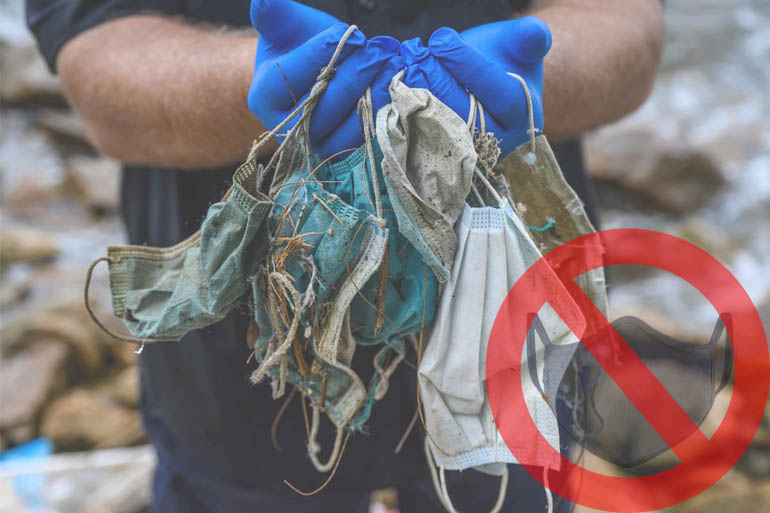
Why Should You Give Up Single-Use Masks Immediately?
As you read this, something ugly is going on a the coast near you. Hundreds of thousands of single-u

