

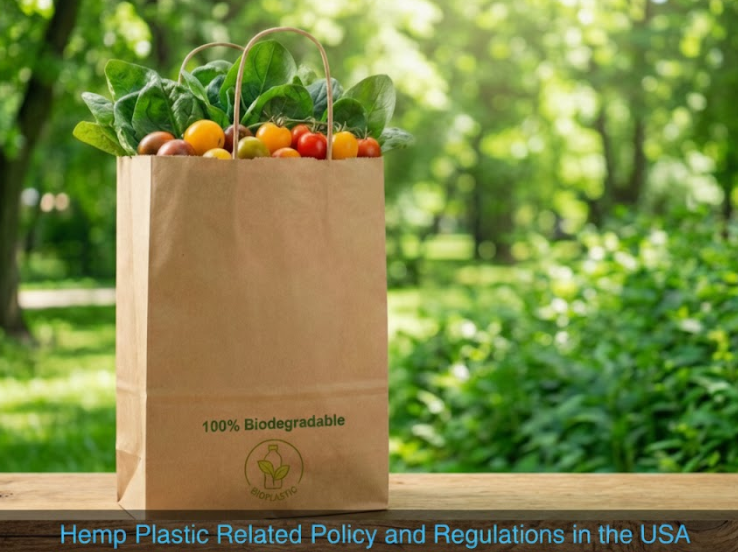
Hemp Plastic Related Policy and Regulations in the USA: What You Need to Know
Hemp-based plastics are no longer a curiosity. Driven by the One Big Beautiful Bill Act (OBBBA) of 2025 and the ongoing changes in the Farm Bill, hemp plastics packaging is a growing sector in the USA.
For manufacturers, being part of this landscape means understanding:
- What is controlled at the farm gate
- What agencies matter for finished products
- Which standards to use for environmental claims
Let’s start by unpacking different aspects of the hemp plastic regulations in the USA.
What Is the Legal Status of Hemp Plastic in the USA?
To understand the current legality of hemp plastic in the USA, you must start with the 2018 Farm Bill.
This law officially recognized industrial hemp as a legal crop. Industrial hemp contains less than 0.3% THC. It was an enormous shift, and in one stroke, hemp moved from the margins into the mainstream. Hemp was removed from the DEA’s list of controlled substances.
Currently, the USDA oversees the cultivation of industrial hemp in the USA. The cultivated hemp fiber is turned into bioplastics or composites for packaging, consumer goods, and more.
You may ask, are there any restrictions on the hemp plastic regulations in the USA? Yes, but they are related to the THC content at the cultivation stage.
What Federal Agencies Regulate Hemp Plastic?
There is a lot of oversight regarding hemp cultivation in the USA and processing it into hemp plastic.
Here are the main agencies involved:
- USDA hemp regulations govern the cultivation phase. The USDA sets the rules for THC testing, farm licensing, and fiber supply.
- FDA rules take over when that hemp fiber is destined for anything that touches food. The FDA focuses on the food safety of hemp-based packaging, polymers, and additives.
- EPA cares about pesticides used in growing hemp and about chemical safety in manufacturing. They ensure polymers do not leach into the ground.

Understanding what this trio does helps manufacturers avoid surprises. You are assured of compliance if you follow the rules set by these three agencies.
What Certifications and Standards Apply to Hemp Plastic?
If you want your hemp plastic to be accepted in the marketplace, it must meet strict certification requirements. Let’s look at the hemp plastic regulations in the USA and which certifications are necessary.
Here’s what matters most:
- ASTM D6400 is the gold standard for compostable hemp plastic in the USA. To earn this label, a product must break down quickly and safely in an industrial composting facility.
- Similarly, ASTM D6868 is the certification for coated materials. It is for products and packaging that consist of a biodegradable plastic coating, like paper cups. The
- The USDA BioPreferred label is awarded to products with verifiable biobased content. It confirms they are made from renewable biological ingredients.
- BPI certification means that your product meets recognized compostability standards.
This table will clarify the essential hemp plastic regulations in the USA.
If you want to export, ISO 17088 and EN 13432 provide similar benchmarks.
With these certifications in place, your products are compliant and market-ready.
How Is Hemp Plastic Regulated for Packaging and Food Contact?
If you want to use hemp plastic for food packaging in the USA, you have to start by earning the FDA’s trust.
FDA regulations are all about food safety. Every ingredient in your packaging (from the hemp cellulose to coloring agents) must be approved.
For example:
Hemp cellulose is Generally Recognized As Safe (GRAS) and widely used in food contexts.
But if you blend hemp with other plant-based polymers or conventional plastics, every component must be proven safe for food use. It is important to test, as the FDA requires manufacturers to show their packaging doesn’t leach harmful substances into food.

EPA packaging regulation comes in if your hemp plastic manufacturing uses chemicals such as coatings and adhesives.
Besides, many states are insisting on biodegradable certification in packaging. This means clear evidence, like ASTM D6400, that your packaging is compostable.
What State Regulations Affect Hemp Plastic?
Till now, we have been discussing federal mandates. Each state has its own framework.
Here are a few statewide hemp plastic regulations in the USA you have to comply with:
California
From October 2026, the ♻ symbol cannot be used on any packaging, including hemp plastic, unless the material is widely collected and processed for recycling by programs serving at least 60% of the state’s population.
Washington
Products marketed as compostable must be tinted green, beige, or brown. The terms biodegradable, degradable, decomposable, and oxo-degradable are prohibited. Only the term “compostable” is allowed if it is verified.
New York
All plastic and bioplastic packaging for adult-use cannabis must contain at least 25% recycled content.
Minnesota
Prohibits labeling plastic bags as biodegradable. Any bag labeled “compostable” must meet ASTM D6400 standards.
These state policies are not to be considered as hurdles but signals. If you can meet the strictest state requirements for compostability without greenwashing, your product will be successful.
What Are the Main Challenges?
In spite of impressive demand from consumers, there are several hurdles in the way.
- The biggest one by far is THC testing delays. There is a lack of DEA-certified labs, causing bottlenecks in the supply chain. It makes hemp fiber hard to access when manufacturers need it most.
- The state laws are evolving into a patchwork. Together with EPR requirements, it means that every new product launch is a regulatory learning curve.
- There is a new PFAS compliance deadline in 2026. It forces every packaging maker to audit their supply chain for these “forever chemicals”. This process is time-consuming for smaller companies.
- Hemp plastic supply chain standardization is another hurdle. Unlike conventional plastics, manufacturing and quality standards vary. This affects both cost and the final product’s performance.
A Realistic Path
The growing hemp plastic market in the USA shows that innovation can thrive even in a complex policy environment. Though it requires effort and attention, hemp plastic manufacturers in the USA are creating a smarter, more responsible hemp plastic industry.
The market for sustainable hemp plastic packaging in the US is growing quickly. Those who can withstand the policy paradox will receive huge opportunities for growth. Therefore, be informed about hemp plastic regulations in the USA, focus on the right standards, and you are set to be a well-positioned leader.
Frequently Asked Questions
Is hemp plastic legal in the USA?
Yes, hemp plastic is legal in the USA. The Farm Bill of 2018 entirely legalized industrial hemp as an agricultural product. Thus, hemp with less than 0.03% THC was removed from the Controlled Substances Act.
Can hemp plastic be used for food packaging in the US?
Hemp plastic can be used for food packaging in the US. Of course, it has to meet FDA rules for food contact safety. Hemp packaging is used for trays, films, bottles, and containers in the USA.
Does the US ban hemp plastic in any state?
No, hemp plastic is not banned in any U.S. state. In many states, cannabinoids (like Delta-8 THC or ingestible CBD) are banned. But products and packaging made from industrial hemp and hemp plastic remain legal nationwide.
What standards must hemp plastic meet in the USA?
Essentially, three certifications – ASTM D6400, USDA BioPreferred, and BPI certifications – are necessary. They are necessary for proving compostability, biobased content, and market readiness.
Does hemp plastic help meet US plastic waste laws?
Hemp plastic provides a renewable, biodegradable alternative to petroleum-based plastics. It helps to meet Extended Producer Responsibility (EPR) mandates and single-use plastic bans in the USA.

Vishal Vivek
Vishal Vivek is the Founder and CEO of Ukhi, a pioneering bio-materials company dedicated to ending plastic pollution by converting agricultural waste into high-performance compostable polymers. With a background in sustainable entrepreneurship and over a decade of technology experience, he leads Ukhi’s vision to create scalable, planet-positive material solutions. Previously, Vishal founded the Hemp Foundation, where he empowered more than 1,000 farmers and advanced sustainable livelihood initiatives. His work has been recognized through awards such as the HDFC Parivartan Grant and featured in leading publications like Forbes and Entrepreneur. Times Group recognized him as a legendary entrepreneur and published his biography in “I Did IT- Vol 2” alongside social pioneers like Bindeshwar Pathak (Sulabh International) and Anshu Gupta (Goonj). Vishal has authored more than 200 articles on sustainability and hemp, reflecting his deep expertise and advocacy for regenerative solutions. His commitment to grassroots impact led him to live in the remote mountains of Uttarakhand, where he immersed himself in the lives of marginal farmers, understanding their challenges and co-creating economic opportunities through hemp-based initiatives. A deeply passionate innovator, Vishal often draws inspiration from seemingly impossible achievements: “If Elon Musk can make rockets reusable, or Dashrath Manjhi can carve a path through a mountain with rudimentary tools, why can’t we eliminate the demon of single-use plastic while uplifting struggling farmers? We will make it happen—whatever it takes.” Ukhi is proud to be supported by premier institutions including IIT Guwahati, NSRCEL-IIM Bangalore, Indian School of Business (Hyderabad), Indian Council of Agricultural Research (ICAR Pusa), and the Indian Institute of Packaging. Vishal is committed to demonstrating that business can be a powerful catalyst for global environmental and social good. Connect with Vishal Vivek
Related Posts
How hemp can help deal with reverse migration and unemployment in Uttarakhand
The pandemic has induced an unprecedented situation few had even thought of. Millions of laborers, w
How Hemp Can Save Our Planet from Plastic Pollution
Hemp plastic can replace plastic and save our planet from this environmental menace. Here are some o
210-year-old history of Uttarakhand’s Self Employment related to Commercial Cannabis Cultivation
Uttarakhand is the first state in the country to commercialize the cultivation of industrial hemp by

