

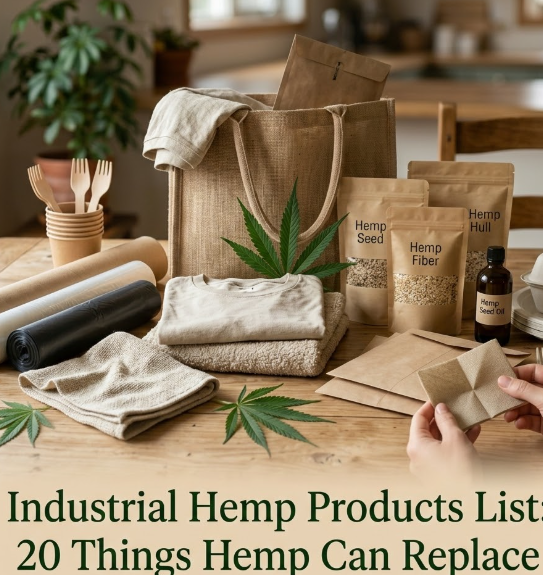
Industrial Hemp Products List: 20 Things Hemp Can Replace
When people hear “hemp alternatives” for everyday items, they often picture something niche, premium, and optional.
But the truth is simpler, and more urgent. The everyday things we rely on, like bags, clothes, packaging films, and paper, are still built on two expensive habits at scale.
First, we keep extracting fossil-based plastics for items we use once and throw away. And second, we keep growing resource-heavy fibers for items that could be made more durable.
Industrial hemp sits right in the middle of that problem. It’s a fast-growing crop that can be turned into high-strength fiber, high-cellulose pulp, and useful oils. And the best part is that it doesn’t need years of growth like trees.
Overall, industrial hemp is an excellent resource that can be used to make eco-friendly alternatives for many everyday use items. This industrial hemp products list talks about 20 such items.
1. Plastic Carry Bags:
Plastic carry bags are usually made from polyethylene. They’re light, cheap, and designed for a short life. And the last part’s the main problem.
A carry bag is often used once, then becomes litter or landfill that stays for years. And because these bags move in huge volumes every day, even small shifts away from them make a big difference.
Hemp carry bags work in two practical ways. One option is a woven bag made from hemp bast fiber. It behaves like a real utility bag. It holds weight and can be used repeatedly. It doesn’t tear easily under load.
The second option is hemp bioplastics. Here, the cellulose from hemp is turned into a biopolymer resin, which is then used to make compostable plastic.
The latter is a plastic alternative that looks and feels like regular plastic, but without the same environmental cost.
2. Cotton T-Shirts:
You may not see cotton t-shirts as anything fancy. But cotton as a crop is heavy on resources.
In many regions, cotton farming consumes a lot of water. It also relies on pesticides and other farm chemicals that can harm soil and nearby water systems if managed poorly.
Hemp is different, though. It grows quickly. In many farming conditions, it can be grown with fewer pesticides than cotton. And the fiber it produces is naturally strong.
That strength matters in daily use. Hemp-based fabric tends to hold up better over time. It resists wear and keeps its shape longer. So, the shirt lasts longer than your average cotton t-shirt.
Hemp is also often described as naturally antibacterial, which can help with odor. The exact effect depends on processing and blends.
But the basic idea is that hemp fabric doesn’t trap smells as easily as some common materials.

3. Plastic Courier Bags:
With the rise of e-commerce, courier bags are everywhere now. They’re the default packaging for shipping clothing, accessories, and small goods.
Most of these mailers are made from LDPE plastic. They’re light and water-resistant, which is why logistics teams like them. But they are also thrown away immediately after delivery.
And unlike a plastic bottle, a courier bag is easy to ignore. It’s thin, it crumples, and it disappears into the bin. So, the scale of the waste is often invisible until you look at it city-wide.
Hemp-based replacements usually come in two practical forms. First, paper mailers that are made with hemp pulp blended into the sheet. These work well for documents and for shipments where the product is already in an inner pack or a box.
Second, compostable film made with the same biopolymer resin made from hemp cellulose I mentioned earlier. This is promising, but it comes with a reality check.
Compostable packaging only helps when it is collected separately and actually sent to industrial composting facilities. If it goes into a mixed waste landfill, it may not deliver the same results.
4. Wood-Pulp Paper:
Most paper still comes from wood pulp. That system works, but it has a built-in limitation. Trees take years to grow. Hemp grows in months.
That matters when demand for paper stays high. It also matters when forests are under pressure for many reasons, not just paper.
Hemp can be used to make pulp from two parts of the stalk:
- the bast fiber
- and the woody core, AKA the hurd
Both contain useful cellulose. So, both can be processed into pulp.
Another practical point is fiber length. Longer fibers usually make stronger paper. They also survive recycling better. Paper fibers don’t last forever. After a few recycling cycles, they become too short to bond well, and the sheet gets weak.
Hemp pulp is often seen as a better alternative to improve strength in certain paper products. It also reduces pressure on the slow-growing wood supply.
5. Plastic Garbage Bags:
Even the bags that are used to contain and collect waste have become an environmental problem. Most garbage bags are still made of conventional plastic. And once a plastic liner reaches a landfill, it becomes long-term waste.
That’s why compostable alternatives are simply better. A compostable garbage bag is designed to break down completely in industrial composting conditions.
Hemp is one of the best feedstock crops used to make compostable films. This film is strong enough for real use. So, the bag can carry weight and doesn’t tear easily.
But switching to compostable garbage bags will only produce the desired outcome if it matches the existing waste collection and processing systems.
If a city has a separate collection for organic waste, compostable liners can keep food waste cleaner and easier to process. But if everything goes into mixed waste, the value drops sharply.
6. Cotton Tote Bags:
Cotton tote bags are often treated as the “green” alternative by default. But cotton is a resource-heavy crop in many regions.
So, the climate and water logic of a cotton tote depends on how many times it is reused. If it sits in a drawer, it’s just a high-footprint product that replaced nothing.
Hemp totes are simpler to justify because they tend to last longer. Hemp canvas is strong, and it handles weight well. It also resists abrasion, which is what destroys totes over time at the seams and edges.
7. Plastic Product Pouches:
Flexible pouches are now the default pack for a lot of FMCG categories. They’re lightweight, space-efficient, and cheap to ship. The problem is what they’re made of.
Most pouches are multi-layer plastics bonded together to get two things at once:
- strength
- barrier protection
That structure is exactly why they’re hard to recycle. The layers aren’t designed to come apart.
Hemp fits into this space in two practical ways. First, hemp fiber can reinforce compostable or bio-based films to improve toughness.
Second, hemp cellulose can contribute to paper-like structures and coatings that reduce reliance on mixed plastic layers.
8. Synthetic Cleaning Cloths:
Most cleaning cloths today are made from polyester microfiber. They wipe well and dry fast. But they also shed plastic.
That shedding often happens during washing. Those tiny fibers can pass through wastewater systems and add to microplastic pollution in rivers and oceans.
This is where hemp is a straightforward replacement. A hemp cleaning cloth is made from plant fiber. It’s naturally durable. So, it holds up to repeated use. And it doesn’t create synthetic microfibers when it wears down.
Hemp fabric also absorbs well. That’s why it has been used for workwear and utility textiles for a long time.
9. Plastic Stretch & Shrink Wrap:
Stretch wrap is used to wrap pallet loads, bundle cartons, and stabilize shipments. Then it’s thrown away.
Because the film is thin and often dirty, it’s hard to collect and recycle reliably. So in many places, it ends up as landfill waste even when businesses try to segregate plastics.
That’s where alternative hemp products enter the picture. Hemp bioplastic can be used to make compostable stretch wraps that perform just as expected.
10. Plastic Garment Covers:
Walk into any garment stockroom, and you’ll see the thin plastic covers that are used to protect clothing in storage and display. They tear quickly and are usually thrown away after use.
Biodegradable garment covers are among the easy-to-adapt hemp products in India. And there are mainly two hemp alternatives for conventional garment covers.
The first is a reusable garment cover made from hemp fabric. The second is hemp plastic-based garment covers that look and function like the conventional option.
11. Polyester Fabric:
Polyester is a fossil-based plastic fiber. And it sheds microfibers over time, especially during washing.
Hemp gives a cleaner baseline. It’s a plant fiber. It’s breathable. It doesn’t create plastic microfibers as it wears down. And in everyday clothing, hemp fabric can stay usable for longer. That’s because the fiber is naturally strong.
Hemp won’t replace polyester in everything. But it can replace it in a lot of daily-use categories where comfort and durability matter more than high stretch.
12. Plastic Food Containers:
Food delivery has made single-use containers a daily habit. Most of those containers are plastic. They’re hard to recover cleanly, and they add up fast.
Hemp can replace part of this through rigid biocomposites and molded fiber formats. Think of hemp fiber adding strength to a plant-based material so that the container stays firm with heat and weight.
In this industrial hemp products list, containers sit in the “high-volume, high-impact” bracket. If you reduce plastic here, the waste reduction will be significant.
13. Plastic Mailing Envelopes:
Plastic mailers are used because they’re light and water-resistant. Most are made from LDPE and used only once.
With hemp, we get two practical alternatives. One is hemp-blended paper envelopes and mailers. They work well for documents, inserts, and shipments where the product is already protected inside.
The second is mailers made with compostable films. We’ve already gone over how hemp cellulose can be used to create the compostable films.
But compostable only helps when collection and composting actually happen.
14. Plastic Lamination Films:
Most of the paper packaging today has a thin plastic film coating. That plastic layer protects it against moisture. But it also makes the paper harder to recycle.
Hemp products provide a solution to this. Hemp pulp can be used as the paper base. And hemp-based compostable plastic films can be added as the coating.
Both layers are biodegradable. So, they are easier to recycle and compost.
15. Plastic-Based Packaging Labels & Tags
Tags may look tiny, but they scale brutally. Every garment, shipping label, and retail item has a plastic tag attached to it. Most of these tags are coated with plastic. So, they can’t be composted or recycled.
Hemp paper tags are a viable alternative. They’re printable, strong enough for retail handling, and biodegradable in the right conditions.
This is also one place where hemp products in India can scale quickly. That’s because tags don’t need a major equipment change in the way that films and molded parts often do.
16. Cotton Towels:
Cotton absorbs well and lasts a long time, even when used regularly. That’s why it’s the preferred material for towels.
What if I told you that Himalayan hemp products can beat cotton towels both in terms of comfort and performance? Hemp towels absorb well and dry faster than cotton towels.
They are also more durable. So, they may last longer than cotton towels.
17. Disposable Plastic Cutlery:
From takeaway counters and food courts to office lunches and events, disposable cutlery is everywhere. And it’s almost never recycled.
It’s small, food-contaminated, and of low value. So, it usually goes straight to the landfill.
Hemp bioplastic can be used to replace conventional plastic cutlery. The hemp resin can be injection-molded into forks and spoons.
The hemp helps add stiffness. So, the cutlery feels solid and doesn’t bend easily with hot food.
18. Plastic Food Wrap:
Plastic cling film is one of the most used plastics in kitchens and food service. And it’s one of the least recycled. It’s too thin, gets contaminated, and is easy to litter without meaning to.
Hemp-based compostable plastic films are viable alternatives. But the rule stays the same. A compostable film only makes sense when it is collected and processed properly.
Still, cling film is so common that even partial replacement can make a huge difference.

19. Single-Use Plastic Plates:
Disposable plates are a peak waste product. They’re used for minutes, then thrown away in bulk. And the worst examples are foam plates. These are lightweight, fragile, and almost impossible to recycle cleanly.
Hemp fiber can be used to reinforce plant-based materials that are shaped into sturdy plates. The result is a plate that can handle real food weight without collapsing.
This is why, when people ask me about best selling hemp products that can work well in India, I point to food-service replacements like plates and cutlery.
20. Refined Vegetable Cooking Oils:
Hemp seed oil is not a frying oil. It’s best used cold. So, you can use it for dressings, dips, drizzles, and finishing oil.
Nutritionally, hemp seed oil is known for its balance of omega-6 and omega-3 fats. That’s why it’s often positioned as a better alternative to heavily refined oils in select uses.
This is also where geography matters. Many people associate Himalayan hemp products with wellness and food categories because of the way the region is marketed.
Conclusion
Switching to hemp alternatives is realistic when three things line up. The product performs the same job, supply is consistent, and the end-of-life route is clear.
That’s why the best starting points are the high-volume basics like bags, mailers, everyday textiles, paper, and food-service items. In many of these categories, hemp can improve durability, breathability, and material strength.
The common hurdles are also predictable. Uneven fiber quality, limited local processing, higher early-stage costs, and compostables being treated like normal waste.
At Hemp Foundation, our role is to make this practical by building pathways from cultivation to material development to real product adoption.
This way, businesses and policymakers can scale hemp solutions with fewer unknowns.

Vishal Vivek
Vishal Vivek is the Founder and CEO of Ukhi, a pioneering bio-materials company dedicated to ending plastic pollution by converting agricultural waste into high-performance compostable polymers. With a background in sustainable entrepreneurship and over a decade of technology experience, he leads Ukhi’s vision to create scalable, planet-positive material solutions. Previously, Vishal founded the Hemp Foundation, where he empowered more than 1,000 farmers and advanced sustainable livelihood initiatives. His work has been recognized through awards such as the HDFC Parivartan Grant and featured in leading publications like Forbes and Entrepreneur. Times Group recognized him as a legendary entrepreneur and published his biography in “I Did IT- Vol 2” alongside social pioneers like Bindeshwar Pathak (Sulabh International) and Anshu Gupta (Goonj). Vishal has authored more than 200 articles on sustainability and hemp, reflecting his deep expertise and advocacy for regenerative solutions. His commitment to grassroots impact led him to live in the remote mountains of Uttarakhand, where he immersed himself in the lives of marginal farmers, understanding their challenges and co-creating economic opportunities through hemp-based initiatives. A deeply passionate innovator, Vishal often draws inspiration from seemingly impossible achievements: “If Elon Musk can make rockets reusable, or Dashrath Manjhi can carve a path through a mountain with rudimentary tools, why can’t we eliminate the demon of single-use plastic while uplifting struggling farmers? We will make it happen—whatever it takes.” Ukhi is proud to be supported by premier institutions including IIT Guwahati, NSRCEL-IIM Bangalore, Indian School of Business (Hyderabad), Indian Council of Agricultural Research (ICAR Pusa), and the Indian Institute of Packaging. Vishal is committed to demonstrating that business can be a powerful catalyst for global environmental and social good. Connect with Vishal Vivek
Related Posts
Is Hemp Plastic Sustainable?
Every year, we generate hundreds of millions of tonnes of plastic waste. Most of it is never recycle

Minnesota Becomes The First US State To Approve Hemp Seed Meal As Feed, Green Signals Market Expansion Of Hemp
In a milestone development, hemp seed meal has been approved for use as feed for laying hens by the
Here is How Hemp can Keep Climate Change at Bay
Hemp is one of the oldest and most versatile plants known to mankind. Such is its versatility that i

