

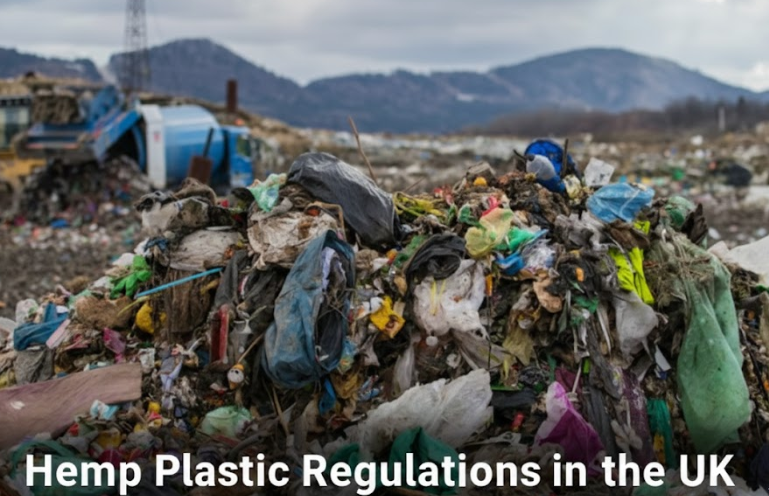
Hemp Plastic Regulations in the UK: What You Need to Know
If my years in the sustainability industry have taught me anything, it’s that the plastic waste problem is a fast-moving crisis, especially in the UK.
The UK generates between 3.8 and 5.4 million tonnes of plastic waste each year, much of it from everyday packaging.
This issue has become a source of frustration for citizens, a subject of intense policy debate, and a driving force behind an increasingly tough wave of plastic regulations in the UK.
Every business, from the smallest retailer to the largest manufacturer, now faces higher expectations and stricter oversight. And if you’re running a business or making buying decisions, you can feel that pressure intensifying.
As far as solutions are concerned, we need to innovate better plastic alternatives. And right now, hemp plastic stands out.
It’s made from a fast-growing crop that absorbs more CO₂ than most others. The plastic is biodegradable, which means it turns into soil when composted.
But is it possible to replace conventional plastic entirely with hemp bioplastic? To really understand what’s possible, you first need to understand the rules of the game.
Let’s break down the UK’s plastic regulatory landscape and see how new materials like hemp plastic fit into it.
How UK plastic laws are reshaping the packaging landscape
The rules around plastic use in the UK have changed rapidly and significantly in recent years.
Five years ago, most attention was on simple recycling targets. Now, government policy covers every stage, from how much recycled content goes into packaging to who pays for collecting and processing the waste after it’s thrown away.
So, what caused this shift? Frankly, the evidence is impossible to ignore.
The majority of single-use plastic waste in the UK comes from packaging. That’s why regulations have zeroed in on packaging materials and the businesses that use them. Retailers, food brands, manufacturers, and importers are all directly affected.
For these businesses, plastic is now a compliance issue with new legal and financial risks attached.
What are the Primary Plastic Regulations in the UK as of 2025?
The UK’s approach is clear: use less plastic, recycle more, and make producers pay for the true cost of waste. Several laws make up the backbone of the plastic regulations in the UK as of 2025:
Plastic Packaging Tax (PPT)
Any plastic packaging made or imported into the UK with less than 30% recycled content is taxed at £223.69 per tonne.
The UK’s plastic packaging tax applies to nearly all types of plastic, including some bioplastics. This way, businesses can’t simply switch to “eco-plastic” to avoid it. It covers everyone handling more than 10 tonnes of packaging per year.
Extended Producer Responsibility
As of April 2025, producers are required to pay for the collection, recycling, and disposal of packaging waste.
This means businesses must register and report their packaging data. They would also need to pay fees based on material type and recyclability.
Single-Use Plastics Ban
Scotland was the first to enforce single use plastic ban in the UK. England and Wales were next.
It is now illegal to supply a range of single-use plastic items, including cutlery and polystyrene containers. That is, even if those items are compostable or made from recycled materials.
Carrier Bag Charge
Single-use plastic bags come with a charge of 10p. It has reduced its usage by more than 95% since 2015. It goes to show how even minor policy changes can change public mindset.
These rules cover a vast range of businesses. Anyone involved in producing, importing, distributing, or selling packaged goods in the UK is now under tighter scrutiny.
The logic is simple: if you profit from packaging, you share responsibility for what happens after it’s used.

How Have Plastic Laws Changed in Recent Years?
If you look back, it’s clear the UK has been steadily ramping up its plastic regulations year after year. Each phase has built on the last and tightened the rules.
- In 2015, the carrier bag charge made reusable bags the norm.
- By 2018, the UK was among the first to ban plastic microbeads in rinse-off cosmetics. This was an early sign that regulators were mindful of even the lesser-talked-about plastic problems.
- The period between 2020 and 2023 was crucial. It included bans on plastic straws, stirrers, cotton buds, and takeaway packaging. It was quickly followed by the introduction of the UK plastic packaging tax in 2022.
- 2025 marks the full enforcement of EPR, pushing responsibility and significant new costs onto packaging producers.
More than ever, business leaders need to anticipate the next wave of regulation. Simply reacting to it is not enough. Only businesses that can adapt early will thrive.
How are These Laws Enforced, and What Do They Mean for the Industry?
UK plastic regulations are backed by strict enforcement.
Fines for failing to register for the UK plastic packaging tax start at £500, with daily penalties that can quickly escalate if records are missing or incorrect.
When it comes to EPR, “PackUK” and the environmental agencies have direct authority to audit and penalize businesses that don’t report packaging data accurately or pay required fees.
For the industry, this means compliance is now a boardroom issue. Some large retailers and manufacturers now dedicate entire teams to regulatory risk. The consequences of non-compliance are just too serious.
But there’s a positive side to this pressure.
- Leading packaging companies are investing in new materials and designs.
- Supermarkets have shifted to paper-based or compostable packaging.
- DS Smith has committed to eliminating 1 billion plastic items from their supply chain by 2025.
The tightening regulations have forced businesses to actively search for viable alternatives. That’s when the conversation around hemp plastic gets interesting.
Bioplastics and hemp plastic – Regulatory impact and opportunities
When talking about plastic alternatives that can do the same job without the same environmental cost, we have to mention hemp plastic.
It’s made from the fibrous stalks of the industrial hemp plant. Hemp plastic is strong, lightweight, and compostable in the right conditions.
But how do these new materials fit into current laws, and what opportunities or challenges do they bring?
Why is Hemp Plastic Gaining Ground?
Businesses in the UK are now looking for alternatives that will help them stay compliant and competitive.
Hemp plastic is emerging as a frontrunner in this landscape because it delivers on several practical aspects.
For starters, unlike conventional plastic, hemp plastic is made from a renewable source. Industrial hemp grows quickly and requires minimal pesticides or fertilizers.
The cellulose in hemp stalks provides a strong base for bioplastics. It allows the final product to be both tough and lightweight.
Furthermore, when designed with compostability in mind, hemp plastic can break down in 3 to 6 months in industrial composters.
Technically, some hemp plastics are already outpacing conventional plastics in performance, being five times stiffer and two and a half times stronger than the latter.
Consumer demand is also a key reason behind the growing interest in plastic alternatives.
More than half of UK consumers are now prepared to boycott brands they believe are making misleading claims to appear eco-friendly.
This growing scrutiny means businesses need genuine solutions to earn customer trust, and hemp plastic offers exactly that.
What are the Hemp Plastic Regulations in the UK?
There are no specific hemp plastic regulations in the UK. But that doesn’t mean the sector is completely unregulated. Here are a few things to remember:
- The UK plastic packaging tax can apply to bioplastics as well. Hemp-based plastic is taxed like any other plastic unless it contains 30% or more recycled content.
- Packaging made from hemp plastic must be reported, and producers have to pay fees like with traditional plastics.
- Even compostable or biodegradable single-use hemp plastics are banned if the item is on the prohibited list.
- If a company markets hemp plastic as compostable, it should meet standards such as EN 13432.
- Hemp plastic packaging must comply with the same food safety regulations as any other material.
As far as supply is concerned, the industrial hemp used for making plastic can only come from licensed growers.
As of 2025, licensing rules are more flexible. Farmers can grow industrial hemp anywhere on their licensed land. And the validity of a hemp license in the UK is six years.

An Overview of the Benefits and Challenges of Hemp Plastic Adoption
There are several advantages to adopting hemp plastic.
Industrial hemp is fast-growing and uses less water and fewer chemicals than most conventional crops. And because it’s not a food source, it doesn’t compete with food agriculture or contribute to rising food prices.
From an environmental perspective, hemp plastic offers two more clear benefits.
Firstly, it breaks down in months, whereas petroleum-based plastics take hundreds or thousands of years. Secondly, hemp absorbs approximately 22 tonnes of CO2 per hectare every year.
It also improves soil health through its deep root systems and natural remediation.
Still, there are some challenges standing in the way.
One of the most immediate is cost. Hemp plastic is currently more expensive than most traditional plastics. This increased cost is what stops many businesses from making the switch..
Disposal presents another hurdle because the UK’s waste infrastructure for compostables is not yet widespread.
Despite all the challenges, solutions are slowly starting to emerge, and the Hemp Foundation plays a key role here.
We connect growers, innovators, and brands to support the entire ecosystem around sustainable hemp products.
Our work covers different stages of the entire process. We develop reliable sourcing channels for industrial hemp and provide guidance on compliance.
Hemp Foundation also collaborates with partners on the research and development of new, more accessible hemp-based materials.
Wrapping up
The UK’s changing plastic laws make clear that regulation is just a starting point for deeper change.
Hemp plastic won’t solve every challenge overnight. But it does open the door to new forms of sustainable manufacturing and smarter use of agricultural resources.
The real test ahead is how we can work together to turn regulatory pressure into lasting progress.

Vishal Vivek
Vishal Vivek is the Founder and CEO of Ukhi, a pioneering bio-materials company dedicated to ending plastic pollution by converting agricultural waste into high-performance compostable polymers. With a background in sustainable entrepreneurship and over a decade of technology experience, he leads Ukhi’s vision to create scalable, planet-positive material solutions. Previously, Vishal founded the Hemp Foundation, where he empowered more than 1,000 farmers and advanced sustainable livelihood initiatives. His work has been recognized through awards such as the HDFC Parivartan Grant and featured in leading publications like Forbes and Entrepreneur. Times Group recognized him as a legendary entrepreneur and published his biography in “I Did IT- Vol 2” alongside social pioneers like Bindeshwar Pathak (Sulabh International) and Anshu Gupta (Goonj). Vishal has authored more than 200 articles on sustainability and hemp, reflecting his deep expertise and advocacy for regenerative solutions. His commitment to grassroots impact led him to live in the remote mountains of Uttarakhand, where he immersed himself in the lives of marginal farmers, understanding their challenges and co-creating economic opportunities through hemp-based initiatives. A deeply passionate innovator, Vishal often draws inspiration from seemingly impossible achievements: “If Elon Musk can make rockets reusable, or Dashrath Manjhi can carve a path through a mountain with rudimentary tools, why can’t we eliminate the demon of single-use plastic while uplifting struggling farmers? We will make it happen—whatever it takes.” Ukhi is proud to be supported by premier institutions including IIT Guwahati, NSRCEL-IIM Bangalore, Indian School of Business (Hyderabad), Indian Council of Agricultural Research (ICAR Pusa), and the Indian Institute of Packaging. Vishal is committed to demonstrating that business can be a powerful catalyst for global environmental and social good. Connect with Vishal Vivek
Related Posts
How GM Seeds Damage the Environment
Generically Modified Seeds – Your environment’s death-sentence? Source While many are pleased wi
How Can Hemp Change The Life of Poor Farmers of Uttarakhand
Before we answer how hemp can improve the lives of poor farmers of Uttarakhand, let’s cover some b
How Can Hemp Mitigate The Perils of eCommerce Plastic Packaging?
[vc_row][vc_column][vc_column_text] Your online orders are damaging the planet. The plastic packagin

