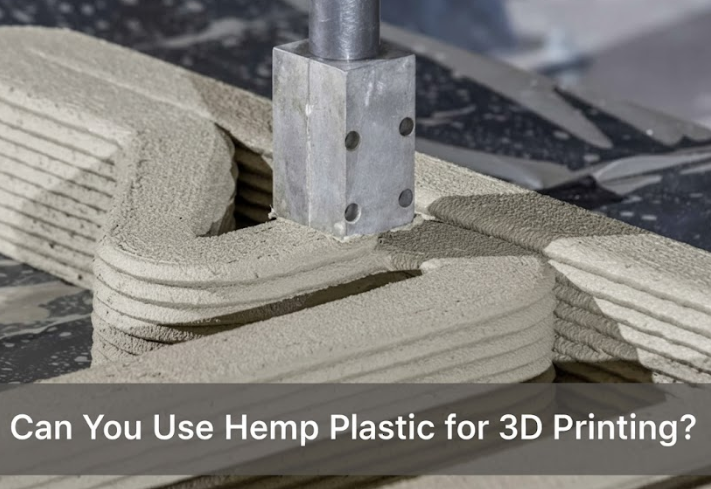
Can You Use Hemp Plastic for 3D Printing?
Just a few years ago, 3D printing was mostly a hobby.
People were printing tiny trinkets, toys, or quirky gadgets in garages and maker labs.
Fast forward to today, and entire houses are being 3D printed.
Aerospace companies are producing aircraft components layer by layer.
Hospitals are creating custom prosthetics and surgical tools.

Source: The Economist
So 3D printing is no longer experimental. It’s mainstream manufacturing.
But with great innovation comes a hidden cost.
Most printers still rely on petroleum-derived polymers like ABS, PETG, or PLA. Every kilogram of filament created from fossil fuels adds to pollution, microplastics, and waste that lasts a long time.
The good news is that there’s a plant-based alternative that changes everything: hemp 3D printing.
But the question remains: Can hemp really be used for 3D printing, and if so, how effective is it?
Can Hemp Really Be Used for 3D Printing?
The short answer: Yes.
The long answer: Not only is it possible, it’s practical, proven, and scaling fast.
Hemp plastic 3D printing works through bio-based composite filaments made by combining industrial hemp fibers with PLA (polylactic acid).
This blend results in a printable material that works with nearly any regular or hemp plastic 3D printer setup already in use.
In other words, manufacturers don’t need to buy new machines to make the switch.
Technically, hemp fibers serve as reinforcement inside the polymer matrix.
This fiber improves both mechanical and thermal performance.
The natural cellulose of hemp also increases the rigidity and impact resistance of the filament while reducing brittleness. Thus, it solves one of PLA’s biggest drawbacks.
Some tests have shown that hemp-PLA composites have 20–25% higher tensile strength and better inter-layer adhesion.
Here’s what makes hemp a strong fit for additive manufacturing:
- Cellulose microfibrils in hemp improve structural stability
- Low shrinkage ratio ensures better print accuracy
- Reduced warping and cracking, especially for large-scale prints
- Superior surface finish, with a natural matte texture
Hemp 3D material is light, renewable, and easy on printer nozzles. That means lower maintenance and longer-lasting machines for industrial users.
So yes, 3D printing with hemp isn’t an experiment anymore. It’s an emerging material category redefining what “eco-efficient” manufacturing can look like.
What Benefits Does Hemp Offer?
Here are a few benefits of sustainable hemp printing:
1. It’s Environmentally Sustainable
Hemp absorbs up to 1.6 kilograms of CO₂ per kilogram of biomass during its rapid growth cycle. It is one of the most carbon-negative crops on Earth. When used for sustainable hemp printing, it replaces petroleum feedstocks. Thus, significantly reducing life-cycle emissions.

Source: Britannica
Beyond that, hemp cultivation enriches soil health and grows without synthetic pesticides. For nations promoting green manufacturing, these are crucial policy advantages.
2. It’s Fully Biodegradable
Traditional plastic filaments persist for centuries. But hemp plastic 3D printing materials decompose naturally. When disposed of in composting conditions, they break down into organic matter. All without releasing toxins. This means failed prints or prototypes don’t add to landfill waste.
This biodegradability also keeps them in line with EU Green Deal and India’s Plastic Waste Rules, which makes them future-proof for regulations.
3. It’s Stronger Yet Lightweight
Hemp’s fiber-to-weight ratio is extraordinary. In hemp 3D printing material, the fibers act like micro-rebar, adding strength without bulk.
This gives printed parts high impact resistance, which is ideal for industries such as automotive interiors, furniture components, or consumer goods. Compared to PLA, hemp composites have higher durability with lower weight.
That’s a rare win-win combination. Lighter prints mean lower shipping costs and better performance.
4. It’s Odourless and Safe Indoors
Anyone who’s ever printed with ABS knows the unpleasant smell and toxic fumes it releases.
In contrast, 3D printing with hemp emits virtually no harmful gases. It’s odorless and safe even in closed rooms. This is an important advantage for schools, labs, and hospitals.
5. It Has a Natural Aesthetic Appeal
Hemp composites have a natural, soft, matte, slightly textured look that feels warm and organic. Designers and producers like it because they don’t need to paint or finish it. For brands, it’s a stylish, eco-friendly way to make products that look good and are sustainable.
Put simply, these five benefits show that hemp isn’t just a good material—it could actually give 3D printing a real edge in the future.
Still, many wonder…
Is It Worth Using Hemp for 3D Printing?
Currently, hemp plastic 3D printer filaments cost around $30–$35 per kilogram.
That’s slightly above premium PLA.
But this small difference fades when you look at the total lifecycle cost and include durability, waste reduction, and environmental savings.
The long-term benefits are clear:
- Fewer failed prints mean less filament consumption.
- Reduced energy demand, since hemp requires slightly lower extrusion temperatures.
- Improved brand value, especially for manufacturers subject to ESG reporting.
Moreover, as the hemp supply chain expands, thanks to new cultivation policies in India, the US, and Europe — production costs are dropping. The conclusion is simple: sustainable hemp printing is economically sound and environmentally necessary.
So, how do we begin this transition at scale?
Coordinated Efforts To Promote Hemp Plastic 3D Printing
The potential of hemp plastic 3D printing goes far beyond replacing traditional filaments. The next phase is about:
- Scaling adoption
- Improving filament quality
- Integrating hemp into mainstream manufacturing pipelines
For this,
- Industrial players can experiment with larger components
- Designers can explore the unique aesthetics and textures of hemp composites.
- Researchers and educators can expand studies on 3D printing with hemp
- Policymakers have an opportunity to support sustainable innovation through incentives and green policies
- Companies can build reliable supply chains, and funding R&D
At the Hemp Foundation, we view hemp as more than just eco-friendly. Instead, it’s a smart choice for innovation, investment, and lasting sustainability.
We’ve seen how using hemp across industries can change markets and mindsets.
The science is solid, the economics are improving, and what’s missing now is the vision to make it happen.
3D printing was meant to make things better. And with sustainable hemp printing, it finally can.
FAQs
1. Are regular 3D printers suitable for hemp printing?
Yes. Most printers can use hemp plastic for 3D printing, and deliver stronger, smoother, and sustainable results. Hemp 3D printing is both useful and good for the environment, as evident from its widespread application in prototypes, car parts, and home goods.
2. How does hemp plastic stack up against PLA or ABS?
Hemp 3D printing material is stronger than PLA and safer than ABS. It prints easily, doesn’t give off harmful fumes, and breaks down completely. Sustainable hemp printing thus, is good for the environment, looks better and even lasts longer, which makes it great for both industrial and creative projects.
3. What’s needed to start 3D printing with hemp?
Any hemp plastic 3D printer can use hemp-based filaments at normal PLA settings. Just keep the filament dry and print at 190–210°C. Businesses and schools can switch easily to hemp plastic 3D printing for cleaner, greener results.

Vishal Vivek
Vishal Vivek is the Founder and CEO of Ukhi, a pioneering bio-materials company dedicated to ending plastic pollution by converting agricultural waste into high-performance compostable polymers. With a background in sustainable entrepreneurship and over a decade of technology experience, he leads Ukhi’s vision to create scalable, planet-positive material solutions. Previously, Vishal founded the Hemp Foundation, where he empowered more than 1,000 farmers and advanced sustainable livelihood initiatives. His work has been recognized through awards such as the HDFC Parivartan Grant and featured in leading publications like Forbes and Entrepreneur. Times Group recognized him as a legendary entrepreneur and published his biography in “I Did IT- Vol 2” alongside social pioneers like Bindeshwar Pathak (Sulabh International) and Anshu Gupta (Goonj). Vishal has authored more than 200 articles on sustainability and hemp, reflecting his deep expertise and advocacy for regenerative solutions. His commitment to grassroots impact led him to live in the remote mountains of Uttarakhand, where he immersed himself in the lives of marginal farmers, understanding their challenges and co-creating economic opportunities through hemp-based initiatives. A deeply passionate innovator, Vishal often draws inspiration from seemingly impossible achievements: “If Elon Musk can make rockets reusable, or Dashrath Manjhi can carve a path through a mountain with rudimentary tools, why can’t we eliminate the demon of single-use plastic while uplifting struggling farmers? We will make it happen—whatever it takes.” Ukhi is proud to be supported by premier institutions including IIT Guwahati, NSRCEL-IIM Bangalore, Indian School of Business (Hyderabad), Indian Council of Agricultural Research (ICAR Pusa), and the Indian Institute of Packaging. Vishal is committed to demonstrating that business can be a powerful catalyst for global environmental and social good. Connect with Vishal Vivek
Related Posts

5 Key Differences Between Hemp Plastic and Regular Plastic
Plastic is evil. There’s no denying the facts. Plastic is bad for the air, the water, the land
How to Identify the Best Hemp Seeds
For anyone associated with the hemp industry, it’s vital to know how to identify hemp seeds for qu

Awareness Regarding Hemp
Awareness Drives Aimed At Helping Farmers Participate in The Hemp Economy Our biggest challenge has