

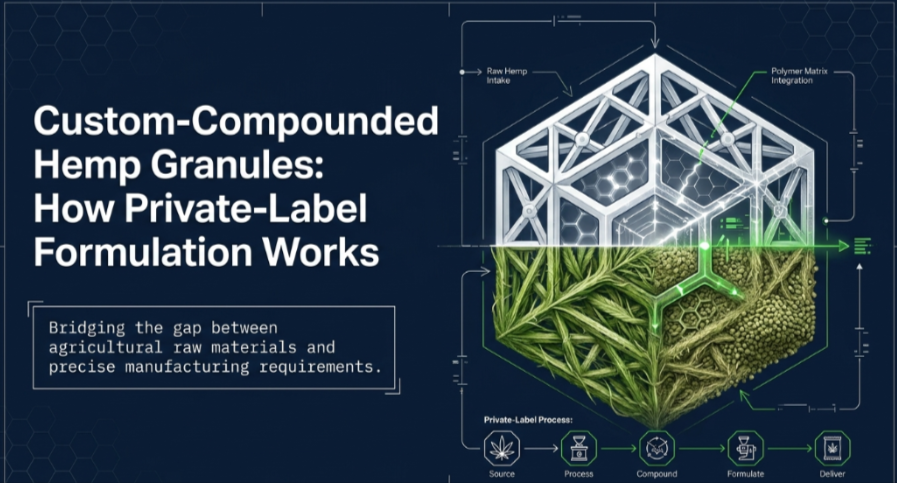
Custom-Compounded Hemp Granules: How Private-Label Formulation Work
Stock hemp granules work well for standard products. But what if your mould needs better flow, your product needs more stiffness, or your brand requires a specific hemp content?
In such cases, buying stock material and hoping it works can waste time and money. The wrong material also means failed trials, production delays and unnecessary costs.
That is where custom-compounded hemp granules and private-label formulations come in.
What Does Custom Compounded Bioplastic Actually Means
Custom compounding means developing a material blend for a particular application.
Custom hemp granules are made by combining hemp-derived material with suitable polymers (and additives, if needed) to achieve the required properties.
With custom compounded bioplastic, the aim is to make the material work for your product and manufacturing process. The blend may need changes to its hemp content, stiffness, colour or flow during moulding.
Important: Private labelling is a separate part of the arrangement. A private label bioplastic product is supplied under your brand, but that does not necessarily mean the formulation is unique to you.
When You Need a Custom Bioplastic Formulation vs Stock Granules
Stock granules make sense when they already meet your product’s requirements. You can start with samples, run them through your machine and see how the finished part performs.
But sometimes, the stock materials don’t fit your needs.

Consider custom compounded bioplastic when:
- Your products need a different level of impact resistance or stiffness
- You want to change the hemp content without compromising processing
- Your current material does not work well with your mould or extrusion line
- You need a particular colour, texture or finish
- A particular buyer has set specific requirements for bio-based content or compostability
A bespoke compostable resin is another option to explore when the end product must meet a compostability standard. The polymer blend and additives must support that outcome because just adding hemp won’t do it.
But remember to identify what is going wrong with your current material before getting custom compounded bioplastics.
The Compounding Process: From Brief to Pellet
Once you know what the material needs to do, the next step is to work through the formulation. Hemp plastic is not one fixed material. Hemp fibre or hurd can be combined with polymers such as PLA or PP, and the choice changes how the final product behaves.

Here’s how the compounding process looks like:
Remember: Hemp plastic compounding needs practical experience. A blend that looks good on paper may not run well on a production line. Moisture, particle size and the bond between hemp and polymer can all affect the result.
Properties You Can Tune: Strength, Flow and Biodegradation
There are many properties that you can adjust with custom bioplastic formulations. But every change has consequences. More hemp may increase stiffness in some blends, for example, while making the material harder to process or more brittle. The aim is to find a workable balance.
Here are the major properties you can tune with custom hemp bioplastic granules and what to test with each:
When developing custom hemp bioplastic granules, be specific about the problem you want to solve. “The part needs to survive repeated impact” gives a supplier something to work with. “Make it stronger” does not.
The same applies to environmental claims. A compound containing hemp may still contain conventional plastic. If you need a compostable product, the full formulation must be assessed under the relevant conditions.
MOQs, Lead Times and Costs for Custom Hemp Plastic Compounding
Custom hemp bioplastic granules involve a few extra considerations compared with ready-made grades.
- MOQ or Minimum order quantity: It depends on the formulation and production setup. We can discuss samples or pilot batches before moving to bulk production.
- Delivery lead times: New formulation often longer because material selection, trials and testing need to happen before production.
- Costs: The final price depends on raw materials, formulation development, compounding and testing. When comparing suppliers, look at how well the material meets your requirements, not just the price per kilogram.
How to Brief a Supplier for Private-Label Granules
When getting bespoke compostable resin developed, you do not need to arrive with finished technical specifications. But you do need to explain what you are trying to manufacture and what matters most to you.
Before requesting a quote for a private label bioplastic, prepare these details:
- Product and intended application.
- Manufacturing process and machine specifications.
- Current polymer or granule grade, if available.
- Required stiffness, impact resistance and heat performance.
- Target hemp content, if already decided.
- Colour, texture and finish.
- Compostability or bio-based content requirements.
- Estimated order volume and expected repeat demand.
- Packaging, branding and documentation needs.
- Tests or certifications required by your customers.
Unsure which material will suit your product? Tell us what you are making and where your current material falls short. Our experts can help you explore the available options and work out what to discuss with a supplier.
Contact Hemp Foundation’s experts with your requirements today so we can get started.
FAQs
Can another company copy my custom bioplastic formulation?
That depends on your agreement. We can discuss formulation ownership, confidentiality and exclusivity in writing before bespoke compostable resin development begins.
Can hemp-based custom compounded bioplastics be made compostable?
Some hemp-based formulations may be developed for compostability. However, the finished material must also meet the applicable requirements. Hemp content alone is not proof of compostability.
Can I get a sample before placing bulk orders?
Yes, at Hemp Foundation, we not just offer samples but also pilot batches of tailored biocomposite pellets before bulk production.
What if the custom bioplastic formulation does not work as intended?
We can help you identify the specific issues, such as poor flow, cracking or an uneven finish. Then, we will suggest if a change is feasible. Some problems take more than one round of testing to resolve.
Will custom hemp bioplastic granules work on my existing machinery?
They may, but the polymer and formulation determine processing requirements. Share your machine details and discuss temperatures, flow and drying requirements with us before running a trial.

Vishal Vivek
Vishal Vivek is the Founder and CEO of Ukhi, a pioneering bio-materials company dedicated to ending plastic pollution by converting agricultural waste into high-performance compostable polymers. With a background in sustainable entrepreneurship and over a decade of technology experience, he leads Ukhi’s vision to create scalable, planet-positive material solutions.Previously, Vishal founded the Hemp Foundation, where he empowered more than 1,000 farmers and advanced sustainable livelihood initiatives. His work has been recognized through awards such as the HDFC Parivartan Grant and featured in leading publications like Forbes and Entrepreneur. Times Group recognized him as a legendary entrepreneur and published his biography in “I Did IT- Vol 2” alongside social pioneers like Bindeshwar Pathak (Sulabh International) and Anshu Gupta (Goonj).Vishal has authored more than 200 articles on sustainability and hemp, reflecting his deep expertise and advocacy for regenerative solutions. His commitment to grassroots impact led him to live in the remote mountains of Uttarakhand, where he immersed himself in the lives of marginal farmers, understanding their challenges and co-creating economic opportunities through hemp-based initiatives.A deeply passionate innovator, Vishal often draws inspiration from seemingly impossible achievements: “If Elon Musk can make rockets reusable, or Dashrath Manjhi can carve a path through a mountain with rudimentary tools, why can’t we eliminate the demon of single-use plastic while uplifting struggling farmers? We will make it happen—whatever it takes.”Ukhi is proud to be supported by premier institutions including IIT Guwahati, NSRCEL-IIM Bangalore, Indian School of Business (Hyderabad), Indian Council of Agricultural Research (ICAR Pusa), and the Indian Institute of Packaging.Vishal is committed to demonstrating that business can be a powerful catalyst for global environmental and social good.Connect with Vishal Vivek
Related Posts

6 Major Influencers in the Hemp Industry
There has been a surge of interest and growth in the hemp industry in recent years, and as a result,

How Hemp Paper Could Bring Life Back to Degraded Land
In a world increasingly dominated by screens, big and small, it is easy to forget paper. But can a
Bulk Hemp Bioplastic Granules: A Guide for US & EU Buyers Sourcing from India
There are 180+ registered sellers of hemp bioplastics in India. But not each one of these suppliers

