

Hemp Bioplastic vs Hemp Biocomposite: What’s the Difference?
Hemp bioplastic and hemp biocomposite look alike on a datasheet, but they behave differently in the factory and in the field. Most products sold as hemp plastic today are actually biocomposites.
This article explains how each material is made, how it performs, where it is used and what it costs.
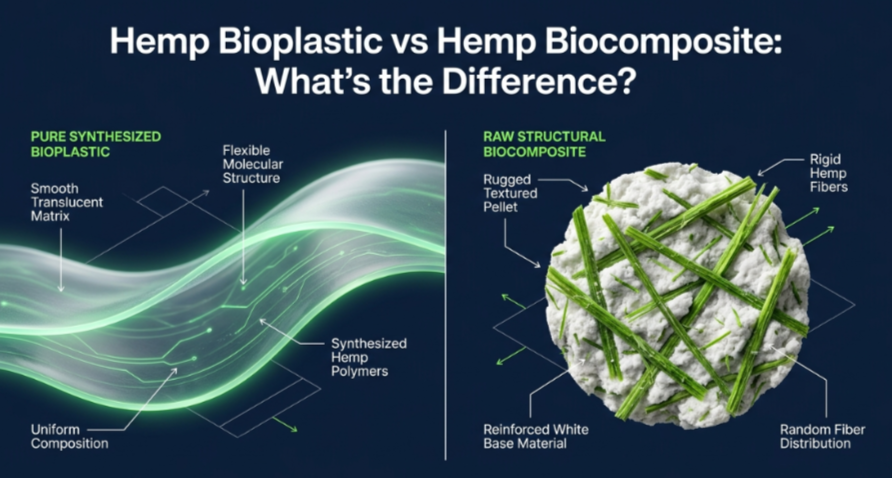
What is the difference between hemp bioplastic and hemp biocomposite?
Both are materials made from hemp fibers. The difference comes down to where the hemp sits: is it a component of the polymer, or a filler inside the plastic?
What is hemp bioplastic?
Simply put, hemp bioplastic means a polymer made from cellulose taken from the hemp stalk, which is about 55 to 77% cellulose. Cellulose acetate and cellophane films are common examples.
What is hemp biocomposite?
Hemp fiber composite is also made from raw hemp. But instead of cellulose from the stalk, processed fibers or hurds are blended into a base polymer as reinforcement. The base can be bio-based (e.g., PLA, PHBV, or starch) or conventional (e.g., PP or HDPE). If the base is bio-based, it is also called a fiber-reinforced bioplastic. Here is a table showing the principal distinctions between hemp bioplastic and hemp biocomposite.

Next, we discuss how each material is made.
How are hemp bioplastics and hemp biocomposites manufactured?
Both materials start from the same industrial hemp crop, but the manufacturing stages are quite different.
Hemp bioplastic (cellulose route)
- Pre-treatment: Stalks are chopped or powdered, then treated with chemicals or enzymes to remove lignin and hemicellulose. This leaves pure cellulose.
- Chemical modification: The cellulose is converted, for example by esterification with acetic anhydride, into a moldable polymer such as cellulose acetate, or into soluble cellulose sheets.
Hemp biocomposite (fiber route)
- Fiber processing: Decortication separates the bast fiber from the inner hurd. The fiber is milled, dried and often washed with sodium hydroxide (NaOH) or paired with a compatibilizer such as maleic anhydride, so it bonds better with the plastic.
- Compounding and molding: The treated fiber is melt-mixed with the base resin in a single-screw or twin-screw extruder to make biocomposite pellets. These pellets go into injection molding, compression molding or 3D printing. Twin-screw mixes better but shortens the fibers, while single-screw keeps more fiber length.
Most converters buy ready-made biocomposite pellets, so the process on your floor looks similar to that for conventional plastics.
At Hemp Foundation, we manufacture biopolymer granules to be processed using standard, existing plastic manufacturing equipment. Our product is designed to be fully “drop-in” ready with no need for altering workflow and minimal modifications to machinery.
Now let us compare how the two materials perform.
Hemp bioplastic vs hemp biocomposite: How do their strength, durability and biodegradability compare?
Hemp biocomposite wins on mechanical performance, while hemp bioplastic wins on clean compostability. Here is a comparison of both materials.
Hemp fiber absorbs moisture, so biocomposites need well-dried fiber, ideally below about 3% moisture, and often a compatibilizer. Without these, voids form in the hemp-based material and strength drops.
Hemp Foundation is your partner in sustainable manufacturing. Our biocomposite granules are specifically made for industrial composting. They are tested by CIPET and certified under the mandatory IS/ISO 17088 standards. This makes your product entirely compliant with India’s Plastic Waste Management (Amendment) Rules, 2026.
Where are hemp bioplastics and hemp biocomposites used?
Each material suits a different type of application. The deciding factor is mostly how long the product has to last and how strong it has to be. This table summarizes the use cases of both hemp bioplastics and hemp biocomposites.
In automotive parts, replacing glass fiber with hemp has brought down component weight by 25 to 30%. European carmakers such as BMW and Mercedes have begun to integrate natural fiber parts.
The rate of adoption is slower in India but promising. Indian manufacturers of furniture, auto interiors and rigid packaging may find hemp fiber composites easier to work with, since they run on existing extruders and molding machines.

Application is only half the decision, so next we look at cost.
What are the cost and processing differences between hemp bioplastics and biocomposites?
It can’t be denied that hemp bioplastics and hemp biocomposites cost more than petroleum plastics today. The gap largely depends on the grade and the order volume and ranges between 1.5X and 3X.
The hemp itself is not the main expense. Studies put the polymer and additives at about 63% of production cost, while harvesting and transport stay under 5%. Biocomposites can lower cost per part when fiber replaces some resin, or when it is blended with recycled polymers such as rHDPE. Here is a breakdown of the various cost factors.
With cost and processing clear, we can now turn to the buying decision.
Hemp bioplastic or hemp biocomposite: Which material should manufacturers choose?
Start with how long the product must last, then check strength needs and budget.
- Short-life items that must compost: Choose hemp bioplastic. Ask for certification to EN 13432, ASTM D6400 or IS/ISO 17088.
- Durable parts that need strength: Choose hemp biocomposite with a bio-based base such as PLA or PHBV.
- Long-life products like decking or auto parts: Choose hemp biocomposite with PP or HDPE, and plan for recycling, not composting.
- Budget: Compare cost per finished part, not price per kg.
Before ordering, ask your supplier for the fiber percentage, base polymer, moisture limit and test data. For food contact, confirm compliance with applicable food safety laws as well. Since industrial hemp cultivation in India is state-regulated, also ask where the fiber comes from.
Frequently asked questions
Is hemp plastic the same as hemp biocomposite?
Usually, yes. Most products sold as hemp plastic are hemp fiber blended into a polymer, not a polymer made from hemp cellulose.
Can hemp biocomposites be composted at the end of life?
Only if the base polymer is compostable, such as PLA, PHBV or starch. Hemp with PP or HDPE needs recycling.
How much hemp do biocomposites contain on average?
Typically 15 to 40% by weight. Higher loads cause processing problems unless the fiber is well treated.
Do I need new machines or change the workflow?
No. Existing extruders and injection molding units work well, but moisture and temperature settings must be altered to suit plant-based polymers.

Vishal Vivek
Vishal Vivek is the Founder and CEO of Ukhi, a pioneering bio-materials company dedicated to ending plastic pollution by converting agricultural waste into high-performance compostable polymers. With a background in sustainable entrepreneurship and over a decade of technology experience, he leads Ukhi’s vision to create scalable, planet-positive material solutions.Previously, Vishal founded the Hemp Foundation, where he empowered more than 1,000 farmers and advanced sustainable livelihood initiatives. His work has been recognized through awards such as the HDFC Parivartan Grant and featured in leading publications like Forbes and Entrepreneur. Times Group recognized him as a legendary entrepreneur and published his biography in “I Did IT- Vol 2” alongside social pioneers like Bindeshwar Pathak (Sulabh International) and Anshu Gupta (Goonj).Vishal has authored more than 200 articles on sustainability and hemp, reflecting his deep expertise and advocacy for regenerative solutions. His commitment to grassroots impact led him to live in the remote mountains of Uttarakhand, where he immersed himself in the lives of marginal farmers, understanding their challenges and co-creating economic opportunities through hemp-based initiatives.A deeply passionate innovator, Vishal often draws inspiration from seemingly impossible achievements: “If Elon Musk can make rockets reusable, or Dashrath Manjhi can carve a path through a mountain with rudimentary tools, why can’t we eliminate the demon of single-use plastic while uplifting struggling farmers? We will make it happen—whatever it takes.”Ukhi is proud to be supported by premier institutions including IIT Guwahati, NSRCEL-IIM Bangalore, Indian School of Business (Hyderabad), Indian Council of Agricultural Research (ICAR Pusa), and the Indian Institute of Packaging.Vishal is committed to demonstrating that business can be a powerful catalyst for global environmental and social good.Connect with Vishal Vivek
Related Posts
The Hemp Era in Uttarakhand – Current Scenario, Challenges and Opportunities
Sounding bugle for an awareness campaign about the economic and environmental advantages of hemp pla

Pet Poop Bags Made from Hemp: Small Steps, Big Impact
It is there in our soil. In our oceans. Floating around in our air. Probably inside our bodies too.
Why You should Not Wear chemically Dyed Clothing
Do you check the kind of dye used when you buy a clothing item? Make that a habit. Prevent the harm

