

How Much Does Hemp Plastic Cost in 2026? (And Is It Worth It?)
I often speak to business owners (of all scales!) looking to disrupt the packaging space or have a positive environmental impact. But the conversation eventually lands squarely on the bottom line. Everyone likes the hemp plastic story, but what they really want to know is:
“So how much will it really cost to switch to hemp plastic?”
It is a fair, pragmatic, and necessary question, to be honest. In 2026, we have moved past the era where sustainability was just a “feel-good” marketing line item. Today, it is a strategic business pillar. However, for a business to be sustainable, it must first be profitable. To make the switch work, the math has to be as robust as the material itself.
So in this blog, I’m going to not just talk about hemp plastic but actually walk you through:
- Hemp plastic costs
- Impact of hemp plastic cost on unit economics
- When you should (and shouldn’t) switch to hemp plastics
Let’s get straight to it.
The Number Talk: Comparing the Alternatives
When we look at the raw data for 2026, we see a market that has matured but still carries a “green premium.” To understand the hemp plastic cost, we have to compare it to the incumbents.
As of early 2026,

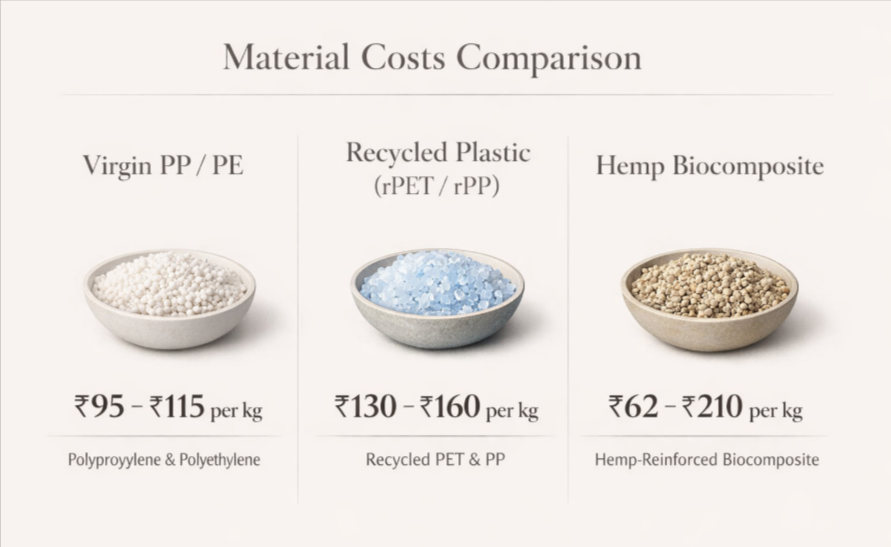
- The cost of virgin Polypropylene (PP) and Polyethylene (PE) hovers around ₹95 to ₹115 per kg. The exact rate depends on crude oil fluctuations.
- Recycled plastic (rPET or rPP), which many brands use as a stepping stone, typically costs between ₹130 and ₹160 per kg. This higher cost is due to the processing required to ensure food-grade safety.
- High-quality hemp-reinforced biocomposite granules currently retail at approximately ₹62 to ₹210 per kg in the Indian market.
At first glance, this price gap looks intimidating on a spreadsheet. However, comparing hemp to virgin plastic is like comparing a carbon fiber mountain bike to a heavy steel commuter. They are designed for different lifecycles and different regulatory environments.
In reality, when you look at other high-end bio-alternatives like pure PLA (Polylactic Acid) or certain seaweed-based resins, hemp actually sits comfortably in the mid-to-high range while offering superior structural strength.
Understanding the Total Cost of Ownership
If you only look at the “price per kg” on a proforma invoice, you are making a short-sighted decision. A sophisticated procurement head looks at the Total Cost of Ownership (TCO). In 2026, the real hemp plastic cost is offset by several mechanical and economic advantages that don’t appear in the raw material line item.

Here’s what you should factor in to understand the trust cost of hemp plastic.
1. Lightweight and Material Efficiency
Hemp fibers are naturally hollow. So they are significantly lighter than the mineral fillers used in traditional plastic. In many industrial applications, a hemp-blended part can be 20% to 25% lighter than a standard plastic part while maintaining the same rigidity. This means you need fewer grams of material to produce the same number of units. Also, your shipping costs decrease across the entire global supply chain.
2. The Regulatory Hedge and Fine Avoidance
India’s Plastic Waste Management (PWM) rules and Extended Producer Responsibility (EPR) mandates are becoming stricter every quarter. Brands using traditional plastic are now paying “hidden” costs in the form of
- EPR credits
- Potential fines for non-compliance.
Switching to hemp plastic in India effectively removes your brand from the “high-risk” category. It turns a packaging expense into a regulatory insurance policy.
3. Enhanced Brand Equity and Customer Loyalty
Modern consumers, particularly in the D2C and premium lifestyle sectors, are actively sniffing out greenwashing. A product packaged in hemp plastic tells a story of Himalayan heritage and carbon sequestration. This narrative allows brands to maintain a premium price point. This far outweighs the additional few paisa spent on the packaging itself.
4. Carbon Credits and ESG Incentives
In 2026, carbon is a currency. Why? Because hemp plastic production involves a crop that sequesters more CO2 per hectare than almost any other forest or commercial crop. Thus, the carbon footprint of your product drops significantly. Many global corporations are now using these “embedded” carbon savings to meet their net-zero targets. So hemp plastic creates a financial value that can attract ESG-focused investment.
5. Operational Efficiency and Cycle Times
Hemp biocomposites often have different thermal properties than pure polymers. In many injection molding setups, hemp-filled plastics cool faster in the mold than traditional plastics. If your factory can shave two seconds off a thirty-second cycle time, you are increasing your daily production output by ~7%. This increased throughput can often bridge the gap between the cost of the resin and the final unit price.
When Does Hemp Plastic Make Economic Sense (And When It Doesn’t)
The decision to switch to hemp plastic shouldn’t be based on emotion. It should be based on your specific business stage and product category. Not every product needs to be made of hemp today, but for those that do, the “cost of waiting” might be higher than the cost of switching.
Here’s a quick guide to understand when you should (and shouldn’t!) switch to hemp plastic:
If you look at the latest hemp plastic reviews from the industry, the consensus is clear: it is an investment in de-risking your future supply chain.
Act Now: Make the Right Choice for Your Business
I have shared the math, the challenges, and the opportunities. Now, the choice is yours. We are at a tipping point where the “Green Premium” is no longer an insurmountable wall. It is a small step toward a more resilient business model.

Choosing hemp plastic in India isn’t just a win for the environment. It is a win for the farmers of the Himalayas and for your brand’s integrity. At Hemp Foundation, we have seen brands transform their market perception overnight by simply being honest about their materials. You now have the information needed to make an informed decision. Don’t wait for the price to reach parity while your competitors capture the “pioneer” advantage, act now.
FAQs
1. Where can I find hemp plastic for sale in bulk?
You can source high-quality, industrial-grade hemp granules directly through the Hemp Foundation or our R&D sister brand, Ukhi. We provide technical data sheets and can customize the “hemp loading” percentage based on your specific manufacturing needs whether it is for injection molding, 3D printing, or blow molding.
2. What can be expected about the cost of hemp plastic in future?
The hemp plastic cost is on a steady downward trend. As decortication hubs scale and hemp plastic production efficiencies accrue, rice reduction of 15% to 20% are possible over the next 24 months. Early adopters who lock in supply chains now will be the first to benefit from these economies of scale.
3. Can hemp plastic be used for the long run?
Absolutely. Many hemp plastic reviews from the automotive sector, for example, confirm that hemp-reinforced composites are actually more “dimensionally stable” than pure plastic. This means they warp and degrade less under heat and stress over long periods. This makes them ideal for durable goods like hemp plastic bottles used in multi-use refills or even structural components.

Vishal Vivek
Vishal Vivek is the Founder and CEO of Ukhi, a pioneering bio-materials company dedicated to ending plastic pollution by converting agricultural waste into high-performance compostable polymers. With a background in sustainable entrepreneurship and over a decade of technology experience, he leads Ukhi’s vision to create scalable, planet-positive material solutions. Previously, Vishal founded the Hemp Foundation, where he empowered more than 1,000 farmers and advanced sustainable livelihood initiatives. His work has been recognized through awards such as the HDFC Parivartan Grant and featured in leading publications like Forbes and Entrepreneur. Times Group recognized him as a legendary entrepreneur and published his biography in “I Did IT- Vol 2” alongside social pioneers like Bindeshwar Pathak (Sulabh International) and Anshu Gupta (Goonj). Vishal has authored more than 200 articles on sustainability and hemp, reflecting his deep expertise and advocacy for regenerative solutions. His commitment to grassroots impact led him to live in the remote mountains of Uttarakhand, where he immersed himself in the lives of marginal farmers, understanding their challenges and co-creating economic opportunities through hemp-based initiatives. A deeply passionate innovator, Vishal often draws inspiration from seemingly impossible achievements: “If Elon Musk can make rockets reusable, or Dashrath Manjhi can carve a path through a mountain with rudimentary tools, why can’t we eliminate the demon of single-use plastic while uplifting struggling farmers? We will make it happen—whatever it takes.” Ukhi is proud to be supported by premier institutions including IIT Guwahati, NSRCEL-IIM Bangalore, Indian School of Business (Hyderabad), Indian Council of Agricultural Research (ICAR Pusa), and the Indian Institute of Packaging. Vishal is committed to demonstrating that business can be a powerful catalyst for global environmental and social good. Connect with Vishal Vivek
Related Posts

10 Best Hemp Plastic Makers in Europe
Hemp is truly a golden goose. You can make clothes from it, its seeds are a superfood, and you can
Hemp Oil Benefits and Nutritional Analysis
[vc_row][vc_column][vc_column_text]Hemp oil is a marginally confusing term, for it can mean either h
5 Key Differences Between Hemp Plastic and Regular Plastic
Plastic is evil. There’s no denying the facts. Plastic is bad for the air, the water, the land

