

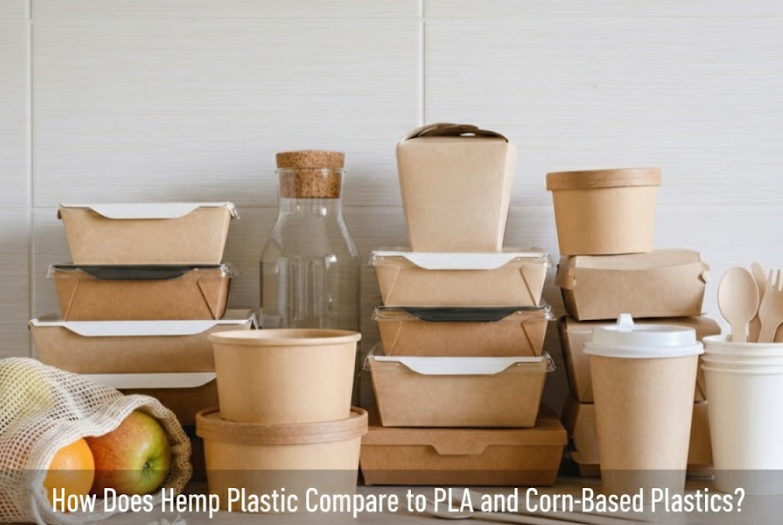
How Does Hemp Plastic Compare to PLA and Corn-Based Plastics?
There is a growing demand for alternatives to petroleum-based plastics. Three materials stand out in the global conversation:
- Hemp Plastic
- PLA (polylactic acid)
- Corn-based Plastics.
But what is the difference between these? And how does our choice affect the environment and the supply chain, or the everyday products we use?
In this article, I will discuss what makes these unique. We will look at different properties of hemp plastic vs PLA/corn plastic, how they are made, and perform.
Let’s begin.
What Are Hemp Plastic, PLA, and Corn-Based Plastics?
Hemp plastic is made from the cellulose of the hemp plant. The stalks of the hemp plant have 80% cellulose content, making it ideal for bioplastics production.
Most hemp plastics on the market are not 100% pure hemp. Instead, they are hemp fiber composites blended with other plant-based or petroleum-based polymers. The result is a tough biodegradable plastic that is excellent for packaging, automotive parts, and consumer goods.
PLA or polylactic acid is a polymer made from biobased sources. It is manufactured by fermenting plant sugars, usually from corn starch but also from sugarcane or cassava. PLA is clear and rigid. It is used for 3D printing and packaging.
Corn-based plastics can mean either pure PLA (since PLA often starts with corn) or simpler starch-based bioplastics. The latter is made by processing cornstarch to produce a soft, flexible material best for lightweight bags and single-use items.
So while all of the above are bioplastics, they have very different manufacturing processes and uses.
What Are the Main Differences in Raw Materials and Manufacturing?
This is where the sustainability story really begins.
Hemp Plastic
The hemp plant has a woody core and very strong outer fibers. After the hemp is harvested, it goes through a process called decortication. At this stage, the fibers are separated from the stalks.
These fibers are dried and ground into a fine powder or left as strands. To make a plastic item, these hemp particles are mixed with a base resin. Then, through the injection molding process, this mixture is heated and pushed into a mold.
PLA and Corn Plastic
The corn is harvested and sent to a mill. There, the starch is separated from the rest of the kernel.
The starch is processed with chemicals and enzymes to break it down into a simple sugar known as dextrose. In the next step, bacteria are used for the fermentation of dextrose to lactic acid.
In the final stage called polymerization, these lactic acid molecules are linked together into long chains, giving rise to corn plastics.

If we consider the sustainability of the source material, hemp requires very little sustenance. It also has a high carbon uptake that instantly marks it as the greener crop when compared to corn. Corn is cultivated more commonly but has higher environmental and opportunity costs.
How Do Hemp, PLA, and Corn Plastics Perform in Use?
Now let’s look at the practical aspect. It’s time to find out if these materials are actually capable of performing as an alternative to traditional plastics.
Hemp plastic stands out for its mechanical strength. When blended into composites, it is up to five times stiffer and two and a half times stronger than standard polypropylene.
You would be surprised to learn that hemp fibers can achieve tensile strengths of 550–1110 MPa, which surpasses mild steel. Since it is made from such strong material, hemp composites significantly surpass PP and ABS in strength and stiffness.
PLA is clear, rigid, and food safe, but also brittle. It has a tensile strength of 38-60 MPa, which is far less than that of hemp plastics. PLA is suitable for 3D printing and cutlery, but not for heavy-duty industrial use. Also, it softens at 60°C, a major disadvantage in hot and humid climates.
Corn starch plastics are the lightweights of the group. Their plus point is that they degrade quickly. This is excellent for the environment. But they have low strength and are best used for single-use bags or liners.

Choosing between hemp plastic vs PLA/corn plastic means understanding these differences in performance.
- Hemp plastic is the perfect material for strength. It is durable and can be molded.
- PLA is suited for 3D printing filament, food packaging (containers, bottles, cutlery).
- Corn starch plastics are ideal when you want fast degradation and a short product life.
Which is More Sustainable and Better for the Environment?
This is the heart of the matter for most people considering bioplastics. Without doubt, all three are by far better than conventional plastics. But what about hemp plastic vs PLA/corn plastic in this regard?
Hemp plastic has a natural advantage from the very beginning. While growing, hemp absorbs large amounts of carbon dioxide. It varies between 8 and 21 tonnes per hectare. Over their lifespan, hemp-based products have a negative carbon footprint. This is especially true if manufactured using renewable energy.
Making PLA needs less fossil fuel use and carbon emissions compared to conventional plastics like PET and polypropylene. But corn farming requires plenty of fertilizers, pesticides, and water. Making dextrose from corn starch also requires a lot of energy.
When it comes to biodegradation, hemp plastic again stands out. It can biodegrade naturally within three to six months. It does not need industrial composting.
PLA, on the other hand, needs industrial composting at high temperatures with controlled moisture and oxygen.
Corn starch plastics degrade the fastest in just weeks. But that rapid breakdown means they aren’t suitable for products needing a long shelf life.
Hemp Plastic Vs PLA/Corn Plastic: Which Bioplastic Is The Best Fit?
Bioplastics are a nascent industry, and every bioplastic comes with its own hurdles.
Hemp plastic’s main challenge is upstream from the consumer. Infrastructure for manufacturing is limited, and crop supply chains are fragmented. The flip side is the opportunity for carbon-negative products and scope for rural upliftment.
PLA faces its biggest challenge downstream. Its environmental benefits depend entirely on access to industrial composting. Without the right infrastructure for composting, PLA can become just another waste that piles up.
Corn starch plastics have the opposite issue. They degrade rapidly, which is excellent for disposal, but the shelf life and mechanical properties limit wider application.
The key lesson is that material choice must follow context. Choose between hemp plastic vs PLA and corn plastic depending on your desire for durability, scalability, and cost.
Frequently Asked Questions
Is corn-based PLA a type of plastic?
Yes, PLA is most commonly made from corn starch and is a type of plant-based plastic. It is most often used for food packaging.
Why isn’t hemp plastic used more?
Though it is excellent, hemp plastic still faces some bottlenecks in production. There needs to be more cultivation and fasciitis for decortication. Also, it is slightly more expensive to produce than conventional plastics.
Is hemp plastic stronger than steel?
Yes. Hemp composite plastic can be stronger than steel in terms of tensile strength. Hemp fibre can be up to 10 times stronger than steel.
Why is PLA better than conventional plastic?
PLA (Polylactic Acid) is far better than conventional plastic because it’s made from renewable plant sources like corn instead of fossil fuels. It has a much lower environmental impact.
Is hemp plastic food safe?
It is generally considered food safe because it is non-toxic and made from natural plant fibres. Hemp plastic is a great choice for food containers and packaging.

Vishal Vivek
Vishal Vivek is the Founder and CEO of Ukhi, a pioneering bio-materials company dedicated to ending plastic pollution by converting agricultural waste into high-performance compostable polymers. With a background in sustainable entrepreneurship and over a decade of technology experience, he leads Ukhi’s vision to create scalable, planet-positive material solutions. Previously, Vishal founded the Hemp Foundation, where he empowered more than 1,000 farmers and advanced sustainable livelihood initiatives. His work has been recognized through awards such as the HDFC Parivartan Grant and featured in leading publications like Forbes and Entrepreneur. Times Group recognized him as a legendary entrepreneur and published his biography in “I Did IT- Vol 2” alongside social pioneers like Bindeshwar Pathak (Sulabh International) and Anshu Gupta (Goonj). Vishal has authored more than 200 articles on sustainability and hemp, reflecting his deep expertise and advocacy for regenerative solutions. His commitment to grassroots impact led him to live in the remote mountains of Uttarakhand, where he immersed himself in the lives of marginal farmers, understanding their challenges and co-creating economic opportunities through hemp-based initiatives. A deeply passionate innovator, Vishal often draws inspiration from seemingly impossible achievements: “If Elon Musk can make rockets reusable, or Dashrath Manjhi can carve a path through a mountain with rudimentary tools, why can’t we eliminate the demon of single-use plastic while uplifting struggling farmers? We will make it happen—whatever it takes.” Ukhi is proud to be supported by premier institutions including IIT Guwahati, NSRCEL-IIM Bangalore, Indian School of Business (Hyderabad), Indian Council of Agricultural Research (ICAR Pusa), and the Indian Institute of Packaging. Vishal is committed to demonstrating that business can be a powerful catalyst for global environmental and social good. Connect with Vishal Vivek
Related Posts

How Face Masks Can Save From the Second Wave of Coronavirus
How Face Masks Can Save From the Second Wave of Coronavirus A study conducted in London has come to
Crop Circles and Game Changers: Hemp’s Unexpected Journey
Hemp’s Bold Reinvention Long overshadowed by its more notorious cousin associated with recreat
How Hemp Can Save the Sea Animals from Extinction
When it comes to pollution, humans have left no area uncovered. Be it soil, water or even air. If yo

