

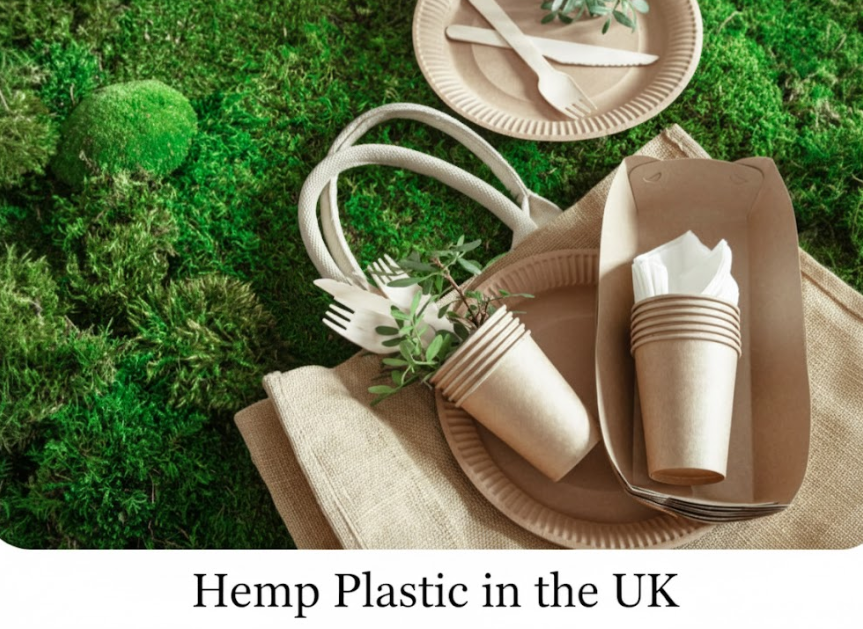
Hemp Plastic in the UK: Where to Buy, How to Use, Local Rules
Hemp plastic in the UK is an emerging sector that holds great promise. It’s no longer a future solution or a niche product, but is already being used today. According to bioplastics market reports, the UK market is projected to reach $2.8 billion by 2030.
Recently, the UK has seen regulatory changes such as the UK Plastic Tax that have paved the way for a robust bioplastic industry to emerge. This guide explores the current state of the hemp plastic market in the UK. I will cover every aspect from sourcing raw materials to navigating local legislation.
Who Uses Hemp Plastic in the UK and Worldwide?
Let’s start by grounding ourselves in real market reality.
Who’s actually using hemp plastic in the UK? The answer: it’s no longer just the niche eco-brands. We see bioplastics industry trends changing and major industrial hemp plastic uptake in sectors like:
- Packaging (especially food and retail, where brands want a sustainability story)
- Automotive (car interiors, trims, door panels)
- Construction (insulation panels, boards)
- Consumer goods (stationery, toys, even 3D-printed prototypes)
For example, Lotus Cars has used hemp-reinforced composites in their car interiors to cut weight and improve eco-credentials.
When it comes to packaging, large consumer brands are trialling hemp plastic trays, films, and containers.
UK firms like Filamentive supply hemp plastic 3D-printing filament to architects who want to build sustainability into their business model.

From Pexels
The lesson is clear: Hemp plastic applications are broadening fast across the UK. But what’s driving this surge in adoption? To answer that, we need to understand the innovation pipeline.
What Are the Latest Innovations in Hemp Plastic?
Today’s hemp plastic innovations go far beyond mixing some plant fibre into a standard resin.
Bioplastics industry trends reveal breakthroughs such as:
- A biodegradable hemp polymer blended food tray or cosmetic bottle that composts at the end of its life. practical, eco-friendly, and suitable for food contact.
- Up to 85% hemp content is now technically possible for rigid goods and packaging.
- Researchers have even developed actual polymers from hemp oil. This has opened new doors for medical and electronics applications.
Companies like The Hemp Plastic Company (through distributors such as LATI in Europe) now offer ready-to-use technical compounds. This enables different manufacturers to use hemp bioplastic with very few process changes.
Of course, the move toward hemp plastic is a direct response to the UK’s Plastic Packaging Tax, and thankfully, it’s working as more manufacturers adopt hemp plastics as a sustainable solution.
Where Can You Buy Hemp Plastic in the UK?
The hemp plastic supply chain in the UK is sometimes fragmented, but rapidly evolving.
Here’s where you start:
Industrial-Scale Suppliers
Niche & Small-Scale Sellers
Key tips for buying hemp plastic in the UK
It is important that you have a good idea of what you are looking for. There is no dearth of unscrupulous suppliers who would sell you some form of low-grade bioplastics and claim they meet all criteria.
- Always be sure to look for EN 13432 certification. It ensures you are buying genuinely compostable packaging. Beware, there are plenty of “bio-based” or “biodegradable” items that might not break down.
- For packaging, seek “Hemp + Recycled Polymer” blends to avoid the UK Plastic Packaging Tax.

- Most hemp plastic suppliers UK require minimum order quantities. Therefore, plan your pilot runs accordingly.
Now you know where to buy hemp plastic in the UK. But how do you actually use it? Let’s talk about turning granules into finished goods.
How Do You Use Hemp Plastic?
Using hemp plastic isn’t rocket science, but you need to understand the process well. Here is a brief guide to hemp plastic manufacturing.
- In injection molding, most UK processors use hemp-filled PP (polypropylene) or PLA blends:
- Keep temperatures below 200°C. If you go higher, hemp fibres degrade—causing smoking, off smells, and darkened parts.
- Choose polymers naturally processed at lower heats (PLA, specific low-temp PP grades).
- For 3D printing (FDM/FFF), hemp PLA filament runs best with:
- A hardened steel nozzle, which is 0.5mm or bigger, since hemp fibre is abrasive.
- This makes layer lines vanish into a matte, natural finish that is ideal for prototyping
- In blow molding (bottles/containers):
- Watch wall thickness as high hemp content (>25%) can reduce impact resistance. It is less “drop-proof” than virgin PE.
- Use for products where a tactile, natural texture is a selling point
- Performance snapshot:
- Stiffer parts than unfilled plastic
- Lighter than glass alternatives (10–20% weight savings)
- Faster cycle times (15–20% higher output potential)
- Natural, textured finish (no high-gloss without coating)
- Transitioning tips:
- Always supply a technical datasheet (Melt Flow Index, fibre size)
- Address molders’ concerns about machine abrasion, offering to pay for a purge after trials helps smooth the process.
To summarize, hemp plastic manufacturing is within reach for any modern plastics processor if you follow the right parameters.
What Are the UK’s Rules for Hemp Plastic?
The regulatory environment for hemp plastic in the UK is serious and complex. If you’re used to thinking that bio-based means free pass, think again.
Here’s the reality:
- The UK Plastic Packaging Tax, set at over £223 per tonne, applies to all types of virgin plastics – fossil, bio-based, and even fully compostable plastics.
- The only exemption: your product must contain at least 30% recycled plastic.
- A blend like “Hemp + Recycled PP” or “Hemp + PCR PE” can legally avoid this tax.
- If you import or manufacture “100% hemp bioplastic” with no recycled content, you pay the tax.
- Single-use plastic bans in England now cover items like plates, trays, and cutlery. It is enforced even if the plastic is plant-based and biodegradable. There just isn’t enough industrial composting infrastructure, and “biodegradable” items in landfills don’t break down as promised.
- Hemp licensing: If you plan to grow hemp in the UK, a Home Office license is required. Only the seed and fibre are permitted for use. The leaves and flowers must be destroyed. This makes UK-grown hemp less profitable than in some European countries.
- Compostability and standards: If you want to claim “compostable,” your product must meet EN 13432. It mandates compatibility in 12 weeks in an industrial facility.
- For any food contact application, full compliance with UK and EU food safety rules is a must.
The bar is indeed high, but it’s clear and navigable if you inform yourself about the statutory framework.
What’s Next for Hemp Plastic in the UK?
The latest bioplastics market report indicates that the UK is entering a critical phase for hemp plastic market growth. Several forces are converging:
Policy momentum
The move toward Net Zero, extended hemp licensing, and stricter single-use bans will increase demand for sustainable plastic alternatives.
Market trend
Durable goods and construction materials are becoming the lead applications for hemp bioplastics.
Investment
New pilot plants, local compounding ventures, and more sophisticated supply chains are on the rise. For investors focused on ESG investing, hemp plastic represents a practical solution that is also going to be very profitable soon. Retailers and major brands are moving from pilot projects to large-scale procurement. As more local composting comes online, the demand for hemp bioplastics will continue to strengthen.
Tips for Success in the UK Hemp Plastic Market
I will wrap up by sharing a winning strategy for the UK market:
- Always specify “Hemp + Recycled Polymer” blends for packaging. This is the only way to avoid the plastic packaging tax.
- With increasing bans on single-use, focus on products that last longer. Typical markets include car interiors, plant pots, and construction panels.
- Partner with UK-based compounders. Highlight “grown and made in the UK” for supply chain resilience.
- Mold shops need clear technical datasheets and reassurance about machine safety. Offer to cover the cost of machine cleaning after trial runs.
This is the blueprint for turning sustainability into real, marketable value in the UK.
Frequently Asked Questions
What are the latest bioplastics industry trends in the UK?
Currently, the UK bioplastics industry is booming. The UK bioplastics market is valued at billions and expected to grow strongly due to policy regulations such as the UK Plastic Packaging Tax.
What is the compostable packaging market size in the UK?
The UK compostable packaging market size is growing steadily as retailers respond to plastic bans. At present, it is valued at $6 million and is poised to reach $ 9 million by 2030.
What is the EN 13432 standard?
EN 13432 is the European standard for biodegradation and composting. It defines whether a plastic product can legally be labelled as compostable. The same framework is also used in the UK.
Is it legal to grow hemp in the UK?
Yes, it is perfectly legal, but needs permission and a license from the UK Home Office. It must only be grown for use as industrial hemp. There is a ban on growing recreational or high-THC medicinal cannabis.
What is the UK plastic tax?
It is a legislation that is meant to curb the use of plastics in the UK and was introduced in April 2022. The UK plastic tax is imposed on plastic packaging that contains less than 30% recycled content. Strangely enough, the tax is also applicable to hemp or any other bioplastic that contains no recycled material.

Vishal Vivek
Vishal Vivek is the Founder and CEO of Ukhi, a pioneering bio-materials company dedicated to ending plastic pollution by converting agricultural waste into high-performance compostable polymers. With a background in sustainable entrepreneurship and over a decade of technology experience, he leads Ukhi’s vision to create scalable, planet-positive material solutions. Previously, Vishal founded the Hemp Foundation, where he empowered more than 1,000 farmers and advanced sustainable livelihood initiatives. His work has been recognized through awards such as the HDFC Parivartan Grant and featured in leading publications like Forbes and Entrepreneur. Times Group recognized him as a legendary entrepreneur and published his biography in “I Did IT- Vol 2” alongside social pioneers like Bindeshwar Pathak (Sulabh International) and Anshu Gupta (Goonj). Vishal has authored more than 200 articles on sustainability and hemp, reflecting his deep expertise and advocacy for regenerative solutions. His commitment to grassroots impact led him to live in the remote mountains of Uttarakhand, where he immersed himself in the lives of marginal farmers, understanding their challenges and co-creating economic opportunities through hemp-based initiatives. A deeply passionate innovator, Vishal often draws inspiration from seemingly impossible achievements: “If Elon Musk can make rockets reusable, or Dashrath Manjhi can carve a path through a mountain with rudimentary tools, why can’t we eliminate the demon of single-use plastic while uplifting struggling farmers? We will make it happen—whatever it takes.” Ukhi is proud to be supported by premier institutions including IIT Guwahati, NSRCEL-IIM Bangalore, Indian School of Business (Hyderabad), Indian Council of Agricultural Research (ICAR Pusa), and the Indian Institute of Packaging. Vishal is committed to demonstrating that business can be a powerful catalyst for global environmental and social good. Connect with Vishal Vivek
Related Posts
Industrial Hemp Products List: 20 Things Hemp Can Replace
When people hear “hemp alternatives” for everyday items, they often picture something niche, pre
Best Hemp Plastic Products to Buy Online (2026) in UK
If you work in manufacturing or packaging, like I do, the writing’s on the wall. Single use plas
500 years of textile, and how they’ve shaped fashion today
Our history with textiles started 34,000 years ago with the fibre material flax fibre. And it’

