

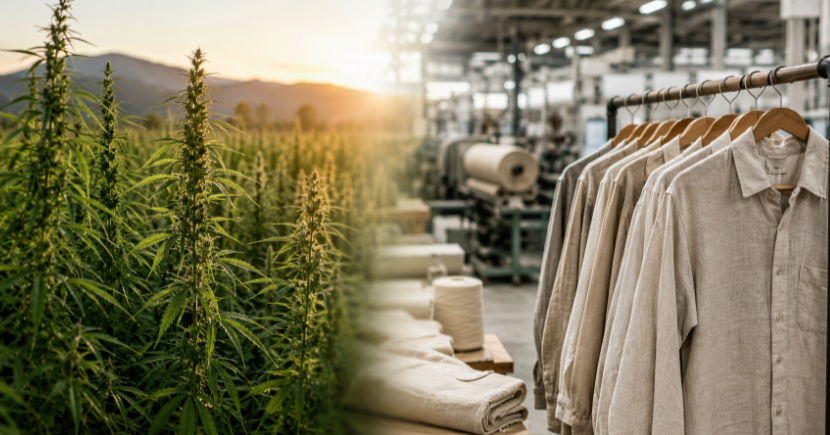
How Is Hemp Fabric Made? From Field to Finished Textile
The shirt on your skin may have started as a tall green stalk in a field, not as a thread in a factory.
That is the interesting part of hemp.
In about three to four months, a hemp plant can grow taller than many people. Inside its stem are long, strong fibres that can be turned into yarn, cloth, shirts, bags, home textiles and many other everyday products.
But this change does not happen in one simple step.
To understand how hemp fabric is made, we need to follow the plant from field to fibre, from fibre to yarn, and from yarn to finished textile. Once you see that journey clearly, hemp stops looking like a new trend. It starts looking like one of the oldest natural materials being understood again with modern eyes.
What is hemp fabric?
Hemp fabric is a textile made from the stem of the hemp plant.
The useful fibre sits in the outer part of the stalk. These are called bast fibres, the same broad fibre family as linen. That is why hemp often has a slightly earthy, textured feel at first, then becomes softer with washing and regular use.
A common question is: Is hemp fabric natural or synthetic?
Hemp has been used as a fibre for over 10,000 years. Ancient China, the Mesopotamian civilisations, and even early Indian societies used hemp rope, canvas, and cloth long before cotton became dominant.
Hemp fabric is natural when it is made from hemp fibre and processed into yarn and cloth. It is not a lab-made fibre like polyester or nylon.
100% Hemp fabric means the cloth is made only from hemp fibre. Many fabrics, however, blend hemp with cotton, organic cotton, linen or other fibres to improve softness, drape or cost.
This is the first thing to understand before we look at how hemp fabric is made.
How is hemp grown for fabric?
Before we understand how hemp fabric is made, we need to look at how the crop is grown.
Hemp grown for textile fibre is usually planted close together. This encourages the plants to grow tall and straight, with fewer branches. A straighter stalk gives longer fibre, and longer fibre is easier to process into stronger yarn.
The farmer is not mainly growing this crop for leaves or flowers. The real textile value sits in the stem.
For making hemp fabric in India, this matters because the country already understands fibre crops, handloom traditions and natural textiles. But good hemp fabric still depends on disciplined farming.
The seed variety, soil, harvest timing and drying method all affect the final cloth.
So the fabric does not begin at the spinning machine.
It begins with the quality of the stalk.
Sourcing of the fabric has grown meaningfully in India over the last few years, with Uttarakhand, Himachal Pradesh, and Manipur emerging as active growing regions. This followed the 2020 industrial hemp policy amendments that made licensed cultivation legal.
Hemp is what agronomists sometimes call a “pioneer crop”. It can grow in degraded soil, requires no synthetic pesticides, and its deep root system actually aerates and improves the land it grows in. In regions like Uttarakhand, where soil depletion has pushed farmers off their land for decades, hemp cultivation is being encouraged for soil revival.
One more thing worth noting: hemp is a carbon-negative crop. One tonne of hemp fibre sequesters approximately 1.39 tonnes of CO₂ during the growing phase. So by the time the plant is harvested, it has already done something valuable for the atmosphere.
What happens after hemp is harvested?

How is hemp fabric made after harvesting? This is where it gets interesting as hemp starts changing from crop material into textile material.
This does not happen by simply pulling the plant apart.
First, the harvested stalks are dried. Then they go through retting. Retting is the process that loosens the natural glue holding the fibre and woody core together.
This can happen in different ways as shown in the table below:
After retting, the stalks are dried and then put through a mechanical process called “scutching”, where the woody core is broken and beaten away, leaving behind the long bast fibres. A secondary combing process called “hackling” then separates the long, clean “line fibres” from the shorter, tangled “tow fibres.”
Line fibres produce finer, softer yarn. Tow fibres are used in coarser applications like rope or industrial canvas.
How do hemp fibres become yarn?
With clean, separated fibres in hand, the next stage is spinning. This step is what largely determines the quality and feel of the finished hemp fabric.
The fibres go through a carding process first. They are mechanically combed into a thin, even web, then drawn into a loose rope called a sliver. From the sliver, spinning machines twist the fibres together under tension, producing yarn.
Two broad yarn types come out of this:
- Wet-spun yarn: fibres are spun through heated water, which softens them and produces a finer, smoother yarn suited for lighter fabrics.
- Dry-spun yarn: faster and cheaper, produces a coarser yarn used in canvas, bags, and industrial textiles.
The fineness of yarn is measured in tex or Nm (metric number). For reference, a fine cotton shirt uses yarn in the 30–50 Nm range. Hemp yarn for apparel typically falls in the 20–40 Nm range. It is slightly coarser but with higher tensile strength.
For 100% hemp fabric, only hemp fibres go into this spinning process. Blended fabrics like hemp-cotton or hemp-silk introduce a second fibre at the carding or spinning stage to change the hand feel or performance properties of the final textile.
How is hemp yarn turned into fabric?

After spinning, hemp yarn moves to the loom or knitting machine.
This is the stage where yarn becomes usable cloth.
Most hemp fabric is woven. Weaving crosses two sets of yarns:
warp yarns, which run lengthwise.
weft yarns, which run across the width.
The weave decides the look and behaviour of the fabric:
A plain weave can create a clean, simple cloth for shirts, bags and home textiles.
A twill weave can give more body and strength.
A looser weave can feel more breathable, while a tighter weave can feel firmer and more structured.
Knitted hemp fabrics are also possible, especially when hemp is blended with softer fibres. These are used where stretch, drape and comfort matter more.
After weaving, the fabric goes through finishing. This typically involves scouring (washing out residual plant matter), bleaching if a white or light base is needed, and sometimes mechanical softening processes that break down the fibre surface slightly to improve hand feel.
This finishing stage of the process of how hemp fabric is made can diverge significantly in terms of environmental impact. Chlorine-based bleaching and synthetic finishing agents are common in low-cost production.
At Hemp Foundation, we work directly with farmers and artisans in Uttarakhand to produce textiles that go through minimal chemical processing. The natural properties of the fibre is kept intact from field to finished product.
If you’re sourcing hemp fabric in India and want to understand where your material actually comes from, that transparency is worth looking for. Explore our hemp products.
Why does hemp fabric feel different?
If you have touched hemp fabric for the first time and found it stiffer than cotton, that is not a defect. It is the fiber’s nature, and it changes with use.
Hemp fibre has a higher cellulose content than cotton (roughly 70–80% vs cotton’s 90%, but with longer polymer chains), and this gives it structural rigidity. That rigidity is why the hemp fabric’s durability is significantly higher than cotton. Hemp fibres are estimated to be 3 to 8 times stronger than cotton fibres of comparable diameter.
With repeated washing and wearing, the fibre surface softens. Most people who wear hemp clothing regularly say it reaches a very comfortable hand feel after 4 to 6 washes.
Is hemp fabric sustainable?
The honest answer is: yes. Significantly more so than most alternatives, with a few conditions worth understanding.
Here is how it compares across the key dimensions:
The condition worth noting: sustainability in textiles is not just about the fibre. Chemical processing, dyeing, transport, and finishing all add to the footprint. A hemp fabric that has been processed using heavy synthetic chemicals is still considerably better than polyester. However, it is not the same as one produced with clean methods.
What should buyers check before choosing hemp fabric?
By now, we know how hemp fabric is made. The next question is how to choose the right hemp fabric for real use.
Do not buy hemp only by looking at the word “hemp” on the label.
Here are the things that actually matter when assessing quality:
- Is it 100% hemp fabric or a hemp blend?
- What is the GSM or fabric weight?
- Is it woven or knitted?
- Has the fabric been pre-washed or pre-shrunk?
- What dyes or finishes have been used?
- Is it meant for clothing, bags, upholstery or home textiles?
- Does the supplier clearly mention the fibre composition?
This matters because the hemp fabric’s durability depends on more than the plant.
It depends on fibre quality, yarn strength, weave construction, finishing and care.
A good hemp shirt needs comfort. A good hemp bag needs strength. A good hemp bedsheet needs softness and breathability.
The right fabric is the one made for the right job.
FAQs
How Is Hemp Fabric Made?
The basic answer to how hemp fabric is made is this: stalks are harvested, retted, cleaned, spun into yarn, then woven or knitted.
Is Hemp Fabric Natural Or Synthetic?
In pure form, hemp fabric is natural. Hemp fabric being natural or synthetic depends on blends, finishes and whether synthetic fibres are added.
Is Hemp Fabric Good For Indian Weather?
Buyers of hemp fabric in India often choose it for breathability and strength. It suits warm weather, but weaving and finishing decide comfort.
Is 100% Hemp Fabric Durable?
100% Hemp fabric is usually strong and long-lasting. The hemp fabric’s durability improves when the yarn, weave, stitching and care are right.
Is Hemp Fabric Sustainable?
It can be, especially when grown responsibly, processed carefully, dyed safely and used for years instead of seasons.

Vishal Vivek
Vishal Vivek is the Founder and CEO of Ukhi, a pioneering bio-materials company dedicated to ending plastic pollution by converting agricultural waste into high-performance compostable polymers. With a background in sustainable entrepreneurship and over a decade of technology experience, he leads Ukhi’s vision to create scalable, planet-positive material solutions. Previously, Vishal founded the Hemp Foundation, where he empowered more than 1,000 farmers and advanced sustainable livelihood initiatives. His work has been recognized through awards such as the HDFC Parivartan Grant and featured in leading publications like Forbes and Entrepreneur. Times Group recognized him as a legendary entrepreneur and published his biography in “I Did IT- Vol 2” alongside social pioneers like Bindeshwar Pathak (Sulabh International) and Anshu Gupta (Goonj). Vishal has authored more than 200 articles on sustainability and hemp, reflecting his deep expertise and advocacy for regenerative solutions. His commitment to grassroots impact led him to live in the remote mountains of Uttarakhand, where he immersed himself in the lives of marginal farmers, understanding their challenges and co-creating economic opportunities through hemp-based initiatives. A deeply passionate innovator, Vishal often draws inspiration from seemingly impossible achievements: “If Elon Musk can make rockets reusable, or Dashrath Manjhi can carve a path through a mountain with rudimentary tools, why can’t we eliminate the demon of single-use plastic while uplifting struggling farmers? We will make it happen—whatever it takes.” Ukhi is proud to be supported by premier institutions including IIT Guwahati, NSRCEL-IIM Bangalore, Indian School of Business (Hyderabad), Indian Council of Agricultural Research (ICAR Pusa), and the Indian Institute of Packaging. Vishal is committed to demonstrating that business can be a powerful catalyst for global environmental and social good. Connect with Vishal Vivek
Related Posts
How Hemp Can Transform the Construction Industry
The hemp plant, also known as industrial hemp, is an incredibly versatile natural resource. Hemp see

Hemp bioplastics – current market, and future
Hemp bioplastic is the sustainable success of traditional plastics. Learn more about how the market
Removing the Cotton Barrier To Indian Hemp
Several conspiracy theories surround hemp. A variety of them proposes that certain companies and mag

